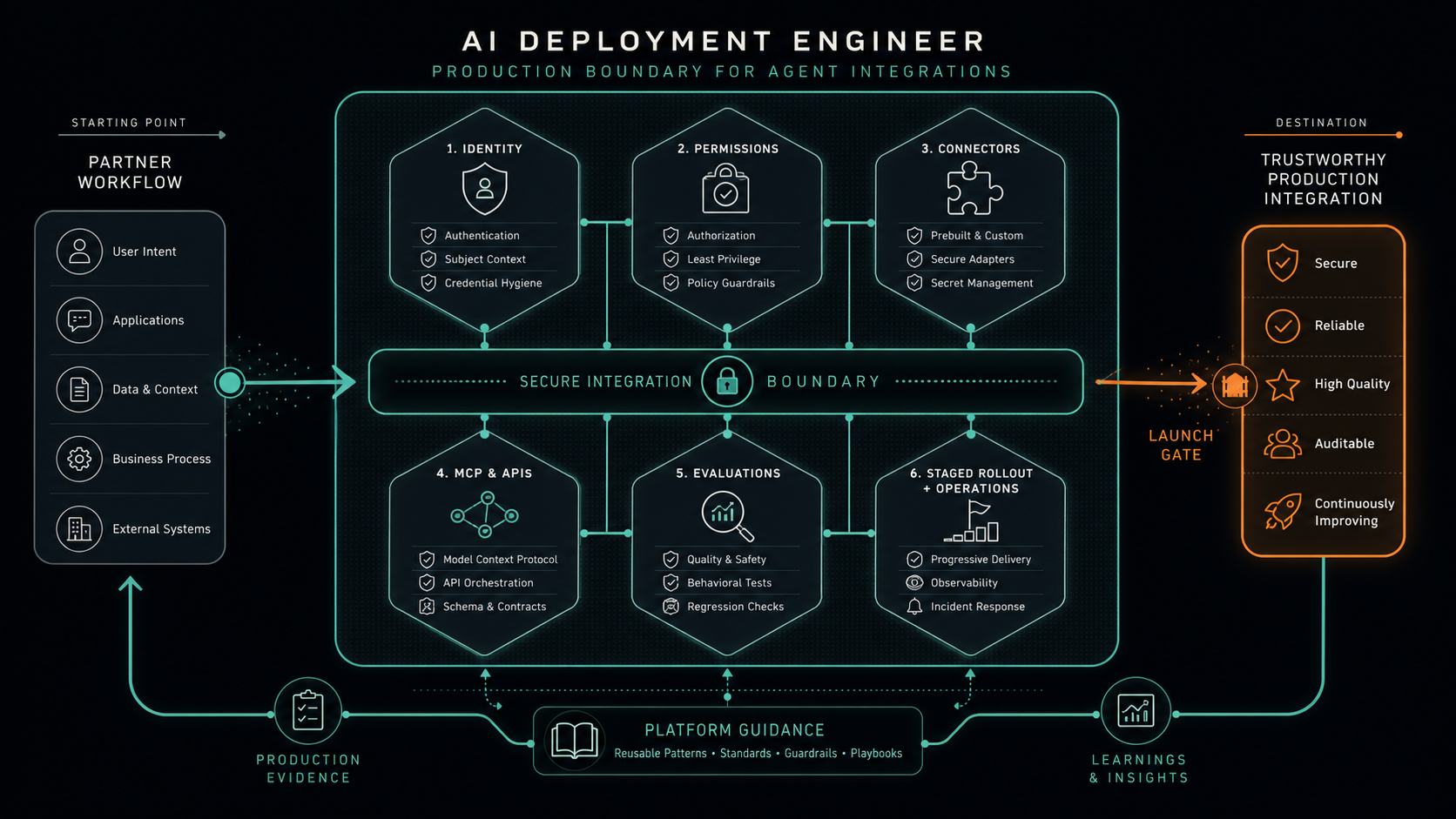
OpenAI's current AI Deployment Engineer, Agent Enablement posting makes a specific version of deployment engineering visible. The role spans browser sign-in, OAuth and OIDC, connectors, APIs, CLIs, MCP servers, evaluations, staged rollout, observability, incident investigation, and ongoing maintenance.
That is a narrower technical surface than the broad discovery-to-outcome contract often attached to a Forward Deployed Engineer. It is still customer- or partner-facing engineering. The specialization is the production boundary between an agent and the tools, accounts, policies, and workflows it can act through.
An agent integration is not production-ready when it can call a tool. It is ready when the right user can take the right action, under the right policy, with evidence and recovery when something fails.
The six-part AI deployment engineer skills map
1. Identity
Trace browser redirects, PKCE and OIDC transactions, token exchange, account mapping, session state, and credential lifecycle end to end.
2. Permissions
Translate user intent into explicit scopes, consent, least privilege, safe fallback behavior, and revocation paths.
3. Connectors
Choose between prebuilt and custom adapters; reason about callbacks, retries, rate limits, secrets, schemas, and long-term ownership.
4. MCP and APIs
Design stable tool contracts, validate inputs and outputs, expose useful errors, and keep agent behavior inside bounded capabilities.
5. Evaluations
Test account states, permission boundaries, malformed inputs, tool failures, latency, and recovery—not only happy-path task completion.
6. Rollout and operations
Use launch-readiness reviews, staged exposure, logs, traces, metrics, incident response, rollback, and post-launch iteration.
Why MCP knowledge is necessary but insufficient
MCP can provide a standard way for an agent to discover and invoke tools. It does not decide who should be allowed to use a tool, which account the action applies to, how consent is represented, what data crosses the boundary, or what happens after a partial failure.
A strong deployment engineer can inspect the entire transaction: user interface state, authentication redirect, token validation, permission scope, tool schema, downstream API response, agent retry, audit event, and user-visible recovery. The useful unit of ownership is the completed and governable workflow—not the MCP server in isolation.
A launch-readiness test for agent integrations
- Name the principal. Identify the human, service, and agent identities involved at every hop.
- Draw the permission boundary. Record scopes, consent, policy checks, data boundaries, and revocation behavior.
- Enumerate account states. Test new, linked, expired, suspended, multi-account, and partially provisioned users.
- Build failure-path evals. Include timeouts, rate limits, stale tokens, invalid tool arguments, partial writes, and conflicting actions.
- Stage the rollout. Start with bounded users and capabilities, define stop conditions, and verify rollback before expanding.
- Close the learning loop. Convert repeated production failures into platform requirements, reference implementations, checklists, or clearer contracts.
How this differs from adjacent roles
A Forward Deployed Engineer may own the wider customer outcome: workflow discovery, custom system design, production build, adoption, and product feedback. An integration-specialist AI Deployment Engineer goes deeper on the access and tool boundary that makes agent action safe and reliable.
Stripe's current embedded AI Engineer role inside Solutions Architecture shows another adjacent model. Its success metric is organizational leverage: production tools and automation that improve how Solutions Architects work, plus custom assets for strategic engagements. The overlap is production engineering near users; the distinction is who the primary user is and which outcome defines success.
What to put in an AI deployment portfolio
A credible project should show more than a working agent and a list of tools. Include an identity sequence, permission matrix, tool contract, evaluation set, failure taxonomy, rollout plan, observability view, and one post-incident change that improved the reusable system.
The strongest artifact explains a tradeoff: why a capability was withheld, why an OAuth path was chosen, why one action requires confirmation, or why a repeated integration failure belongs in the platform rather than another workaround.
Sources and evidence limits
- OpenAI — AI Deployment Engineer, Agent Enablement
- OpenAI — current AI Deployment Engineer roster
- Stripe — AI Engineer, Solutions Architecture
Sources were checked August 11, 2026. They are point-in-time employer evidence and do not prove hiring velocity, filled headcount, or industry-wide title consistency.
The FDE Brief
Get the next operator playbook.
Source-backed field notes for engineers and teams turning AI prototypes into trusted production workflows.
Reader question
Where does your agent integration break?
Identity, permissions, tool contracts, evals, rollout, or operations—which boundary creates the most production work?