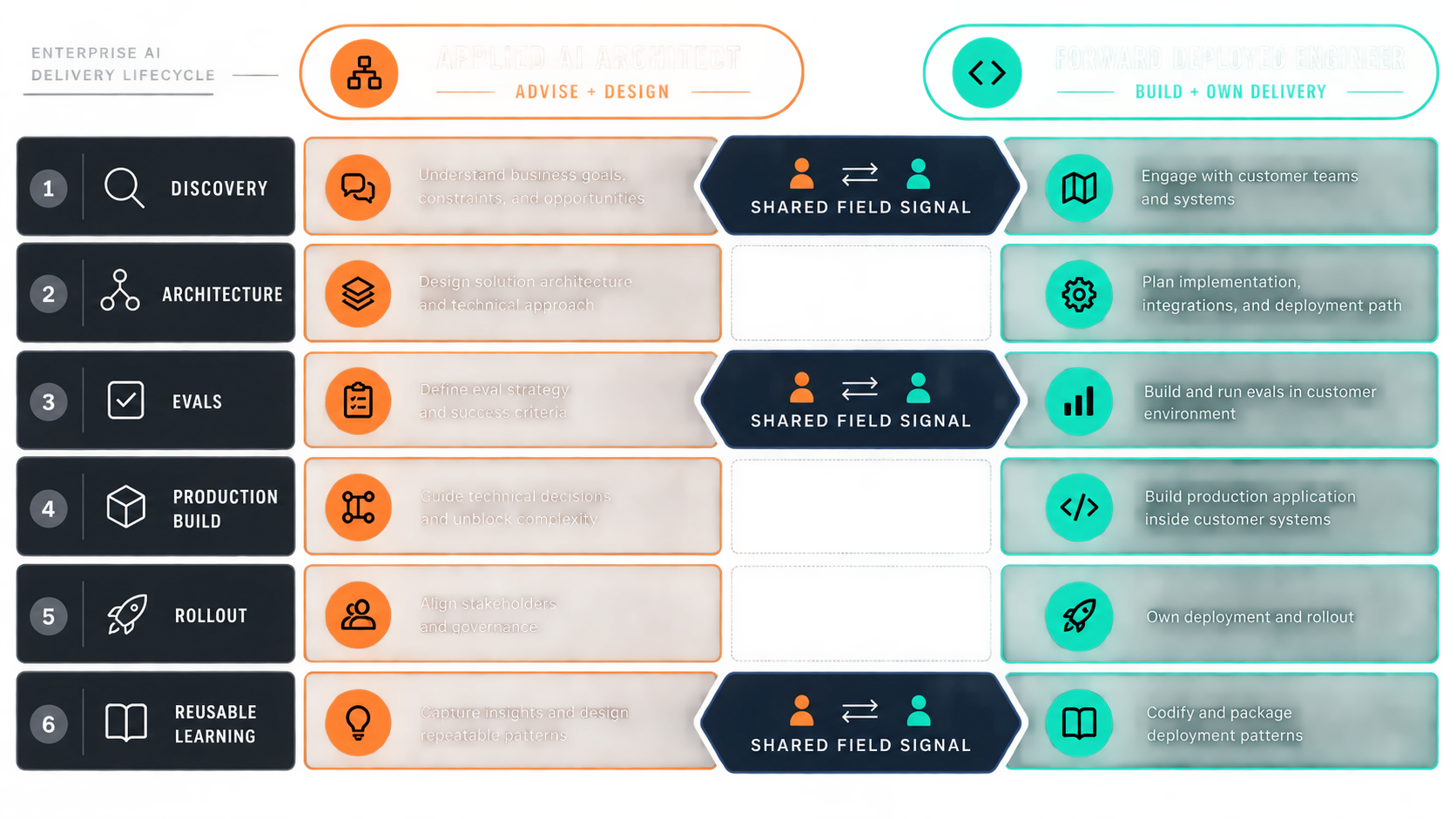
“Technical” and “customer-facing” are no longer enough to distinguish enterprise AI roles. Applied AI architects and forward deployed engineers can both run discovery, design systems, develop evaluation strategies, and carry field feedback into product teams.
Current job descriptions from Anthropic make the boundary unusually visible. Its Applied AI Architect is explicitly a pre-sales technical advisor. Its FDE embeds with strategic customers to ship production applications inside their systems. OpenAI's current FDE description reinforces that delivery span: discovery, scoping, design, build, and production rollout.
The role boundary is not who can draw the architecture. It is who stays accountable when the architecture has to become a stable production system.
Where the roles overlap
Discovery and translation
Both roles translate business requirements into technical decisions. Anthropic asks architects to understand requirements and align business objectives with implementation; it asks FDEs to conduct discovery and navigate complex customer organizations.
Architecture and evals
The architect guides integration architecture and helps customers develop evaluation frameworks. The FDE needs production experience with agent development and evaluation frameworks because those decisions must survive real workflows.
Field-to-product learning
Both roles identify common patterns and send insights back to product and engineering. That shared field signal is why titles alone are a poor guide to the work.
Where the ownership separates
- Applied AI architect: advise, design, guide, coordinate, and help the customer make sound technical choices.
- Forward deployed engineer: work within customer systems, build production applications, ship technical artifacts, and own the delivery path through rollout.
- Management test: ask who has the authority and obligation to change code, sequence scope, remove blockers, and protect production quality when plans collide with reality.
This is not a hierarchy. A strong architect can prevent months of bad implementation, while an FDE without architectural judgment can simply produce custom code faster. The operating question is which responsibility your deployment currently lacks.
A five-question title test
- Is the role pre-sales, post-sales, or accountable across both?
- Does the person advise customer engineers, or commit production code inside customer systems?
- Who owns the release plan, reliability bar, and rollback decision?
- Who turns repeated field work into reusable tools or product changes?
- What evidence closes the engagement: an approved architecture, a deployed system, or sustained adoption?
Sources
- Anthropic — Applied AI Architect, Enterprise Tech
- Anthropic — Forward Deployed Engineer
- OpenAI — Forward Deployed Engineer, Seattle
The FDE Brief
Get the next operator playbook.
Source-backed field notes for engineers and teams turning AI prototypes into trusted production workflows.
Reader question
Where does advice become ownership?
Tell us how your team separates architecture from embedded delivery.