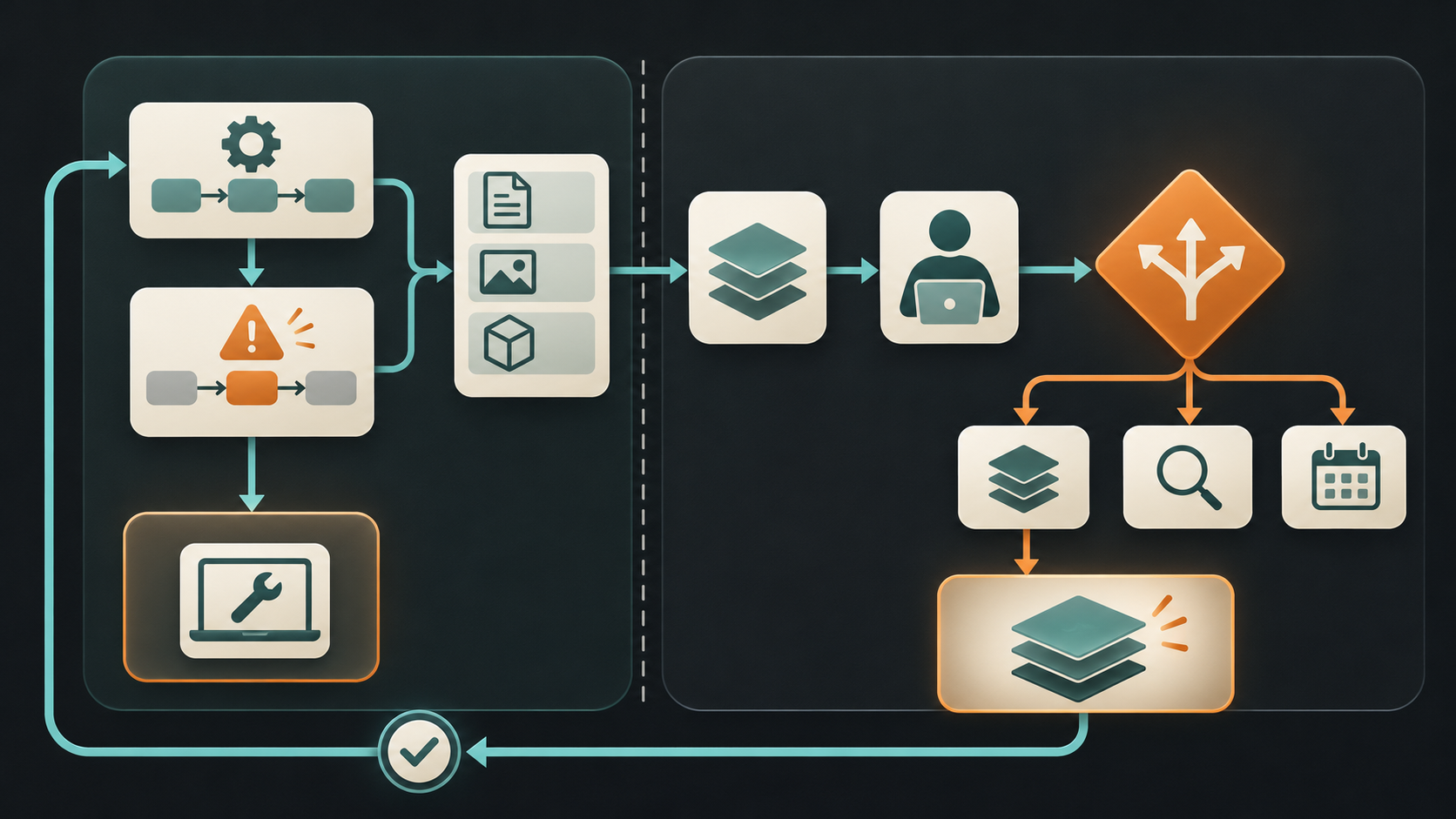
Forward deployed work creates useful local knowledge: a workflow exception, a workaround that made a test possible, or an integration choice that only surfaced in a real environment. The problem begins when a useful observation is quietly promoted into a product commitment without anyone recording what made it transferable.
What the sources actually support
Supermove’s Founding FDE, AI posting says the role should learn from customer deployments and make successful work reusable across the product. Warner Music Group’s FDE, Data & AI posting similarly describes translating business needs into scalable data and AI products. Those are each employer’s stated expectations. They do not show that a particular customer fix became a feature, establish product outcomes, or prove a universal FDE operating model.
The six fields to record
- Observed workflow. Name the bounded work and the actual friction. Do not include customer-sensitive detail in a public template.
- Local exception. State what was unique to this environment, policy, integration, or handoff.
- Supporting evidence. Link the trace, evaluation slice, repeated request, or engineering constraint—not a conclusion without evidence.
- Reusable candidate. Describe the smallest possible product or platform capability, not a broad feature wish.
- Product owner. Name who decides whether the candidate belongs on a roadmap or investigation queue.
- Decision and next test. Choose reuse, investigate, or defer; record what evidence would change that choice.
| Decision | Use it when | Next move |
|---|---|---|
| Reuse | The same need appears in a second compatible context and the boundary is understood. | Give a product owner a bounded capability and acceptance evidence. |
| Investigate | The observation is promising but its repeatability, owner, or technical shape is unclear. | Collect a specific missing example or evaluation slice. |
| Defer | The need is local, evidence is weak, or the cost of standardizing is unknown. | Keep the local boundary explicit; do not quietly create a product promise. |
Fictional example: a document-routing exception
A fictional operations team needs a routing assistant to check a customer-specific document code before a reviewer sees a case. An FDE records the code mapping as a local exception, links the failure examples that motivated it, and proposes a smaller candidate: configurable document-code routing. The product owner cannot yet tell whether another customer shares the condition, so the decision is investigate, not reuse.
The next test is to look for one compatible workflow and determine whether the configuration can be owned safely. The record does not claim reduced handling time, customer demand, or a product commitment. It only keeps the next decision honest.
Why this is an FDE tool
FDEs are often closest to the difference between a valuable local adaptation and a durable pattern. The useful contribution is not a bigger backlog. It is a better handoff: evidence attached to the workflow, a visible local boundary, a named product decision-maker, and a test that can disprove the reuse hypothesis.
What field signal would you need before asking product to generalize a fix?
Share the evidence or boundary that would make a reusable-candidate decision safer.
Related guides
Sources and limits
Supermove: Founding FDE, AI and Warner Music Group: FDE, Data & AI. These are employer-authored role descriptions. The field-learning record and fictional example are FDE Brief editorial guidance.