The FDE pod is three jobs, not one
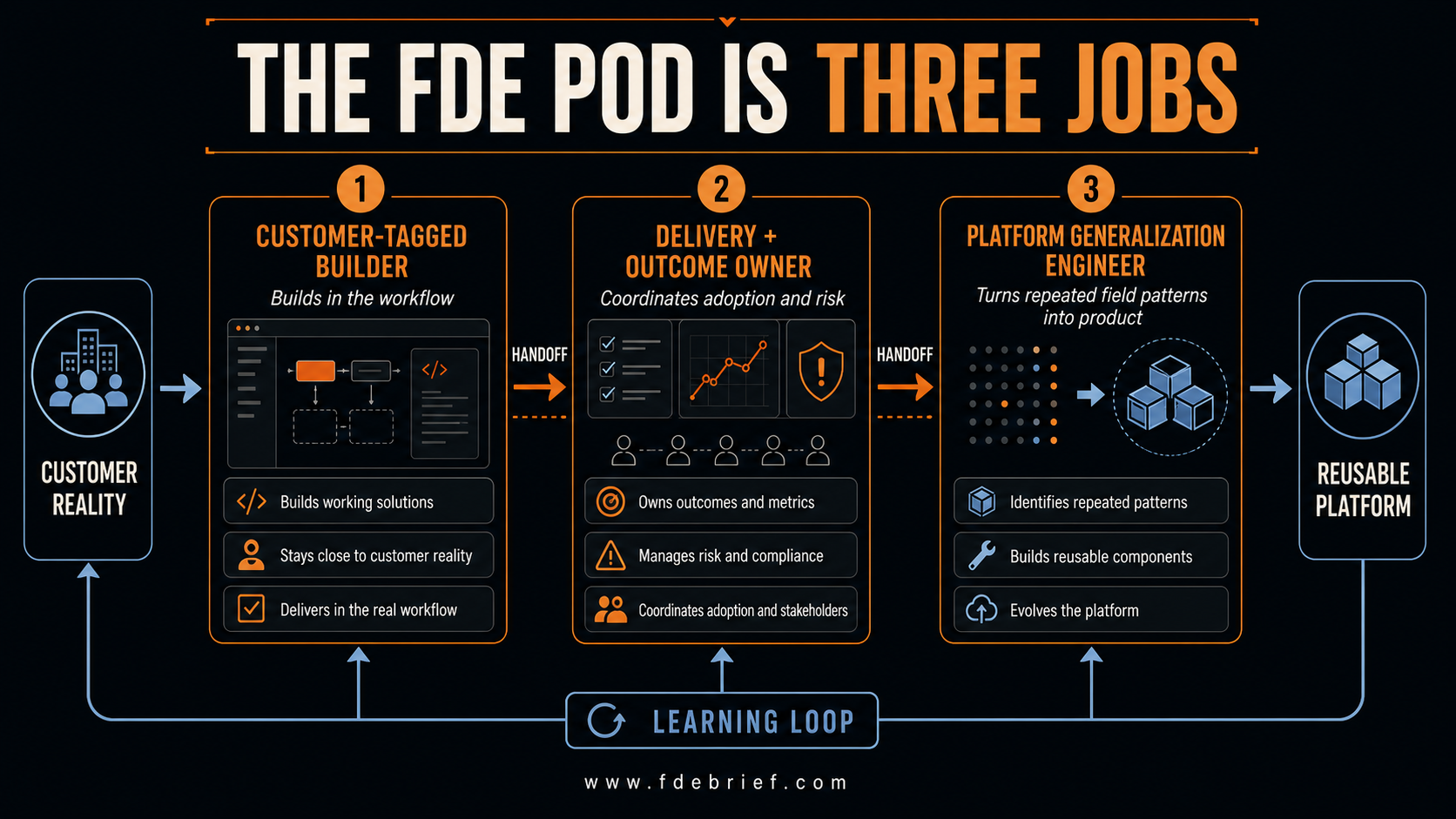
Scaled forward deployed engineering teams are separating customer-tagged building, delivery and outcome ownership, and platform generalization. Treat this as an emerging design pattern—not a universal org chart.
Why this structure is showing up
One FDE can discover a workflow, build an implementation, coordinate stakeholders, manage deployment risk, and identify reusable product patterns. At scale, asking one person to own all five creates a hidden bottleneck.
Current OpenAI postings make the separation unusually legible: a customer-tagged Forward Deployed Engineer builds near the workflow; a Technical Deployment Lead owns delivery coordination and outcomes; and a Platform Engineer turns repeated field needs into reusable systems. Palantir's broader family of forward deployed roles reinforces the idea that the category becomes more specialized as the organization matures.
Interpretation, not a universal standard: the postings support distinct responsibility boundaries. The three-role pod is FDE Brief's inferred operating model for reading those boundaries, not a claim that every company uses the same titles or reporting lines.
The three ownership lanes
1. Customer-tagged builder
Primary contract: make the workflow work. This engineer stays close enough to users and systems to build integrations, prototypes, evals, and production paths under real constraints.
2. Delivery and outcome owner
Primary contract: make the deployment land. This role coordinates stakeholders, adoption, risk, sequencing, and success measures so a technically correct build becomes an operating outcome.
3. Platform generalization engineer
Primary contract: make the next deployment cheaper and safer. This engineer identifies repeated field patterns, builds reusable components, and evolves the platform without abstracting away the customer evidence too early.
Where teams fail
- The builder becomes the permanent coordinator. Coding time disappears into status management and stakeholder translation.
- The delivery lead becomes a program manager without technical decision rights. Risk gets tracked, but hard implementation tradeoffs remain ownerless.
- The platform team generalizes before repetition is proven. One customer's preference becomes infrastructure that every future deployment must carry.
- The handoffs erase field learning. The platform receives feature requests instead of the failure modes, constraints, and evidence behind them.
A practical decision-rights test
- Who can change the implementation when customer reality contradicts the original plan?
- Who owns the adoption metric and decides whether a deployment is actually complete?
- Who decides that a repeated field pattern is ready to become a platform primitive?
- What evidence moves with the work at each handoff?
If the same name answers every question, the team may still be in an early founder-like phase. If no name answers one of them, the pod has a responsibility gap.
Sources
- OpenAI: Forward Deployed Engineer, Seattle
- OpenAI: Technical Deployment Lead, Forward Deployed Engineering
- OpenAI: Platform Engineer, Forward Deployed Engineering
- Palantir open positions and forward deployed role families
- FDE Brief 30-day KPI, Search Console, and growth reports generated 2026-07-14.
The question
Which of these three contracts is currently implicit—or missing—on your forward deployed team?
Get the next FDE operating map
Weekly field notes for engineers and operators designing customer-embedded technical teams.