The best FDEs turn one deployment into a platform bet
The strongest FDE signal is no longer just "can you ship for one customer?" It is "can you tell which part of the deployment should become reusable, and which part should stay customer-specific?"
Why this page exists now
The July 9 KPI report shows a small but active archive signal: 5 active subscribers, 1 new active subscriber, 45 page views in the last 7 days, and no reader questions yet. Search Console remains configured but blocked by OAuth invalid_grant, so this page uses the current draft queue plus public source evidence instead of pretending there are fresh query rows.
The target search surface is the platform side of forward deployed work: forward deployed engineer platform, platform FDE, FDE reusable patterns, and forward deployed engineer product feedback. That is a narrower query family than the basic role-definition pages, but it answers a real operating question for current FDEs, deployment leads, platform engineers, and teams designing customer-embedded AI roles.
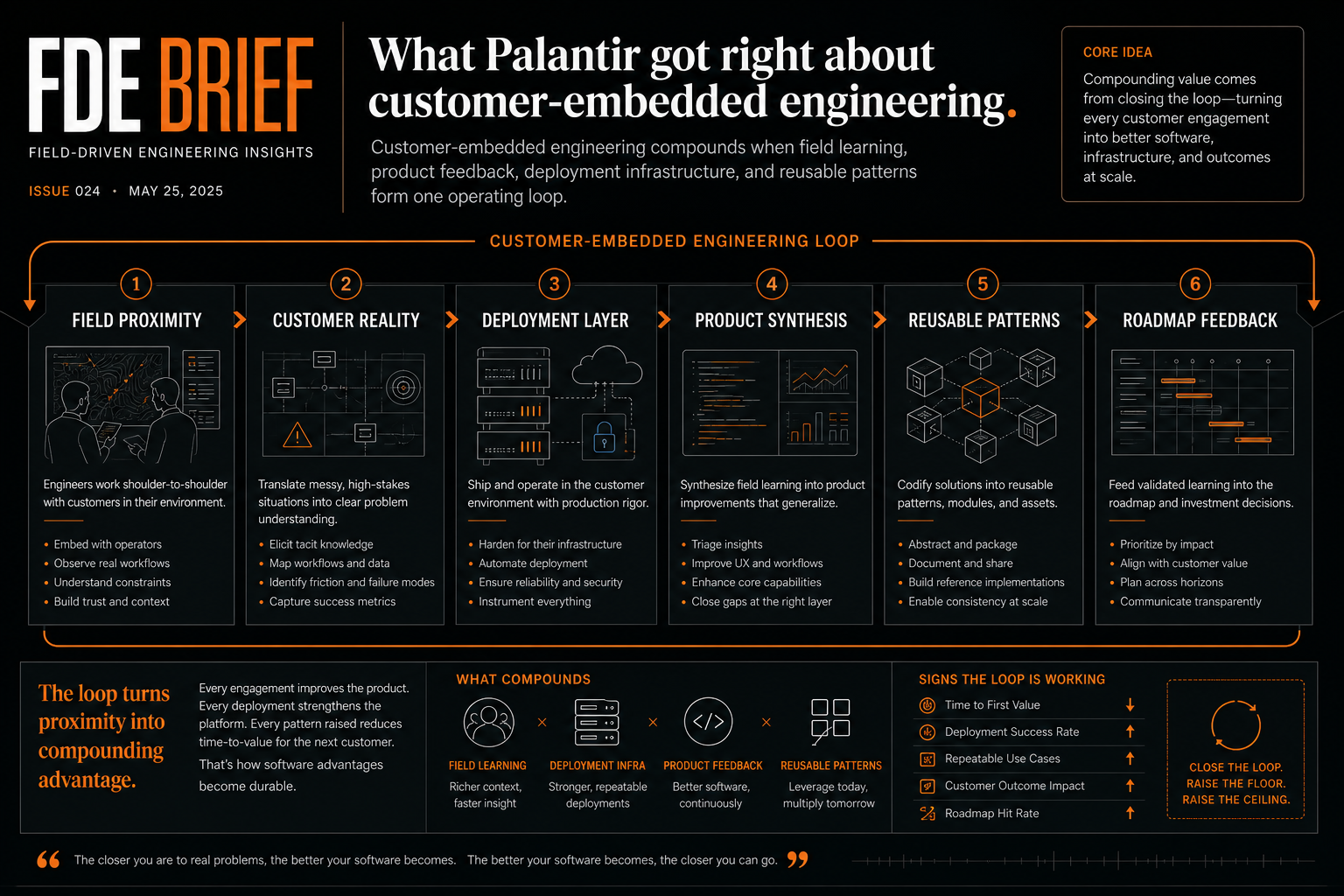
Interpretation: the FDE role is splitting into two related loops. The visible loop ships the customer outcome. The less visible loop decides what should generalize into reusable platform leverage.
The two loops
A serious deployment should produce both a customer outcome and a generalization decision.
Customer deployment
Map the workflow, build the integration, launch with the customer, unblock adoption, and prove value under real constraints.
Platform leverage
Decide whether the field failure is a local exception, a reusable pattern, a missing primitive, a better eval, or a handoff candidate.
Bespoke boundary
Some work should stay customer-specific because the process, data shape, compliance requirement, or business rule is genuinely local.
Handoff criteria
If the pattern should become platform, define the owner, interface, observability, support model, migration path, and adoption metric.
What AWS makes explicit
AWS frames its forward-deployed AI investment around embedded engineers working with customers to build production systems, but the important detail is what remains after the engagement. The official AWS announcement says the work should leave customers with systems, skills, workflows, patterns, runbooks, and documentation.
That is a platform-leverage claim, not just a services claim. The deployment is valuable because it solves a customer problem. It compounds when the deployment teaches the team how to make the next implementation faster, safer, or more repeatable.
What OpenAI makes structural
OpenAI's current FDE Platform role language points in the same direction. Its technical deployment lead and platform engineering roles describe moving from prototype to production, surfacing reusable patterns, turning raw customer signal into shipped software, and deciding what should generalize versus what should remain customer-specific.
The practical read is not "every FDE should become a platform engineer." The better read is that strong FDE work should make the platform question explicit before the customer-specific build becomes permanent ownership.
The failure mode
A team can ship impressive customer projects and still create a pile of permanent custom work. That usually happens when the team rewards first-customer heroics but never asks what should become reusable, supportable, observable, and owned by a durable team.
The result is a high-talent queue for exceptions. FDEs keep carrying production context because no one wrote the handoff criteria, no platform owner helped shape the reusable interface, and no adoption metric proved whether the generalized bet was worth building.
The practical playbook
- Name the customer-specific problem. Write the workflow, stakeholder, data, governance, and adoption constraint in plain language.
- Track the repeated failure mode. One customer is evidence. Three similar customers are a platform hypothesis.
- Separate artifact from pattern. The artifact may be a script, dashboard, agent workflow, connector, approval flow, eval set, or runbook. The pattern is the reusable reason it worked.
- Define the do-not-generalize case. Label genuinely local work early so custom code does not masquerade as product strategy.
- Write handoff criteria before handoff day. Define owner, interface, observability, support model, security review, docs, migration path, and adoption metric.
- Package the field signal. Send the customer context, repeated pain, current workaround, usage proof, risk, expected leverage, and what would make the bet wrong.
How candidates should use this
For current FDEs, this is a promotion-level story. The baseline is "I shipped a deployment under ambiguity." The stronger story is "I shipped the deployment, identified the reusable primitive, proved it with field evidence, and helped the durable product or platform owner take it over."
For aspiring FDEs, this changes the portfolio bar. A good project is not only a demo or integration. It should show how you found the workflow pain, what you built for the first user, what you instrumented, what you learned from adoption, what you would generalize, and what you would intentionally leave bespoke.
How teams should use this
If you hire FDEs only to absorb customer exceptions, the team becomes a custom-work queue. If you hire platform engineers far from the field, the platform team may build clean abstractions for problems customers do not actually have.
The better design is an explicit boundary: FDE owns customer understanding and first working proof, technical deployment lead owns scope and adoption, platform owner owns the reusable architecture and handoff path, and product owners use field evidence to decide what deserves durable roadmap space.
Sources
- Amazon / AWS official news on its forward-deployed AI engineer investment
- OpenAI careers: Technical Deployment Lead, Forward Deployed Engineering
- OpenAI careers: Platform Engineer, Forward Deployed Engineering
- OpenAI careers: Platform Engineering Manager, Forward Deployed Engineering
- FDE Brief weekly KPI report generated 2026-07-09
The question
Where does your customer-specific deployment work usually get stuck: proving the first outcome, deciding what should generalize, or handing the reusable piece to a durable owner?
Get the next deployment operating model
Weekly role maps, deployment patterns, and field notes for engineers trying to turn customer work into reusable leverage.