Forward deployed engineer deliverables: build, prove, generalize
The strongest forward deployed engineers do more than ship custom customer work. They build a real workflow, prove it works under production constraints, and turn the lesson into tooling, patterns, or product feedback the next team can reuse.
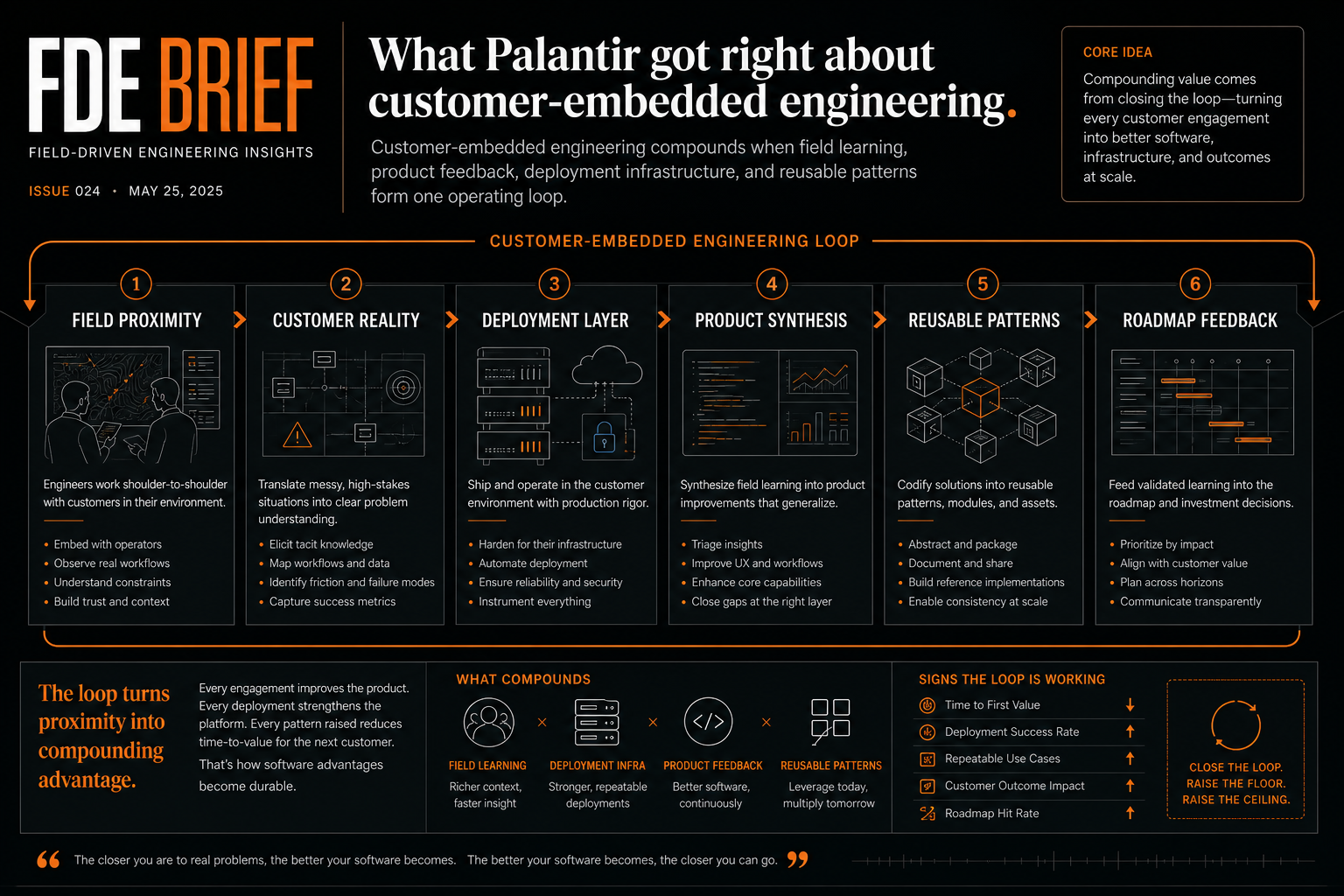
Why this page exists now
Recent public role language is getting more explicit about the real output of forward deployed work. OpenAI’s Deployment Company announcement says its Forward Deployed Engineers identify high-value workflows, redesign infrastructure and workflows around AI, and turn those gains into durable systems. OpenAI’s current government FDE role says the job includes owning deployments from prototype to stable production and codifying working patterns into tools, playbooks, or building blocks.
That same pattern appears elsewhere. Webflow’s Senior Forward Deployed Engineer posting says the role should prove what agentic web operations look like in production and turn those learnings into durable platform leverage. Stripe’s Forward Deploy Engineer posting says the team directly builds software for strategic users while contributing tooling, frameworks, and best practices that scale impact across accounts. Anthropic’s Applied AI FDE role says the engineer identifies repeatable deployment patterns and contributes those insights back to product and engineering.
Interpretation: the useful market signal is not just “customer-facing engineers are in demand.” It is that stronger FDE roles are defining success as reusable leverage, not only one-off delivery.
The three-part operating bar
A clean way to read the current role pattern is through a three-step loop.
- Build: ship something real inside the customer workflow, not a disconnected demo.
- Prove: make it hold up in production with observability, rollback, adoption, and incident judgment.
- Generalize: convert what worked into reusable tools, playbooks, product input, or reference implementations.
The third step is the distinction that matters. If the work never becomes something the next team can inherit, the company bought heroics instead of capability.
1) Build the real workflow
Forward deployed work starts with reality, not abstraction. The question is not whether the model can do something impressive in isolation. The question is whether the engineer can map the customer workflow, the business constraint, the integration boundary, and the operational risk clearly enough to ship a useful system.
- Good signal: the engineer can name the workflow, the blocked step, and the technical boundary.
- Weak signal: the story stays at the level of “we prototyped an AI use case” without a real operating context.
2) Prove it survives production
The second bar is proof, not enthusiasm. OpenAI’s current government FDE role explicitly calls for observable systems spanning infrastructure through applications. That matters because customer deployments break on environment constraints, missing controls, unclear ownership, and brittle handoffs long before they fail on demo quality alone.
- Good signal: the engineer can describe production evidence such as adoption, latency, error handling, rollback, or support reduction.
- Weak signal: the story ends when the prototype worked once.
For the narrower AI deployment loop behind this production bar, see Audit, Evals, Deployment: The Operating Loop Behind Applied AI Deployments.
3) Generalize the lesson
This is where the role becomes more than consulting with code. The strongest pages, postings, and announcements now point toward the same idea: the deployment should produce a transferable asset. That asset might be a connector, MCP server, eval harness, rollout checklist, anti-pattern memo, reference architecture, or product requirement that improves the next deployment.
- Good signal: the team can show what became reusable after the engagement.
- Weak signal: the same embedded engineer owns permanent custom logic with no path to transfer or productization.
How to use this in interviews
If you are interviewing for an FDE role, structure one story around the full loop.
- What exact workflow was blocked?
- What did you build under real customer constraints?
- How did you prove it worked in production?
- What became reusable after the deployment?
If you cannot answer the last question, you may have created value, but you probably have not shown the full forward deployed bar. Pair this page with the FDE skills checklist and the FDE interview guide.
How employers should read the role
Employers should be careful not to design the role around launch speed alone. A team that only rewards time to first deployment will quietly build a custom services trap. A better operating contract scores both customer outcome and reusable output.
- Did the deployment create measurable value?
- Did it leave behind a reusable artifact or product lesson?
- Can the next account start ahead because of what this team learned?
If you are defining the role from scratch, pair this page with How To Write A Forward Deployed Engineer Job Description.
Sources
- OpenAI: OpenAI launches the OpenAI Deployment Company to help businesses build around intelligence
- OpenAI careers: Forward Deployed Engineer, Gov
- Webflow: Senior Forward Deployed Engineer
- Stripe: Forward Deploy Engineer, Professional Services
- Anthropic: Forward Deployed Engineer, Applied AI
- Intercom: Forward Deployed Software Engineer
The question
What is the most reusable thing your team has ever produced from a messy customer deployment: a tool, a checklist, a reference implementation, or a product change?
Get the next FDE operating model breakdown
Weekly role teardowns, deployment patterns, and field notes for engineers who live at the customer edge.