How To Write A Forward Deployed Engineer Job Description
A good FDE job description makes the operating model explicit: customer-embedded engineering, deployment ownership, product feedback, and scope judgment.
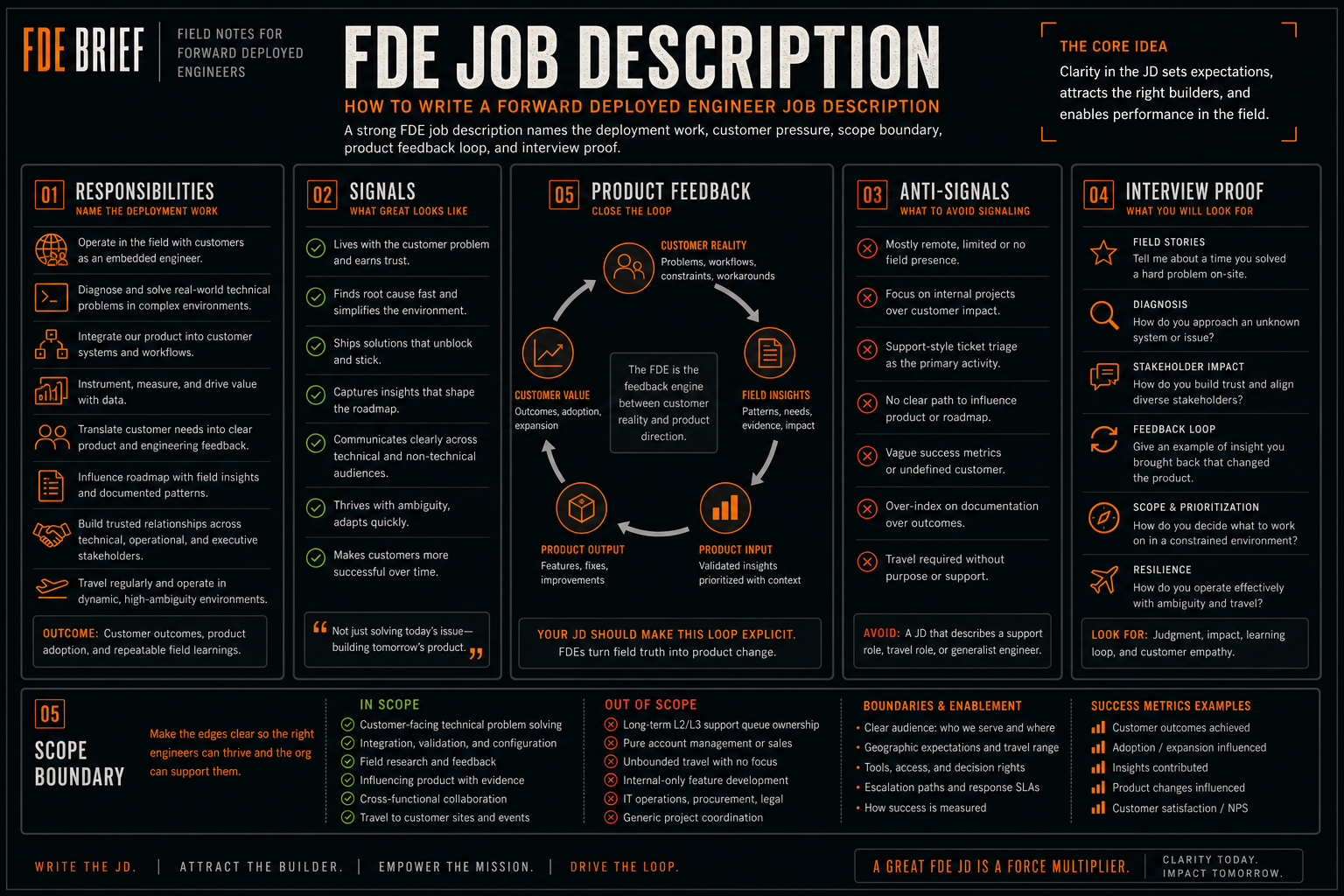
Most bad FDE job descriptions fail because they blur the role into three other jobs at once: solutions engineer, implementation consultant, and backend engineer. The right description tells candidates what kind of customer pressure they will own and what kind of engineering judgment they need to bring.
Start With The Operating Model
Define where the FDE sits between customer, product, engineering, sales, and success. If the role owns customer-specific technical work, say so. If it feeds product roadmap decisions, say how. If it should avoid becoming unlimited custom services, make that boundary visible.
Responsibilities That Attract The Right Candidates
- Translate ambiguous customer workflows into scoped technical plans.
- Build prototypes, integrations, and deployment paths that prove value in real environments.
- Debug implementation issues across product, data, infrastructure, and customer process.
- Turn repeated customer pain into reusable product feedback and implementation patterns.
- Communicate tradeoffs clearly with technical teams and customer stakeholders.
Signals To Ask For
Ask for evidence of deployed software, customer or user-facing technical work, integration judgment, written tradeoff memos, and examples where the candidate handled vague requirements without losing technical rigor. If you are defining the broader hiring package, use the FDE employer resources hub for the interview rubric, scorecard, and onboarding follow-through.
Hiring rule: if the job description only says “work with customers and engineering,” it is too vague. Name the deployment work, the scope boundary, and the product feedback loop.
What To Avoid
Avoid compensation claims you cannot source, generic “move fast” copy, and requirements that make the role sound like pre-sales plus after-hours custom engineering. Strong FDE candidates want to know what they own, what they can push back on, and how their field work affects product.
Interview Loop
The interview should test code, systems thinking, customer judgment, scope control, and written communication. A good loop includes one technical build or design exercise, one customer ambiguity simulation, and one retrospective story about a shipped workflow or integration.
Get the next FDE hiring brief
Weekly role teardowns, career maps, and field notes for engineers who live at the customer.