What Palantir Got Right About Customer-Embedded Engineering
The lesson is not “copy Palantir.” The lesson is that field learning, product feedback, and deployment infrastructure have to be designed as one system.
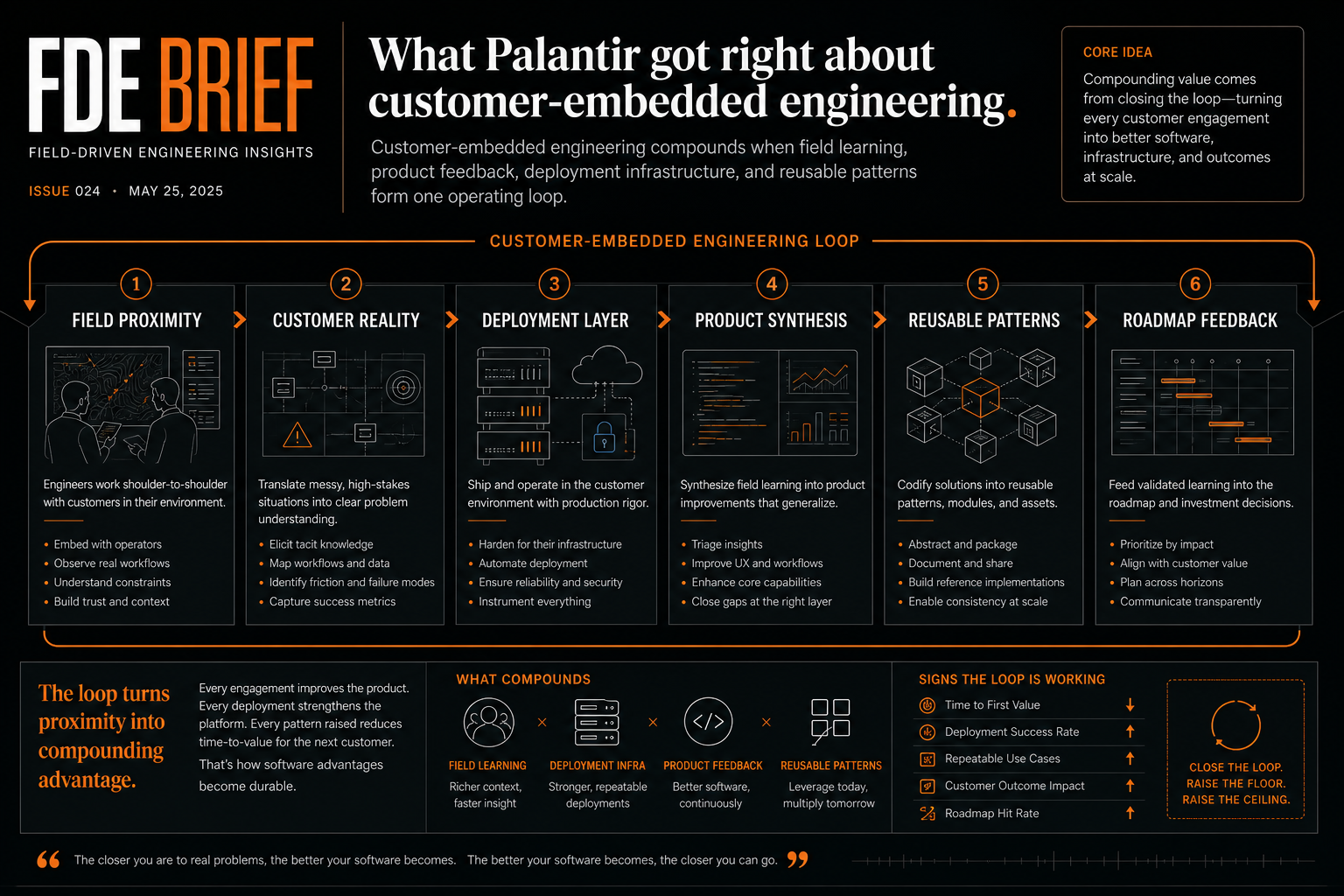
Interpretation: Palantir is useful to study because it made customer-embedded engineering part of the product operating system, not just a services function. Its public architecture docs describe forward deployed engineering as teams getting close to customer problems while working with core engineering to synthesize feedback and ship product improvements.
1. Field Work Was Treated As Product Learning
The important move is turning customer-specific reality into reusable product knowledge. FDE work should not be measured only by whether one customer got unstuck. It should also answer: what did this deployment teach the product team that should become easier next time?
2. Deployment Was A First-Class Constraint
Palantir's public Apollo docs frame deployment as a hard platform problem across cloud, on-prem, and disconnected environments. That matters because customer-embedded teams lose leverage when each deployment depends on heroic manual coordination.
3. The Customer Environment Shaped The Product Model
Palantir's Foundry architecture docs emphasize Ontology as a way to model operational reality. Whether or not a company uses that exact architecture, the lesson is broader: field teams need a durable way to convert customer workflows, entities, and constraints into product structure.
Operator takeaway: customer-embedded engineering compounds only when the company builds a path from field work to reusable product, deployment automation, and shared language.
What Not To Copy
Do not copy the title, the mystique, or the assumption that every customer needs custom engineering. Copy the mechanism: close field learning, explicit scope judgment, deployment infrastructure, and a product feedback loop that reduces repeated custom work.
Implication For Smaller Teams
A startup does not need a full Palantir-style operating model. It needs one sharp version of the loop: one person close to the customer, one place to record repeated pain, one deployment path that gets less manual over time, and one product decision rhythm that turns field learning into roadmap changes.
Get the next FDE operating model teardown
Weekly role teardowns, career maps, and field notes for engineers who live at the customer.