Beyond the copilot: the new FDE job is workflow redesign
The market signal is shifting from AI demos to workflow ownership. The stronger forward deployed roles now expect engineers to map the business process, connect the right systems, define controls and rollback, and leave behind an operating model the customer can run.
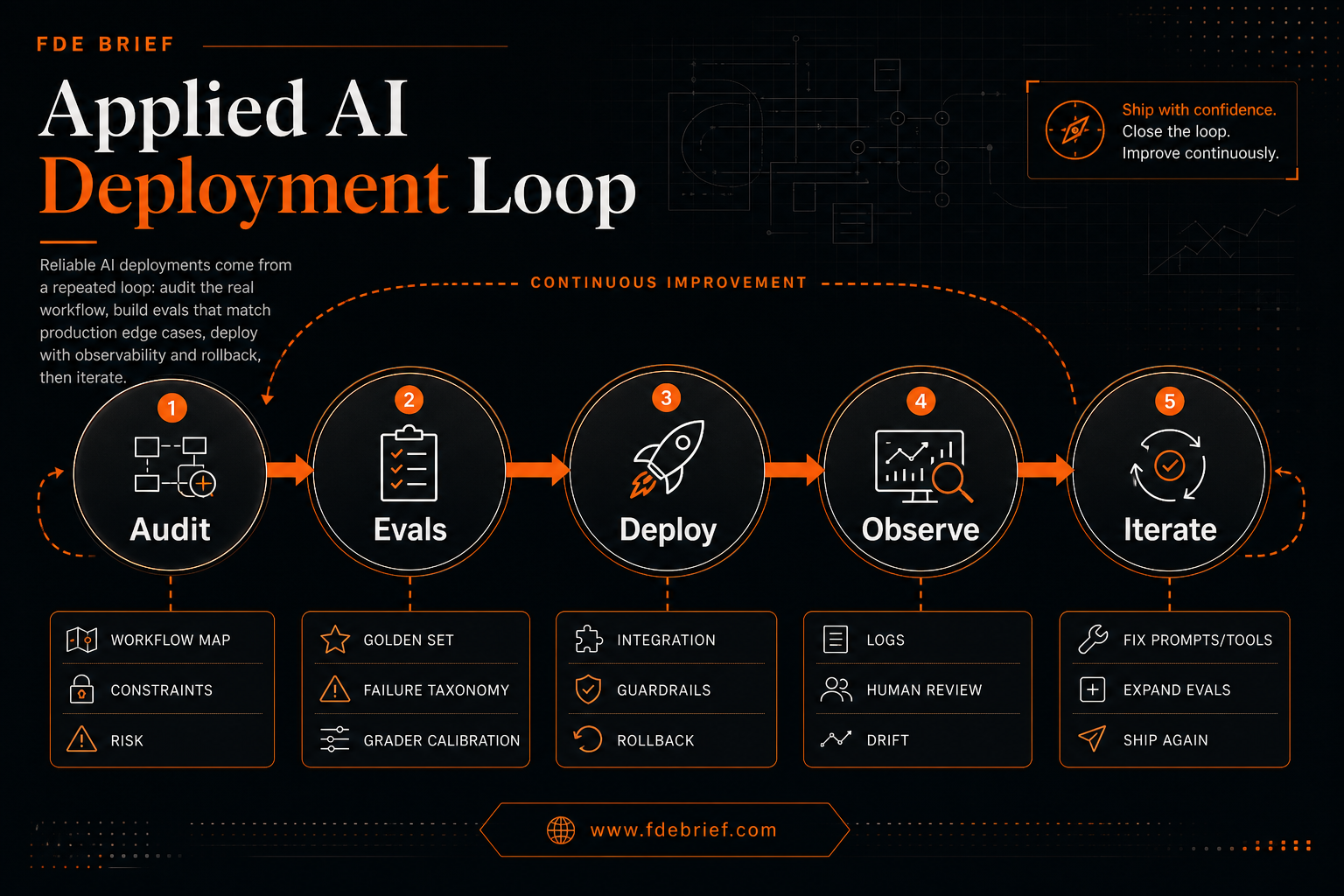
Why this page exists now
The latest 30-day KPI report generated on June 16, 2026 still shows role-and-career intent dominating archive demand. At the same time, the freshest public source set in this repo points at a more specific shift: companies no longer just want prompt demos or isolated copilots. They want engineers who can redesign how work actually moves through the business.
That pattern shows up across current company language. OpenAI’s May 11, 2026 Deployment Company launch explicitly says forward deployed teams work with operators and business leaders to identify AI opportunities, redesign critical workflows, and turn those gains into durable systems. OpenAI’s enterprise note from April 8, 2026 argues that companies are tired of point solutions and want one operating layer connected to the real systems, data, permissions, and controls around the work. Anthropic, Webflow, and Intercom role language lands in the same zone: production applications, observability, governance, handoff, and reusable deployment patterns.
Interpretation: the current market signal is not merely “be better at prompts.” It is “own the workflow around the model well enough that the customer can trust and operate the result.”
The short version
Use this as the fast mental model.
1. Workflow map
Name the actual business process and where it breaks before AI changes anything.
2. System connections
Connect the tools, data sources, and human approvals the workflow already depends on.
3. Controls
Define permissions, rollback, and governance so the system is safe enough to trust.
4. Production behavior
Instrument failure paths, observability, and adoption signals inside real daily work.
5. Customer-owned operation
Leave behind a deployment the customer can run without permanent FDE babysitting.
Why “copilot” is no longer enough
A weaker deployment story is still common: one model, one demo, one polished moment. That can prove a concept. It does not prove the workflow survives contact with real systems, real permissions, real exceptions, or real human adoption.
The newer FDE bar is different. OpenAI’s current Technical Deployment Lead postings make adoption, change management, delivery rhythm, and reusable rollout patterns explicit parts of forward deployed work. OpenAI’s AI Deployment Engineer postings show the title cluster broadening around startup and developer-workflow deployments. Google splits similar work across one Applied AI FDE role and one applied-AI customer-engineering role. Anthropic and Databricks make the same point from the build side: the job is to productionize real customer workflows and leave behind reusable operating patterns. Those are workflow-redesign expectations, not copilot-decoration expectations.
What stronger FDE ownership looks like
- Business-process clarity: the engineer can name what task flow changes, who owns it, and why the change matters.
- System realism: the deployment connects to the actual tools, data, and approvals the work depends on.
- Trust mechanics: permissions, governance, rollback, observability, and human handoff are treated as core product work.
- Operating proof: the team can point to cycle-time, escalation, completion, or adoption evidence inside the workflow.
- Transferability: the deployment leaves behind a reusable pattern rather than a permanent custom-support obligation.
The practical review before calling a deployment complete
- Name the workflow. What exact business process changes, and who owns it before and after the deployment?
- Name the system boundary. Which tools, data sources, permissions, and approvals does the AI need to touch?
- Name the failure path. When the system is wrong, blocked, slow, or uncertain, what happens next?
- Name the operating proof. What evidence shows the workflow is actually better in day-to-day use?
- Name the transfer plan. What has to exist so the customer team can run the result without you?
If the answer to the fifth question is vague, the system is probably still a pilot even if it is already live.
What this means for candidates
The portfolio story has shifted. A weaker story is “I built an AI feature.” A stronger story is “I mapped the workflow, connected the surrounding systems, defined the trust boundaries, and got the customer to a point where they could operate the system without me.”
That signals more than technical fluency. It signals operational judgment. If you are interviewing, prepare at least one example where the model was not the hard part. Prepare the example where the hard part was getting the workflow, controls, and stakeholder behavior to work together.
What this means for employers
If you are hiring FDEs, decide whether you want a demo specialist or a workflow owner. The public role language in this repo suggests the better teams are hiring for workflow ownership: people who can map the business process before they build, separate a product gap from a local workaround, and leave the customer with a system instead of a sprint artifact.
A useful interview prompt is simple: tell me about a deployment where the technical build was not the hardest part. What workflow or operating constraint made the work difficult, and how did you redesign around it?
Sources
- OpenAI: OpenAI launches the Deployment Company
- OpenAI: The next phase of enterprise AI
- OpenAI careers: Technical Deployment Lead, Forward Deployed Engineering (FDE) - Platform
- OpenAI careers: Technical Deployment Lead, Forward Deployed Engineering (FDE) - SF
- OpenAI careers: AI Deployment Engineer, Startups
- OpenAI careers: AI Deployment Engineer - Codex
- Google careers: Forward Deployed Engineer III, Google Cloud, Applied AI
- Google careers: Practice Customer Engineer, Applied AI, Google Public Sector
- Anthropic: Forward Deployed Engineer, Applied AI
- Databricks: AI Engineer - FDE (Forward Deployed Engineer)
The question
Where does your team’s AI work usually break first: workflow mapping, systems integration, permissions and governance, failure handling, or customer handoff?
Get the next workflow-ownership breakdown
Weekly field notes and role maps for engineers building AI systems that have to survive real customer workflows.