Every cloud is building a forward-deployed AI team
The durable signal from AWS, Google Cloud, and OpenAI is not simply that enterprise AI services are growing. It is that cloud AI now needs a forward-deployed layer between model access and production workflow adoption.
Why this page exists now
The July 7 KPI report still shows the archive's strongest measured demand around role taxonomy: FDE vs Solutions Engineer vs Deployment Strategist led tracked archive traffic with 34 views in the last 30 days. Search Console remains configured but blocked by OAuth invalid_grant, so this page uses KPI demand plus the freshest source-backed backlog signal instead of pretending there are usable query rows.
That signal is visible across three public source clusters: Amazon announced a major AWS investment in forward-deployed AI engineers, Google Cloud has reachable generative-AI forward-deployed roles, and OpenAI has publicly framed deployment as a company-building layer. The search intent is direct: forward deployed ai engineer, aws forward deployed ai engineers, google cloud forward deployed engineer, and enterprise ai deployment engineer.
Interpretation: enterprise AI is moving from access to adoption. When the platform is powerful but the customer's workflow is messy, the scarce layer is not another demo team. It is embedded technical ownership that can turn model and tool access into production behavior, then bring field learning back into the product.
The pattern
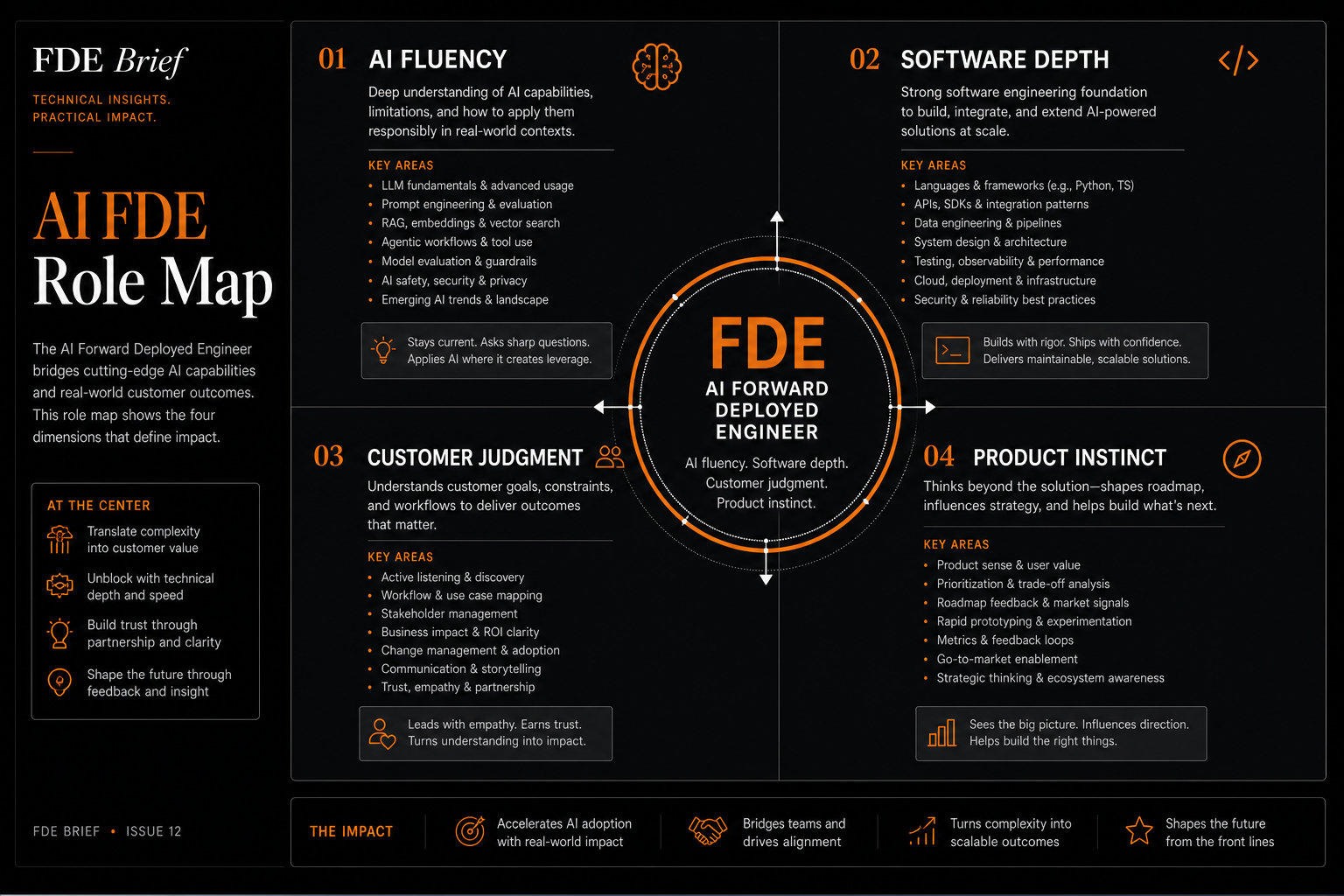
Read the new cloud-provider posture as a deployment-layer stack, not a single job title.
Cloud AI platform
Models, agent tools, infrastructure, security controls, data services, and partner ecosystems make the capability available.
Forward-deployed layer
Embedded builders, outcome owners, and technical deployment leads convert that capability into a working customer workflow.
Customer workflow
The real test is whether the system changes how work happens under production constraints, not whether the pilot impresses a room.
Product feedback
Field failures become roadmap signal: missing tools, weak integrations, unreliable evals, unclear controls, or repeated implementation gaps.
What AWS makes explicit
AWS now uses forward-deployed AI engineers as public language for enterprise AI adoption. The important part is not only the investment size. The important part is the operating assumption: customers need help moving from AI services to business workflows that actually run.
That is the FDE-shaped problem. A cloud provider can ship models, managed services, and agent tooling, but the customer's real environment still has legacy systems, data boundaries, approval paths, risk controls, and ambiguous ownership. The forward-deployed layer exists because those constraints cannot be solved by documentation alone.
What Google Cloud makes visible
Google's reachable generative-AI forward-deployed postings show the title becoming part of the cloud go-to-market vocabulary. They sit near customer engineering, partner work, and AI outcome ownership, which is exactly where title confusion appears.
The practical read is that Google Cloud is not just hiring generic solutions engineers with AI in the title. It is naming a set of customer-embedded roles around generative-AI adoption, technical deployment, and outcome ownership. Some roles may be closer to customer engineering. Others may be closer to build-and-deploy ownership. The posting details matter more than the title.
What OpenAI makes structural
OpenAI's deployment-company framing points to the same market pressure from a different direction. Enterprise AI adoption is becoming a craft: identify the workflow, build the right implementation layer, prove reliability, manage change, and feed product learning back to the platform.
That makes the forward-deployed layer more than services packaging. It is a product-discovery and implementation loop sitting inside customer reality. The best teams will not treat field work as separate from product work. They will use it to discover what the platform must become.
How candidates should use this
- Search for the artifact. Strong postings mention integrations, workflow redesign, evals, deployment plans, implementation quality, or reusable product feedback.
- Look for the success metric. Adoption, expansion, production reliability, customer outcome, and product learning each imply a different operating contract.
- Do not chase the title alone. "Forward deployed" is useful only if the role actually owns technical work close to the customer.
- Prepare field stories. The strongest examples show how you handled messy data, stakeholder ambiguity, production constraints, and product tradeoffs in one deployment.
- Ask where the handoff ends. If the team cannot say who owns build quality after the demo, the deployment layer is underdesigned.
How employers should use this
If you are building an AI deployment team, separate four contracts before writing the job description: who shapes the customer outcome, who builds the implementation, who owns production quality, and who turns field learning into product direction.
One person can cover more than one contract, but only if the hiring bar and reporting line match that scope. The weak version is renaming customer success, solutions engineering, or professional services as FDE. The strong version is naming the deployment layer clearly enough that candidates know whether they are joining a technical sales motion, a delivery organization, or a product-adjacent field engineering team.
Sources
- Amazon / AWS official news on its forward-deployed AI engineer investment
- Google careers: Forward Deployed Engineer III, Generative AI, Google Cloud
- Google careers: Partner Forward Deployed Engineer, Generative AI, Google Cloud
- Google careers: AI Outcome Customer Engineer, Forward Deployed Engineering
- OpenAI announcement: launching the Deployment Company
- FDE Brief weekly KPI, Search Console, and growth reports generated 2026-07-07
The question
In the AI teams you watch, is the forward-deployed layer a real build-and-feedback loop, or is it still a services motion with a newer title?
Get the next deployment-role map
Weekly field notes for engineers and operators trying to read the changing AI deployment market before the titles settle.