AI outcome customer engineer vs forward deployed engineer
Google Cloud's new AI outcome customer-engineering language is a useful clue about where the market is moving. It does not collapse customer engineering and FDE into one job. It shows a bridge between outcome-led adoption and production deployment ownership.
Why this page exists now
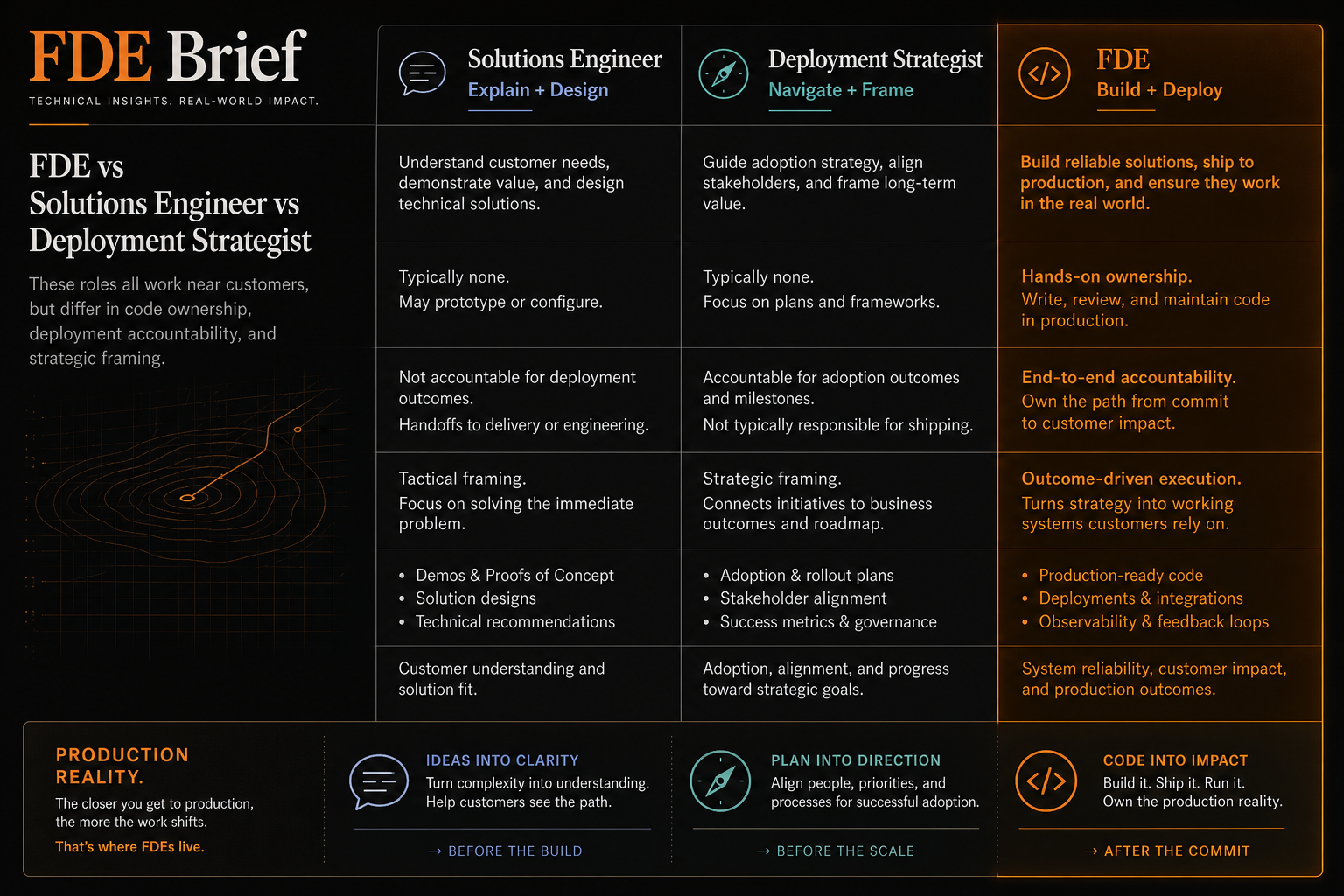
The 30-day KPI report generated on June 30, 2026 still shows the archive's strongest demand around role taxonomy: FDE vs Solutions Engineer vs Deployment Strategist leads tracked archive traffic with 35 views. Google Search Console is configured but still blocked by OAuth invalid_grant, so there are no fresh query rows to overfit.
The freshest unserved backlog signal is a title gap: AI Outcome Customer Engineer. Google Cloud has live job URLs for AI Outcome Customer Engineer, Partner Forward Deployed Engineer, and Forward Deployed Engineer III roles in its generative-AI/customer-engineering orbit. Channel Dive also reported in May 2026 that Google Cloud had 59 roles related to moving customers beyond experimentation. That makes this a good Tuesday evergreen publish: it answers a narrow search-intent question inside the already-working role-boundary cluster.
Interpretation: AI outcome customer engineer is best read as an outcome-led customer-engineering title, not a simple synonym for FDE. It is closer to the customer-engineering side when it validates use cases, shapes outcome plans, and drives adoption. It moves closer to FDE when it owns build, integration, production behavior, and product feedback under real deployment pressure.
The short version
Use this as the fast mental model when reading the title.
AI outcome customer engineer
Usually sits closer to customer engineering: qualify the AI opportunity, shape the outcome, translate business workflow into technical fit, and help the account adopt the right architecture.
Forward deployed engineer
Usually sits closer to deployment ownership: build the workflow, connect the systems, debug production constraints, and turn field failures into product or platform learning.
Where the roles overlap
Both roles live near customers, both need technical credibility, and both are pulled into ambiguous AI deployments before the implementation shape is obvious. The overlap is strongest around workflow diagnosis: what is the customer actually trying to change, what data and controls matter, and what would count as a real outcome instead of a demo?
That overlap matters because AI deployments fail when the handoff between value promise and production reality is weak. A customer engineer who cannot read the workflow will oversell the wrong pattern. An FDE who cannot read the outcome will build something technically impressive but commercially irrelevant.
Where the roles split
- If the role is measured on opportunity shaping, technical validation, and adoption planning, it is closer to AI outcome customer engineering.
- If the role is measured on production workflow behavior, integration quality, and field feedback, it is closer to forward deployed engineering.
- If the role owns both, the job description should say that explicitly because the hiring bar is higher than generic customer engineering.
- If the role has no build ownership, do not assume the FDE label applies just because the customer is using AI.
- If the role has no outcome ownership, do not assume the engineering work will land as customer value.
How candidates should read the posting
Do not start with the title. Start with the artifact the role is expected to leave behind. Customer workshops, outcome maps, reference architectures, and account plans point toward customer engineering. Working integrations, eval harnesses, production workflows, deployment runbooks, and reusable product feedback point toward FDE work.
The interview stories should change accordingly. For AI outcome customer engineering, prepare stories about diagnosing the business workflow, translating value into technical path, and influencing adoption across stakeholders. For FDE work, prepare stories about building under messy customer constraints, making scope calls, and shipping something that survives production usage.
How employers should write the job
If the job is outcome-led customer engineering, name the success metric: adoption, business workflow change, architecture fit, qualified use cases, or customer expansion. If the job is FDE, name the delivery contract: build ownership, integration scope, production reliability, escalation boundaries, and product feedback loops.
The weak version is pretending every customer-facing AI title is interchangeable. The strong version is describing the boundary directly so candidates can tell whether the company needs a technical seller, an outcome owner, a deployment builder, or a hybrid.
Sources
- Google careers: AI Outcome Customer Engineer, Forward Deployed Engineering
- Google careers: Partner Forward Deployed Engineer, Generative AI, Google Cloud
- Google careers: Forward Deployed Engineer III, Generative AI, Google Cloud
- Channel Dive: Google Cloud is hiring an army of AI deployment engineers
- FDE Brief internal weekly KPI, Search Console, and growth reports generated 2026-06-30
The question
In your market, does "AI outcome" mean customer-engineering adoption work, real deployment ownership, or an unclear hybrid that needs a better operating contract?
Get the next role-boundary breakdown
Weekly field notes for engineers and operators trying to read the changing AI deployment market before the titles settle.