Forward deployed engineer vs solutions architect
These roles can both be technical and customer-facing, but they diverge at the point where a customer deployment stops being an evaluation and starts becoming a messy production system that needs code ownership, rollout judgment, and reusable product signal.
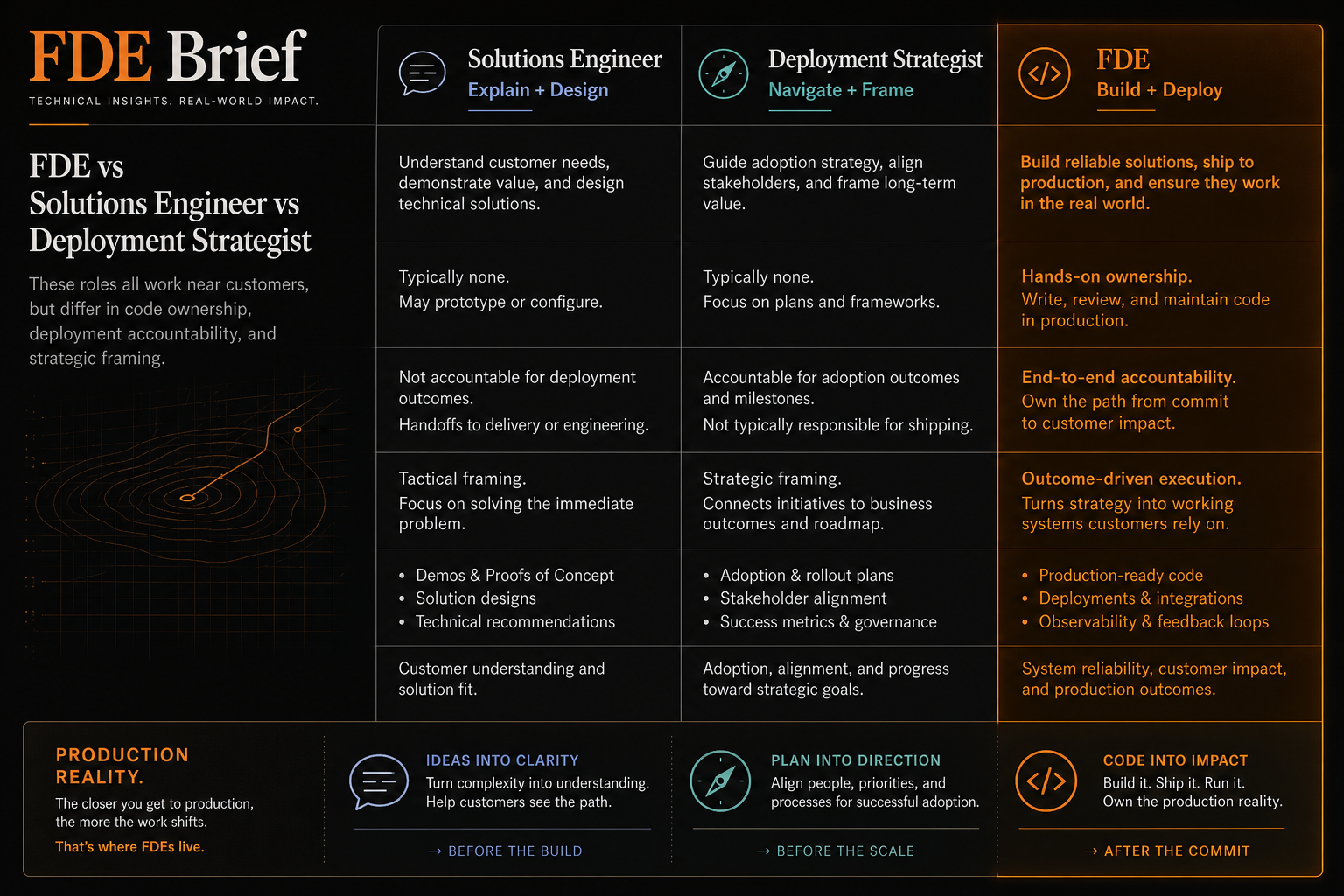
Why this page exists now
The current archive demand in this repo still clusters around role-comparison pages. The latest 30-day KPI report generated on June 11, 2026 shows FDE vs Solutions Engineer vs Deployment Strategist as the top archive page with 22 tracked views. That is a useful clue: readers are still trying to separate adjacent customer-facing technical roles, not just learn the generic definition of FDE.
Current job markets reinforce the confusion. OpenAI’s careers search, as of June 11, 2026, lists both Forward Deployed Engineer roles and a separate Solutions Architect, Digital Natives role. Anthropic likewise has an active Forward Deployed Engineer, Applied AI posting and separate Applied AI Architect roles. Google Cloud shows the same split across Forward Deployed Engineer and Customer Engineer roles. The exact company titles vary, but the useful question is stable: who owns the deployment once it stops being a proof point and becomes real operational work?
Interpretation: if someone says “consultant-style AI role,” they are often describing a solutions-architect or customer-engineer boundary. This page uses the more current public job-title evidence from OpenAI, Anthropic, and Google, then marks the consultant analogy as interpretation rather than as a sourced title claim.
The short version
Use this as the fast mental model.
Solutions architect
Helps a customer understand architecture, shape the solution, reduce technical risk, and move toward adoption.
Forward deployed engineer
Owns customer-embedded build and deployment work when the solution must actually ship, hold up, and teach the product team something reusable.
What the solutions-architect side usually owns
OpenAI’s current careers search makes the split visible by listing a separate Solutions Architect, Digital Natives track alongside FDE and AI deployment roles. Anthropic’s Applied AI Architect postings describe a pre-sales architect who helps enterprises understand Claude’s value, acts as a trusted technical advisor, and paints the integration vision. Google’s customer-engineer postings frame the job around partnering with technical sales teams, differentiating Google Cloud, developing architectures, running proofs of concept, and accelerating technical wins.
That is still real technical work. The role can involve code, prototypes, workshops, and system design. But the center of gravity is usually architectural guidance and adoption support rather than being the primary owner of the ugly last-mile build when the customer workflow and production environment start fighting back.
What the FDE side usually owns
The current Anthropic FDE posting is unusually explicit. It says FDEs embed directly with strategic customers, build production applications in customer systems, deliver technical artifacts like MCP servers, sub-agents, and agent skills, provide white-glove deployment support, and codify repeatable deployment patterns back into product and engineering. That is not just advisory architecture. That is hands-on deployment ownership inside the customer reality.
Google’s current FDE language points the same way. One live Google Cloud posting describes the FDE as the “Agent Engineer” and the primary driver for customers’ critical AI initiatives. OpenAI’s FDE listings also separate deployment builders from solutions-architect and technical-success roles, which is another signal that the company sees a meaningful difference between explaining the architecture and owning the deployed workflow.
Where the real boundary shows up
- Before the deployment: solutions architects are often strongest at shaping the path, de-risking the design, and translating business needs into architecture.
- During the deployment: FDEs are more likely to be accountable for shipping the integration, handling ambiguity, debugging the workflow, and making the system usable in production.
- After the deployment: FDEs are more likely to turn field failures, edge cases, and repeated customer asks into reusable product feedback.
How to tell which job you are actually reading
- If the posting emphasizes technical wins, proofs of concept, architectural guidance, and trusted-advisor work, it is closer to solutions architect.
- If the posting emphasizes embedding with customers, building in their environment, deploying production systems, and leaving reusable patterns behind, it is closer to forward deployed engineer.
- If the role expects both, check which responsibility becomes the job when things break. That is the real title signal.
What this means for candidates
If your best stories are architecture reviews, solution design, stakeholder influence, and POC acceleration, you probably have stronger evidence for solutions-architect work. If your best stories are messy rollout ownership, customer-specific implementation, deployment debugging, and product feedback loops, you have stronger evidence for FDE work.
The mistake is assuming FDE is just a more prestigious label for technical pre-sales. The titles overlap, but current job evidence suggests companies are increasingly separating advisory architecture from customer-embedded deployment engineering.
What this means for employers
If you need someone to help customers understand the architecture and move toward adoption, say that clearly and hire a solutions architect or adjacent customer-engineering profile. If you need someone to embed with the customer, build the workflow, handle rollout risk, and convert field pain into product leverage, say FDE and write the operating contract accordingly.
Using one label for both jobs usually creates hiring confusion, bad interview loops, and scope mismatch after the person starts.
Sources
- OpenAI careers search: live Forward Deployed Engineer, AI Deployment Engineer, and Solutions Architect listings
- Anthropic: Forward Deployed Engineer, Applied AI
- Anthropic: Applied AI Architect, Industries
- Google: Customer Engineer, Federal Civilian Agencies, Google Public Sector
- Google: Practice Customer Engineer II, Cloud AI, Public Sector
- Google: Forward Deployed Engineer III, Google Cloud, Applied AI
The question
Do you want to be the person who shapes the architecture, or the person who owns the deployed workflow when the architecture meets production reality?
Get the next FDE role-boundary breakdown
Weekly field notes and role maps for engineers deciding between customer-facing architecture work and true deployment ownership.