Forward deployed engineer career ladder
The title is getting less useful on its own. Current deployment teams are splitting the work into operating contracts: embedded builder, AI deployment specialist, technical deployment lead, AI outcome customer engineer, and platform leverage.
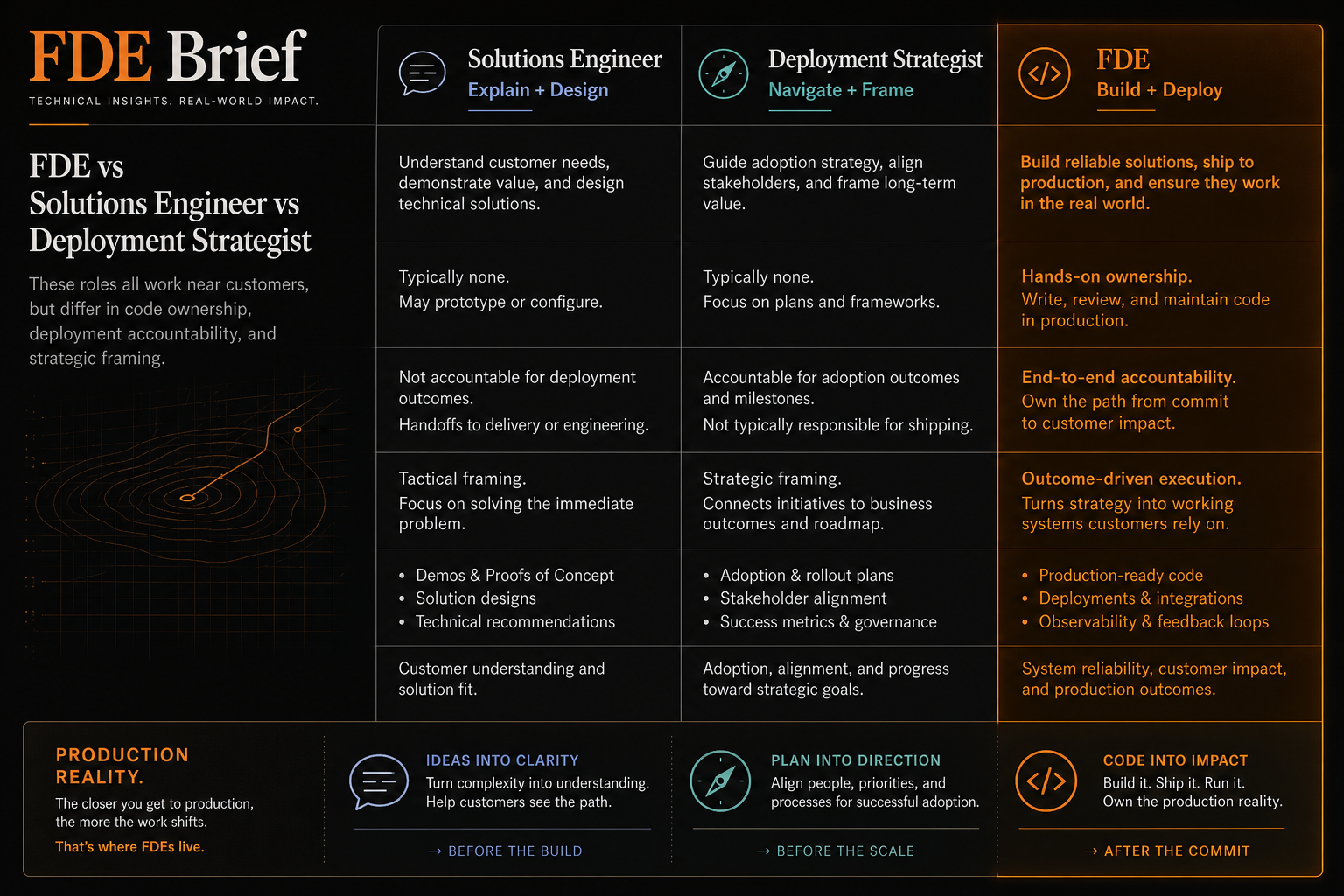
The current source set still favors role-definition pages. The 2026-06-29 autonomous research run collected current OpenAI, Google, Anthropic, Channel Dive, and SaaStr sources around FDE title taxonomy, operating contracts, compensation scope, and customer-embedded ownership. That makes this page a clean archive companion for the newsletter: it extends the strongest title-taxonomy cluster with a sharper search surface.
The short version
One deployment org can now contain several distinct jobs that used to get flattened into one loose "FDE" label. The practical read is not title prestige. It is operating contract: who owns code, workflow design, delivery sequencing, stakeholder alignment, outcome adoption, and reusable platform leverage once the deployment gets real.
As of the 2026-06-29 source run, OpenAI's deployment careers search showed several adjacent titles inside the same broader deployment orbit, including forward deployed engineer, AI deployment engineer, technical deployment lead, partner, platform, and manager variants. Google adds partner FDE, FDE III, and AI Outcome Customer Engineer examples. Anthropic and current market reporting show the same broader shift toward implementation, evals, reference patterns, and customer-embedded ownership.
The four-contract ladder
How the work splits
Forward deployed engineer
Own the messy customer reality, write code when needed, get the workflow live, and push the field learning back into product or research.
AI deployment engineer
Turn model capability into a workflow customers can actually adopt, often with deeper product or use-case specialization.
Technical deployment lead
Own pilot scope, success criteria, milestones, dependencies, and stakeholder alignment so the deployment does not stall under ambiguity.
AI outcome customer engineer
Own the path from AI possibility to credible customer outcome, including use-case shaping, adoption, rapid activation, and viable delivery.
Best test
If this person disappears, does the account lose hands-on build ownership and production progress?
Best test
Does the account lose workflow adoption design, delivery sequencing, outcome clarity, or reusable engineering leverage instead?
What the current source set supports
OpenAI's FDE posting reads like the classic embedded-builder contract: discovery, scoping, system design, build, rollout, adoption, workflow impact, eval-driven feedback, and meaningful travel. The Technical Deployment Lead posting makes a different contract explicit by centering success criteria, delivery planning, stakeholder alignment, enterprise readiness, adoption, and demonstrated value. The AI Deployment Engineer posting centers the path from product capability to scaled customer workflows.
Google's Partner FDE and FDE III postings reinforce that the embedded-builder lane is still highly technical: code, debugging, and jointly shipping agentic solutions in customer environments. Google's AI Outcome Customer Engineer posting adds a nearby customer-engineering contract around adoption and viable delivery. Anthropic's applied AI architecture role points at pattern-building across MCPs, evals, reference implementations, and shared infrastructure.
Interpretation: the market is not simply replacing one title with another. It is separating failure modes. Some roles exist to keep code and production behavior moving. Others exist to keep the rollout coordinated. Others exist to make the customer outcome credible. Others exist to turn repeated account pain into reusable platform leverage.
How candidates should read the ladder
Stop searching for one title alone. Search by contract. If you want the classic FDE lane, prepare stories about ambiguous customer ownership plus code-level execution. If you want AI deployment work, prepare stories about turning a model capability into a usable workflow. If you want deployment-lead work, prepare stories about cross-functional sequencing, tradeoffs, and keeping adoption on track. If you want outcome customer-engineering work, prepare stories about use-case qualification, stakeholder alignment, and business value translation.
The interview shortcut is simple: ask what artifact the role is expected to leave behind. Integrations, evals, and production workflows point toward the build lanes. Milestones and stakeholder plans point toward the delivery lane. Outcome maps and adoption plans point toward customer engineering. Tooling, defaults, and architecture point toward the platform lane.
What this means for employers
"We need an FDE" is no longer precise enough if your deployment org has already specialized. Write the operating contract directly. Say whether the role owns code in the customer pod, workflow adoption, rollout sequencing, outcome definition, or platform generalization. Otherwise the compensation band, interview loop, and first-90-day success metrics will pull in different directions.
The stronger public role language suggests better teams are starting to make that split explicit. The weaker pattern is still compressing several contracts into one vague customer-facing AI role and then wondering why no candidate fits cleanly.
Sources
- OpenAI careers search: deployment roles
- OpenAI careers: Forward Deployed Engineer (FDE), SF
- OpenAI careers: AI Deployment Engineer, Startups
- OpenAI careers: Technical Deployment Lead, Forward Deployed Engineering Platform
- Google careers: Partner Forward Deployed Engineer, Generative AI, Google Cloud
- Google careers: Forward Deployed Engineer III, Generative AI, Google Cloud
- Google careers: AI Outcome Customer Engineer, Forward Deployed Engineering
- Anthropic Greenhouse: Global Applied AI Architecture Lead, Beneficial Deployments
- Channel Dive: Google Cloud is hiring an army of AI deployment engineers
- SaaStr: Lovable, Harvey and AssemblyAI rebuilt customer success
The question
Which contract is least legible in your market right now: embedded builder, AI deployment specialist, technical deployment lead, AI outcome customer engineer, or platform leverage inside the deployment org?
Get the next role-taxonomy breakdown
Weekly field notes for engineers and operators trying to read the changing AI deployment ladder before the market language settles.