Forward deployed engineer vs consultant
The confusion is real because both roles work inside messy customer environments. The difference is not whether you talk to the customer. It is whether you are primarily selling advice, delivering scoped transformation work, or owning code, deployment reliability, and reusable product signal after the hard conversations start.
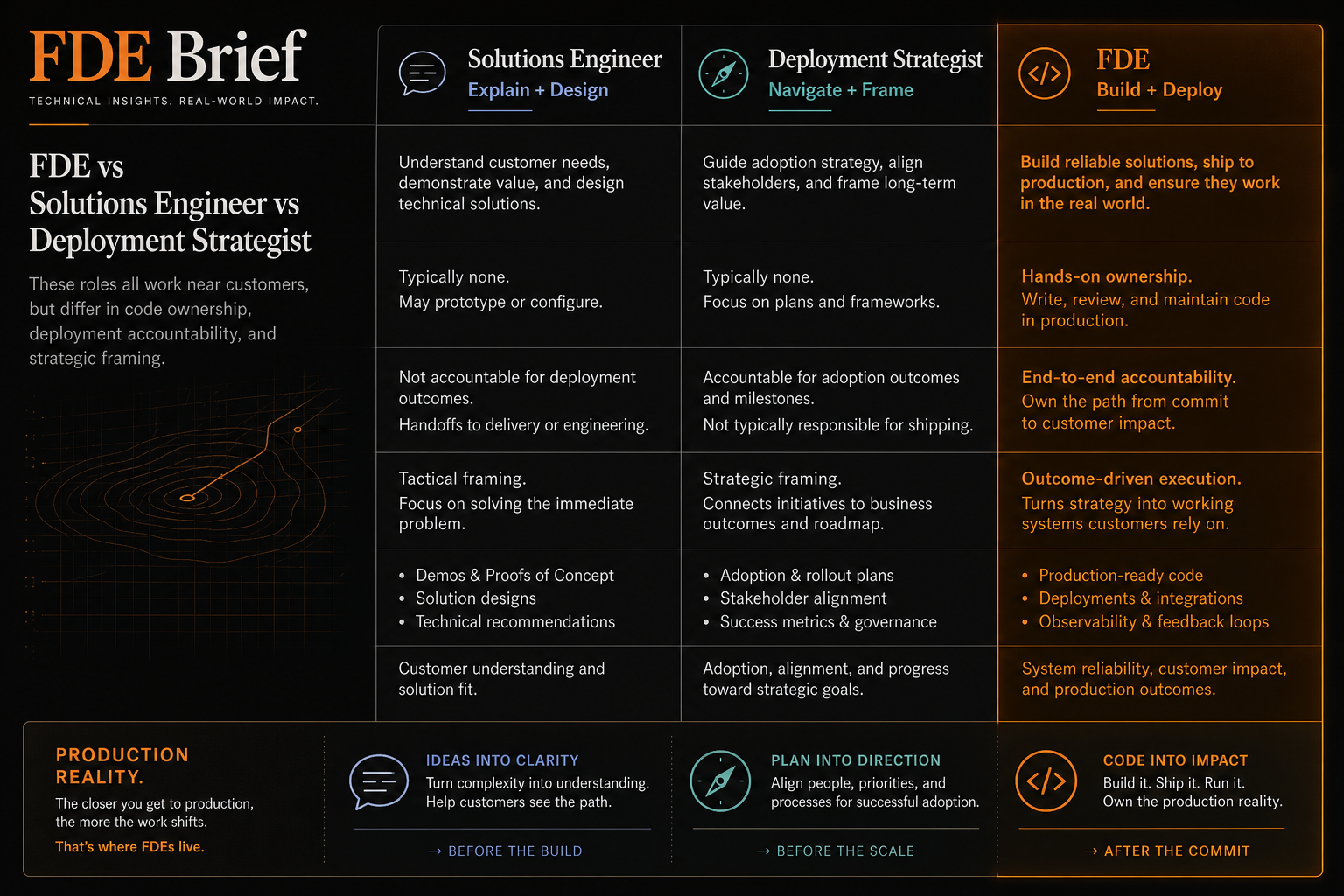
The last 30 days of repo KPI data still concentrate demand on role-definition pages. The top viewed page is FDE vs Solutions Engineer vs Deployment Strategist, while Google Search Console remains blocked by OAuth invalid_grant. That makes this query a clean next publish: it extends the highest-signal role-boundary cluster without pretending current GSC data exists.
The short version
A consultant is usually hired to diagnose, recommend, align stakeholders, and sometimes help run a transformation program with finite scope. A forward deployed engineer is usually hired to turn one of those ambiguous customer problems into deployed software, a working workflow, and reusable product learning for the company.
That does not mean consultants never build or that FDEs never advise. It means the center of gravity differs. Consultants are often judged by clarity, trust, and program movement. FDEs are judged by whether the thing actually works in production and whether the company can reuse what they learned.
Where they overlap
- Customer proximity: both sit close enough to the operator to see where the process breaks in reality.
- Ambiguity handling: both turn vague business pain into a more concrete path forward.
- Cross-functional translation: both need to explain tradeoffs across technical teams, business owners, and executives.
- Workflow judgment: both should know when a process problem is bigger than a feature request.
Where the operating contract splits
Consultant vs FDE
Consultant
Diagnose the operating problem, frame options, align stakeholders, and help the customer change behavior or process.
Forward deployed engineer
Build or adapt the system, own the deployment path, handle the integration mess, and convert field learning into product leverage.
Success signal
The customer understands the path, adopts the plan, and the engagement creates strategic clarity.
Success signal
The workflow works in production, the customer can run it, and the company can reuse the pattern.
Failure mode
Advice is smart but the hard implementation layer is still somebody else’s problem.
Failure mode
The team becomes a custom engineering shop with no product boundary or transfer plan.
Why AI teams blur these roles
AI deployment work makes the boundary harder to read because customers often need both diagnosis and build ownership at the same time. The consultant-style work is still there: workflow mapping, stakeholder alignment, change management, and business-priority framing. But the public FDE signals from OpenAI, Anthropic, Google, and Databricks keep pointing at something consultants are not usually hired to own long-term: production deployment, technical integration, evals, reliability, and reusable product patterns.
The safer read is that some companies are replacing generic post-sales or transformation language with FDE language when the role now carries enough technical ownership to justify it. Other companies are still selling consulting work with a sharper title. That is why reading the operating contract matters more than reading the title alone.
Practical rule: if the role is measured mostly by recommendations, steering committees, or transformation milestones, it is still closer to consulting. If the role is measured by deployed systems, workflow reliability, and what becomes reusable product leverage, it is closer to forward deployed engineering.
How candidates should read the job
If your strongest proof is diagnosis, executive communication, process redesign, and program leadership, consulting language may fit better. If your strongest proof is ambiguous customer ownership plus real software, integration work, and deployed outcomes, FDE is the stronger frame.
Interview shortcuts help. Ask who owns the production system after the customer says yes. Ask who writes or changes code. Ask who decides whether the local workaround should become product. Ask how the team measures success after launch. The answers usually reveal whether the company needs a consultant, an FDE, or both.
What this means for employers
If you need customer-facing technical builders, do not hide the job behind vague consulting language. You will attract people optimized for diagnosis and decks when the work actually needs software judgment under live constraints. If you need transformation leadership without deep build ownership, do not use FDE language just because it sounds more current. The wrong title creates the wrong hiring bar on both sides.
The strongest teams are explicit about the split: who owns the operating recommendation, who owns the deployed system, and how field work becomes reusable leverage instead of permanent custom work.
Sources
- The Pragmatic Engineer: The Pulse - Forward Deployed Engineering heats up again
- OpenAI: OpenAI launches the Deployment Company
- OpenAI careers: Forward Deployed Engineer (FDE) - SF
- Google careers: Forward Deployed Engineer III, Google Cloud, Applied AI
- Anthropic: Forward Deployed Engineer, Applied AI
- Databricks: AI Engineer - FDE (Forward Deployed Engineer)
The question
When your team says it needs more customer-facing technical help, does it actually need diagnosis and change management, or does it need someone to own the build-and-deploy layer after the advice phase ends?
Get the next role-boundary breakdown
Weekly field notes for engineers and operators trying to separate advisory work from real deployment ownership.