Forward deployed engineer vs customer success
AI companies are pushing more post-sales work toward builders who can redesign workflows, connect live systems, and own measurable outcomes in production. That does not mean customer success disappears. It means the boundary is moving, and weak teams blur the jobs until nobody owns the hard part.
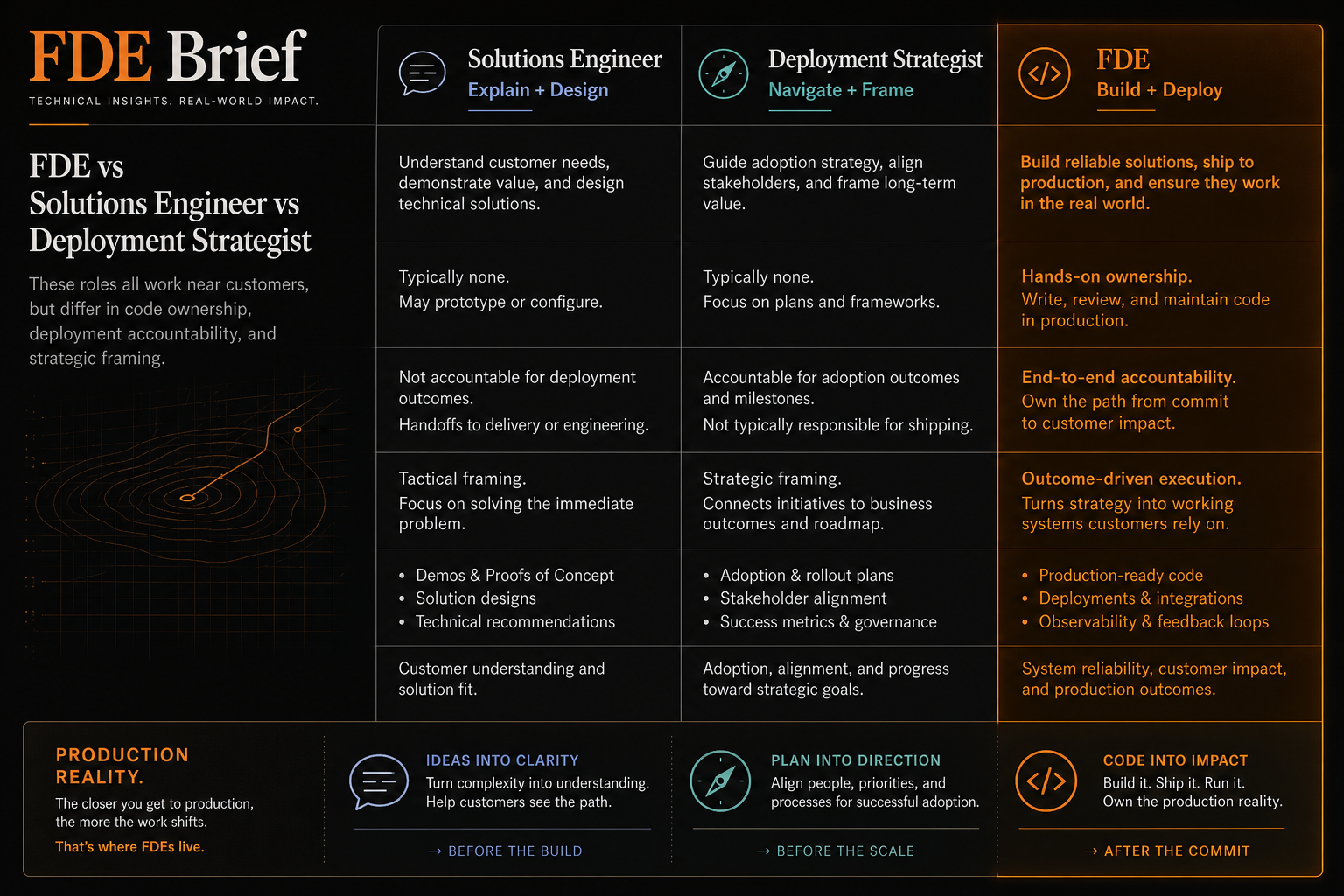
Why this page exists now
The archive demand in this repo still clusters around role-definition pages. The latest KPI report generated on June 18, 2026 shows FDE vs Solutions Engineer vs Deployment Strategist as the top archive page in the 30-day window, while Google Search Console is still blocked by OAuth invalid_grant. That means the best current signal is still role confusion plus the freshest public source set, not fresh query rows.
The newest public evidence points at a narrower confusion: AI companies increasingly want post-sales teams that can land production change, not just manage onboarding and renewals. OpenAI’s May 11, 2026 Deployment Company launch says forward deployed engineers work with operators and frontline teams to identify AI opportunities, redesign critical workflows, and turn those gains into durable systems. OpenAI’s April 8, 2026 enterprise note says companies are tired of point solutions and want an AI operating layer connected to their systems, data, permissions, and controls. That is a stronger technical bar than traditional customer-success language usually implies.
Interpretation: this is not proof that every customer-success role becomes an FDE role. It is evidence that the most technical post-sales work in AI companies is moving toward engineers who can build, deploy, and drive measurable workflow outcomes.
The short version
Use this as the fast mental model.
Customer success
Owns trust, onboarding rhythm, stakeholder communication, change support, and making sure the customer actually adopts the product in the context of their team.
Forward deployed engineer
Owns workflow redesign, system integration, production delivery, technical tradeoffs, and turning what breaks in the field into reusable product leverage.
What changed in AI companies
Traditional customer-success motions assumed the product mostly existed already. The post-sales job was to guide adoption, reduce churn risk, coordinate training, and keep the account healthy. In AI deployments, that is often not enough because the hard part is no longer just helping the customer use a tool. The hard part is connecting models to the customer’s data, controls, permissions, workflows, and failure paths.
OpenAI’s current FDE role language is direct about this. The Singapore FDE posting says the role owns discovery, technical scoping, system design, build, and production rollout, then measures success through production adoption, measurable workflow impact, and feedback that changes product and model roadmaps. OpenAI’s Technical Deployment Lead role makes the same shift from the delivery side: success is defined by delivered outcomes, adoption in critical workflows, enterprise readiness, and patterns reused across deployments, not by activity.
What customer success still owns
- Trust and relationship context: who has to believe in the rollout, who can block it, and what behavior actually changes after launch.
- Adoption support: onboarding, enablement, usage habits, and making sure the system lands inside the team’s real day-to-day behavior.
- Change-management follow-through: not just whether the feature works, but whether the customer organization absorbs it.
The best recent market reporting does not say those jobs vanish. SaaStr’s June 2026 piece on Lovable, Harvey, and AssemblyAI argues the old CS function is splitting and moving, not disappearing. Harvey still emphasizes domain expertise and change management in legal workflows. That matters here because it keeps this page honest: the human adoption layer remains real, even when the technical ownership layer gets heavier.
Where FDEs take over
- When the deployment requires net-new build work: custom integrations, workflow orchestration, evals, controls, and production hardening.
- When the customer needs a builder, not a coordinator: someone has to ship the endpoint, connect the tools, or debug the live workflow.
- When the work should teach the product team something reusable: field pain becomes a roadmap input, not just an account-management note.
SaaStr’s AssemblyAI example is useful because it makes the boundary concrete. Their reported title shift from customer success to technical account manager to forward deployed engineer did not come from a cosmetic urge to sound sharper. It came from customers wanting someone who could build and from recruiting getting better once the company named the job that way.
The safer way to read the market signal
- If the work is mostly trust, enablement, and adoption support, it is still closer to customer success.
- If the work includes building production systems in the customer environment, it is closer to forward deployed engineering.
- If the team expects one person to do both, the company needs to say that explicitly and accept the hiring bar that comes with it.
- If the role is measured by activity, QBRs, or seat utilization alone, calling it FDE is probably inaccurate.
- If the role is measured by time to value, workflow outcomes, and productized learning, the FDE label may be justified.
What this means for candidates
If your strongest proof is trust-building, executive communication, onboarding design, and change-management follow-through, customer success may still be the right lane. If your strongest proof is messy deployment ownership under real constraints, plus the judgment to turn customer-specific work into reusable leverage, your stories are closer to FDE.
The mistake is assuming these titles only differ in prestige. The more useful read is operating contract. What are you trusted to own when the customer wants the workflow to actually work, not just the relationship to stay warm?
What this means for employers
If your product still needs substantial build-and-deploy work after the sale, do not hide that inside generic customer-success language. You will attract the wrong candidates and force the right ones to discover the real job after they start. If you genuinely need both adoption leadership and build ownership, write the two-layer model clearly: who owns the customer behavior change, and who owns the production system.
The current AI market is punishing vague post-sales role design. Technical buyers can tell when they need an engineer. Candidates can tell when a title is covering for a missing operating model.
Sources
- OpenAI: OpenAI launches the OpenAI Deployment Company to help businesses build around intelligence
- OpenAI: The next phase of enterprise AI
- OpenAI careers: Forward Deployed Engineer - Singapore
- OpenAI careers: Technical Deployment Lead, Forward Deployed Engineering (FDE) - Platform
- SaaStr: Lovable, Harvey & Assembly AI: How the Fastest AI Companies Rebuilt Customer Success
The question
On your team, who owns the moment where adoption stops being a program and becomes a production workflow that has to work every day?
Get the next FDE role-boundary breakdown
Weekly field notes for engineers and operators trying to separate adoption work from real deployment ownership.