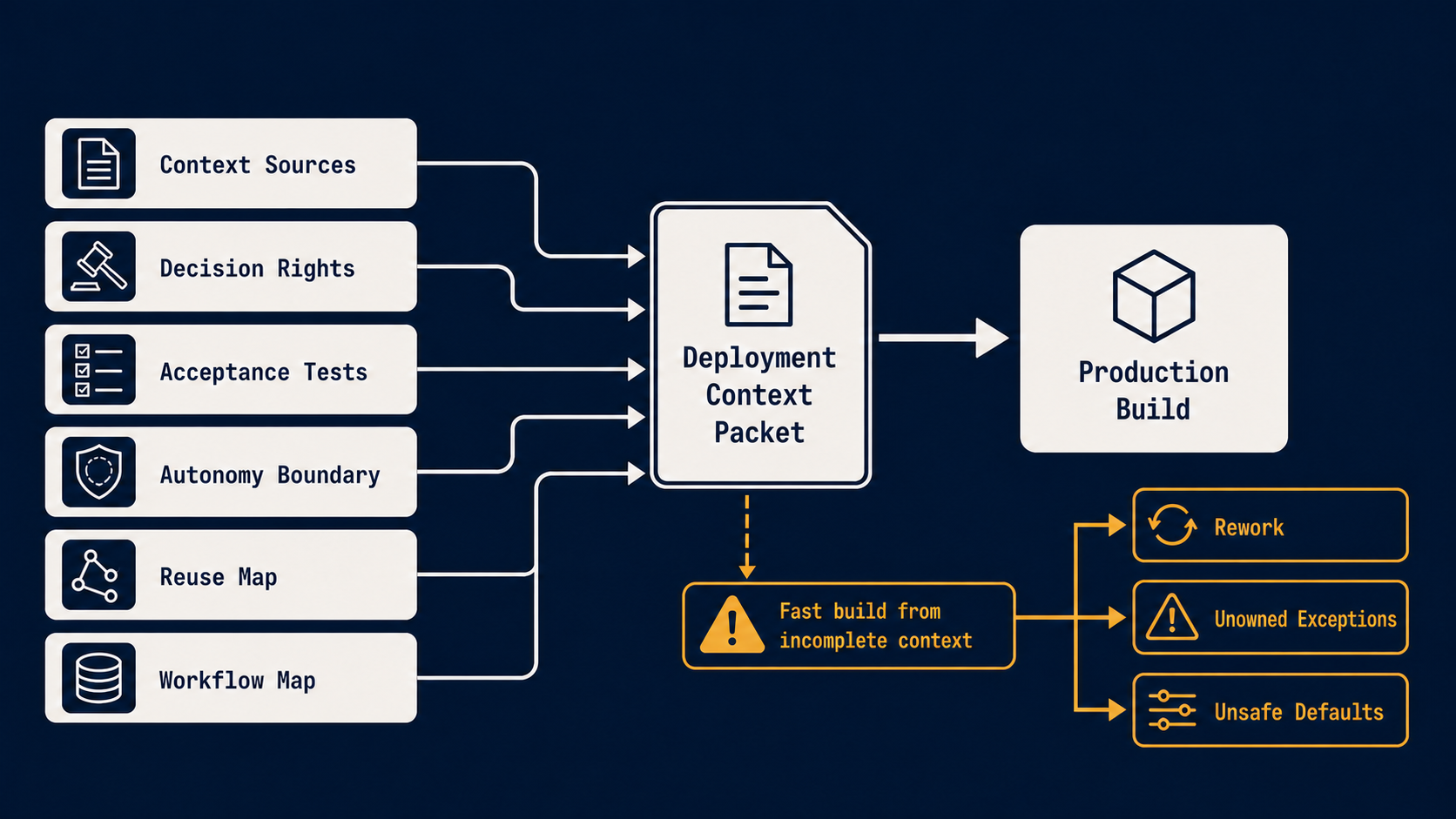
A request to “automate this workflow” is not yet a production contract. A demo can appear quickly while the consequential questions remain unanswered: which data is allowed, who owns each action, what stops automation, how behavior is evaluated, and who operates the system after handoff.
Atlassian’s May 2026 qualitative study of engineers using AI coding agents says context gathering, planning, acceptance criteria, and judgment remain significant work around implementation. Atlassian explicitly describes the sample as small and directional. Its current Principal Forward Deployed Engineer posting separately spans customer builds, enterprise integrations, production evaluation, risk, stakeholder communication, and product influence.
Fast code does not repair missing context. It hardens the assumptions already present.
The six-part deployment context packet
1. Draw the workflow as it actually runs
Name the trigger, actors, systems, handoffs, outputs, and exception paths. Separate observed behavior from the official process. If you have only stakeholder descriptions, label the workflow reported, not observed. Keep an explicit unknown lane.
2. Create a context-source ledger
List every document, table, API, ticket queue, conversation, and policy the system would rely on. For each source, record its owner, freshness, access boundary, and failure mode. The ledger should answer: where did this instruction come from, and when should the system distrust it?
3. Assign decision rights
For each consequential action, name who recommends, approves, executes, and reviews it. “The business” and “the customer” are not owners. If nobody has authority for an action, automation is premature.
4. Write acceptance tests before prompts
Translate stakeholder language into examples the system can pass or fail. Include ordinary cases, edge cases, prohibited actions, escalation triggers, latency expectations, and required audit evidence. Measure operational consequences, not only response quality.
5. Set the autonomy boundary
Decide where the system may observe, suggest, draft, act with approval, or act independently. Define the evidence required to cross each boundary, the stop conditions, and the mechanism for revoking permission.
6. Mark what should generalize
Tag each part of the solution as customer configuration, reusable deployment asset, or candidate product capability. Record the evidence needed before a one-customer pattern becomes shared infrastructure. “We used it twice” is not a complete productization test.
The readiness test
The packet is ready when a skeptical engineer can identify the unknowns, challenge the permissions, reproduce the acceptance tests, and tell who will own the system after handoff.
- Can another engineer trace important requirements to a source?
- Are unknowns visible instead of converted into silent defaults?
- Are decision rights assigned to people with actual authority?
- Do evaluations cover operational failure, not only model output?
- Can autonomy be narrowed or revoked?
- Is post-handoff ownership explicit?
- Does the reusable layer have evidence beyond one urgent account?
What this means for an FDE portfolio
“I built an agent” is weak evidence by itself. A stronger deployment dossier shows how you converted ambiguity into a production contract: a redacted workflow map, context-source ledger, decision-rights matrix, evaluation set with failure categories, autonomy and rollback boundary, and the handoff and reuse decision.
That gives an interviewer inspectable judgment: which fact changed the architecture, which unknown blocked deployment, which permission you refused to assume, and which artifact survived into the next implementation. This is an editorial inference from the published role responsibilities, not evidence of how a specific hiring panel scores candidates.
Sources and evidence boundary
The factual spine uses two first-party Atlassian sources accessed August 27, 2026: How AI is Changing Developer Workflows: Lessons From Engineers and the current Principal Forward Deployed Engineer posting. The study is qualitative, small-sample, and directional. The posting states an intended operating contract; it does not prove team practice, performance, or market-wide demand. The six-part packet is FDE Brief’s editorial synthesis. No interview, application, or private practitioner claims are used.
The FDE Brief
Get the next operator playbook.
Source-backed field notes for engineers turning customer ambiguity into production systems.
Reader question
Where did context fail?
Which missing piece caused the most expensive rework: workflow, data, decision rights, evaluation, or ownership?