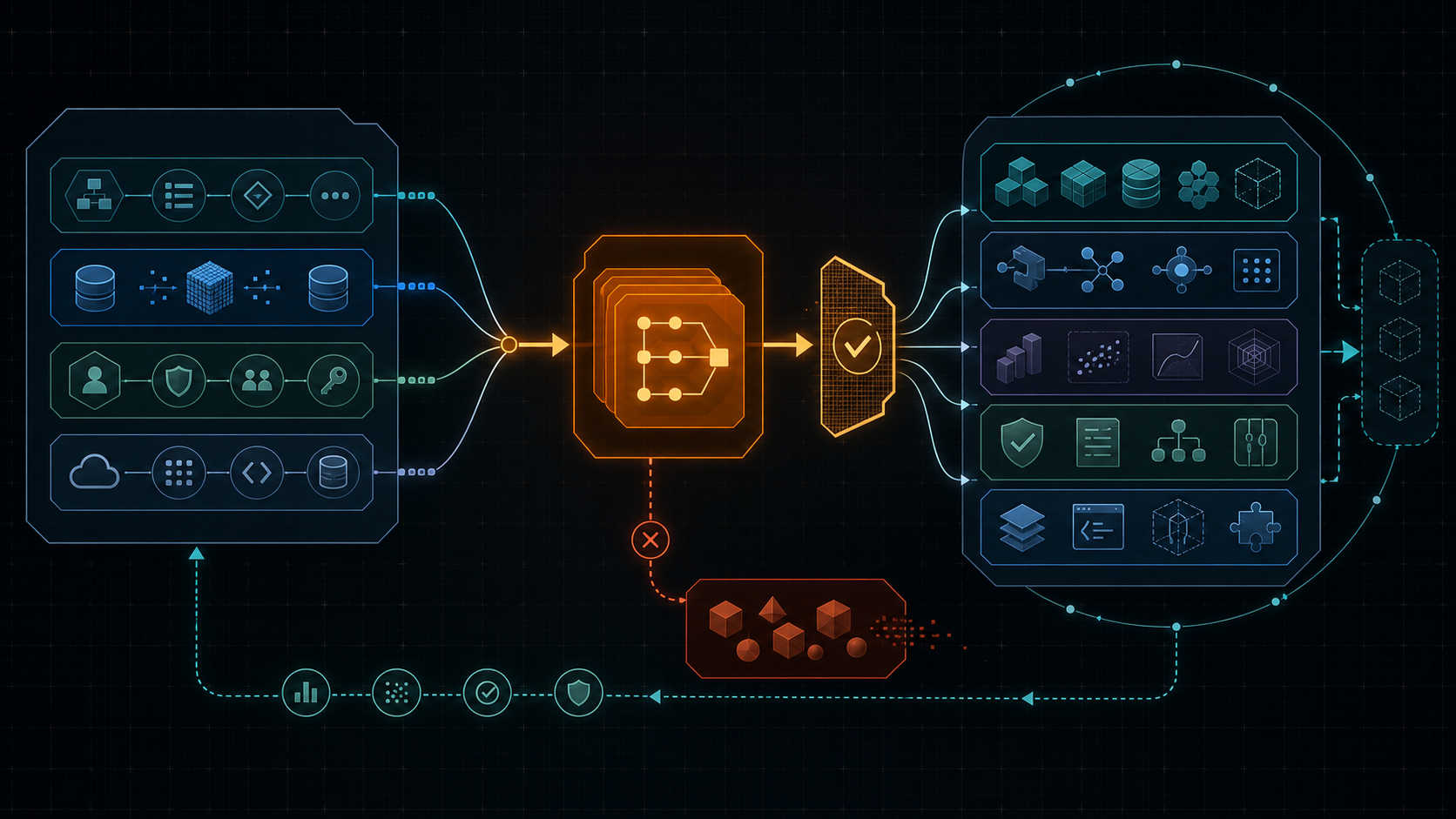
“Customer-facing engineer” is too broad to explain the newest enterprise software FDE roles. The more useful question is what durable artifact remains after a deployment.
Current employer descriptions from ServiceNow and Atlassian point to an operating contract that spans a product suite: build in a real customer environment, carry the solution into production, extract reusable code and patterns, and use field evidence to influence the platform. These descriptions are point-in-time employer evidence, not proof that every team delivers the stated outcomes.
The field build compounds only when it leaves the next deployment with a stronger starting point.
The four outputs of a product-suite FDE
1. A production reference implementation
The first output is working software inside real constraints: identity, data, legacy integrations, risk controls, evaluation, observability, and rollout. ServiceNow explicitly describes the build as a reference implementation for enterprise generative AI—not merely a demo.
2. Reusable deployment assets
The second output is the layer that future teams can reuse: libraries, prompts, scaffolds, connectors, SDKs, documentation, evaluation fixtures, and governance patterns. Reuse must be inspectable. “We learned a lot” is not an asset.
3. Product-suite feedback
Atlassian’s current Principal FDE description connects customer building to product direction and work across its suite. The practical implication is a two-way contract: platform teams provide primitives; field engineers return evidence about missing abstractions, integration friction, and production failure modes.
4. A stronger baseline for the next deployment
The final test is not whether the first project looked impressive. It is whether the next team begins with better defaults, safer components, clearer acceptance tests, and fewer repeated integration decisions.
A field-to-platform scorecard
- Customer truth: Which workflow, decision rights, data boundaries, and failure costs were discovered?
- Production truth: What shipped, how was it evaluated, and who owns it after rollout?
- Reusable artifact: Which code, evals, connectors, documentation, or governance patterns can another team adopt?
- Platform decision: What should become a primitive, a supported integration, or an explicit non-goal?
- Next-deployment delta: Which repeated steps are now faster, safer, or unnecessary—and what evidence supports that claim?
Where this role should stop
Not every customer-specific request belongs in the product. The FDE needs a boundary for one-off requirements, weakly repeated patterns, unsupported risk, and work that transfers to the customer or a partner. Product-suite influence is not permission to turn the roadmap into a list of escalations.
The clean handoff is an evidence packet: the customer problem, production constraints, implementation, evaluation results, adoption signal, repeated pattern, and proposed platform action. Product and platform teams can then accept, reject, or defer the abstraction without losing the field context.
What candidates and managers should ask
- Does the role own production implementation or mainly advise?
- Which repositories, platform teams, and roadmap forums can the FDE influence?
- What counts as a reusable artifact?
- How is customer-specific code handed off, supported, or retired?
- Can the team show that later deployments start from a better baseline?
Sources and attribution
This analysis is based on current employer-authored role definitions: ServiceNow Applied AI FDE, Atlassian Principal Forward Deployed Engineer, Atlassian AI and Machine Learning careers, and Anthropic Forward Deployed Engineer, accessed August 25, 2026. The field-to-platform scorecard is FDE Brief’s editorial synthesis. Employer descriptions state intended responsibilities; they do not independently establish adoption, team performance, or market-wide demand.
The FDE Brief
Get the next operator playbook.
Source-backed field notes for engineers turning customer deployments into durable product capability.
Reader question
Does your field work compound?
Tell us what your team successfully moved from one customer build into the shared platform—or where that loop broke.