Early-career forward deployed engineering is now visible in several employer-authored role descriptions. Wipro calls its role early career and says junior FDEs work closely with senior FDEs, solution architects, and delivery teams. Vishleshan describes guidance from a senior or manager FDE while also expecting engineers to work inside customer environments. LangChain and RingCentral currently advertise roles explicitly labeled early career or entry level.
That is evidence that some employers are defining earlier entry points. It is not evidence that the whole market is moving junior, that every listed program trains well, or that an early-career title comes with safe production boundaries.
The question is not whether a junior can do FDE work. It is whether senior production risk has been hidden inside a junior title.
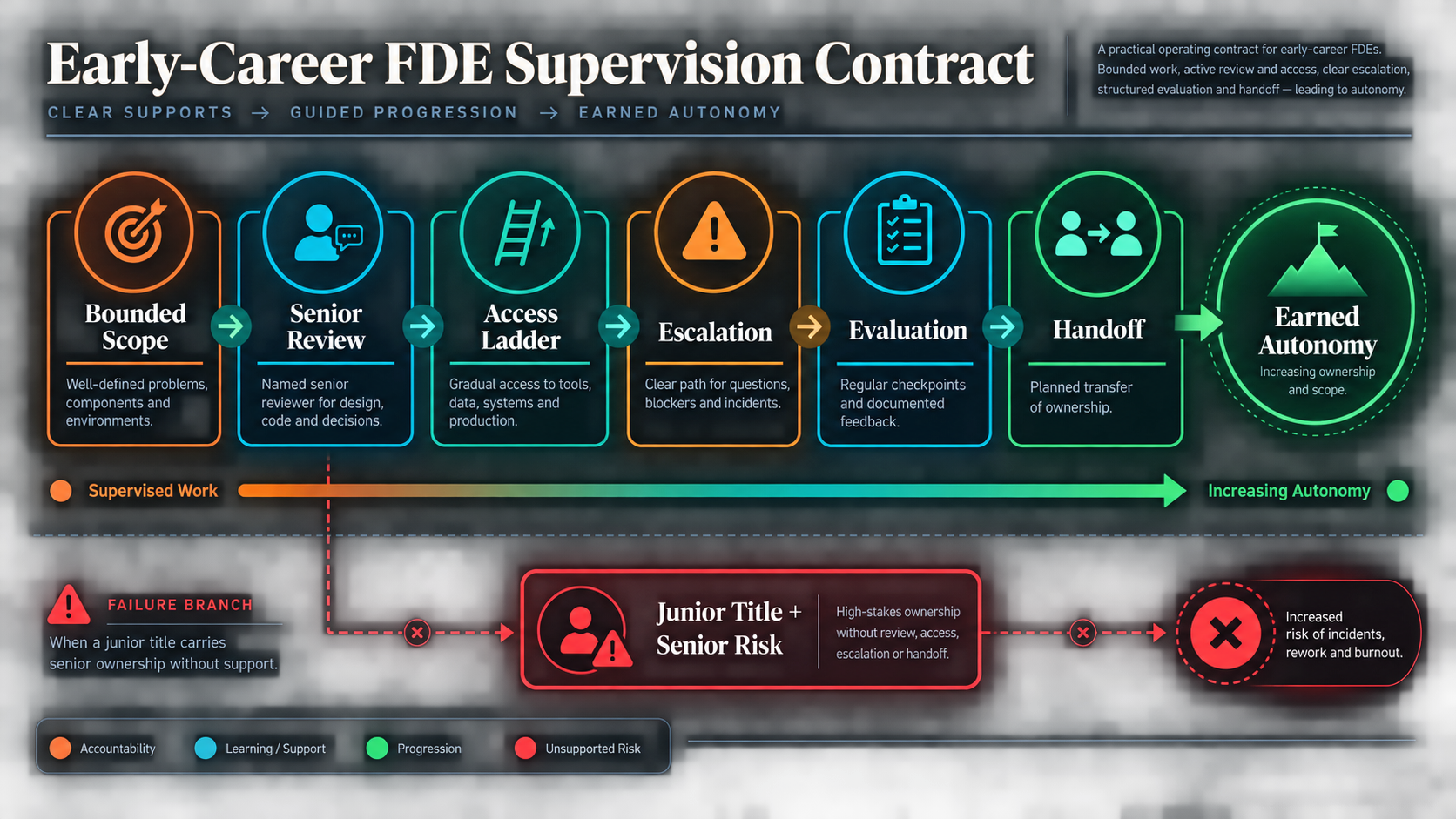
The six-part supervision contract
1. Bounded customer scope
Name which workflows, components, environments, and decisions the early-career engineer owns. “Embed with the customer” is not a boundary. A good role distinguishes supervised delivery from independent technical ownership.
2. A named senior reviewer
Specify who reviews architecture, code, evaluation design, customer commitments, and launch decisions—and how often. Access to senior people is different from a reliable review mechanism.
3. A production-access ladder
Move from observation to sandbox work, supervised changes, limited production access, and broader autonomy only after explicit evidence. Each step should name permissions, rollback authority, and the person who can revoke access.
4. An escalation path
Define when uncertainty, security concerns, customer pressure, system incidents, or scope conflict must move upward. Escalation should be a designed control, not a test of whether a junior engineer is “resourceful.”
5. An evaluation checklist
Review technical correctness, operational safety, customer communication, documentation, and learning—not just shipping speed. The checklist should expose the judgment the engineer must develop before receiving more autonomy.
6. An explicit handoff
Name what the engineer hands to customer operators, internal platform teams, or the next deployment owner. Junior work should create durable artifacts: runbooks, evaluation evidence, decision logs, and reusable patterns.
Questions to ask before accepting the role
- Who reviews my architecture and production changes?
- Which customer decisions can I make alone in the first 90 days?
- What production access do I begin with, and how does it expand?
- What situations require escalation, and who is on call?
- How is readiness for more autonomy evaluated?
- Who owns the system after deployment?
If the answers are vague, the title may still offer useful experience. But the risk is now visible: the organization may be transferring senior accountability before it has built the support system that makes early-career field work a real apprenticeship.
Sources and evidence boundary
This analysis uses employer-authored pages accessed September 1, 2026: LangChain’s Deployed Engineer, Early Career role, Wipro’s Junior Forward Deployed Engineer role, RingCentral’s early-career AI FDE role, Vishleshan’s early-career FDE role, and OpenAI’s healthcare FDE role. Job descriptions are point-in-time intended operating contracts; they do not prove training quality, actual practice, hiring velocity, or outcomes. The supervision contract is FDE Brief’s editorial synthesis.
The FDE Brief
Get the next operator playbook.
Source-backed field notes for engineers building and supervising customer-embedded systems.
Reader question
What support would you inspect?
Which supervision boundary would decide whether you accepted an early-career FDE role?