FDE seniority is a leverage ladder, not a bigger-account ladder
The useful difference between a mid-level and senior-staff forward deployed engineer is not simply account size. Seniority expands the radius of decisions improved—from one production system to the deployment portfolio and organization around it.
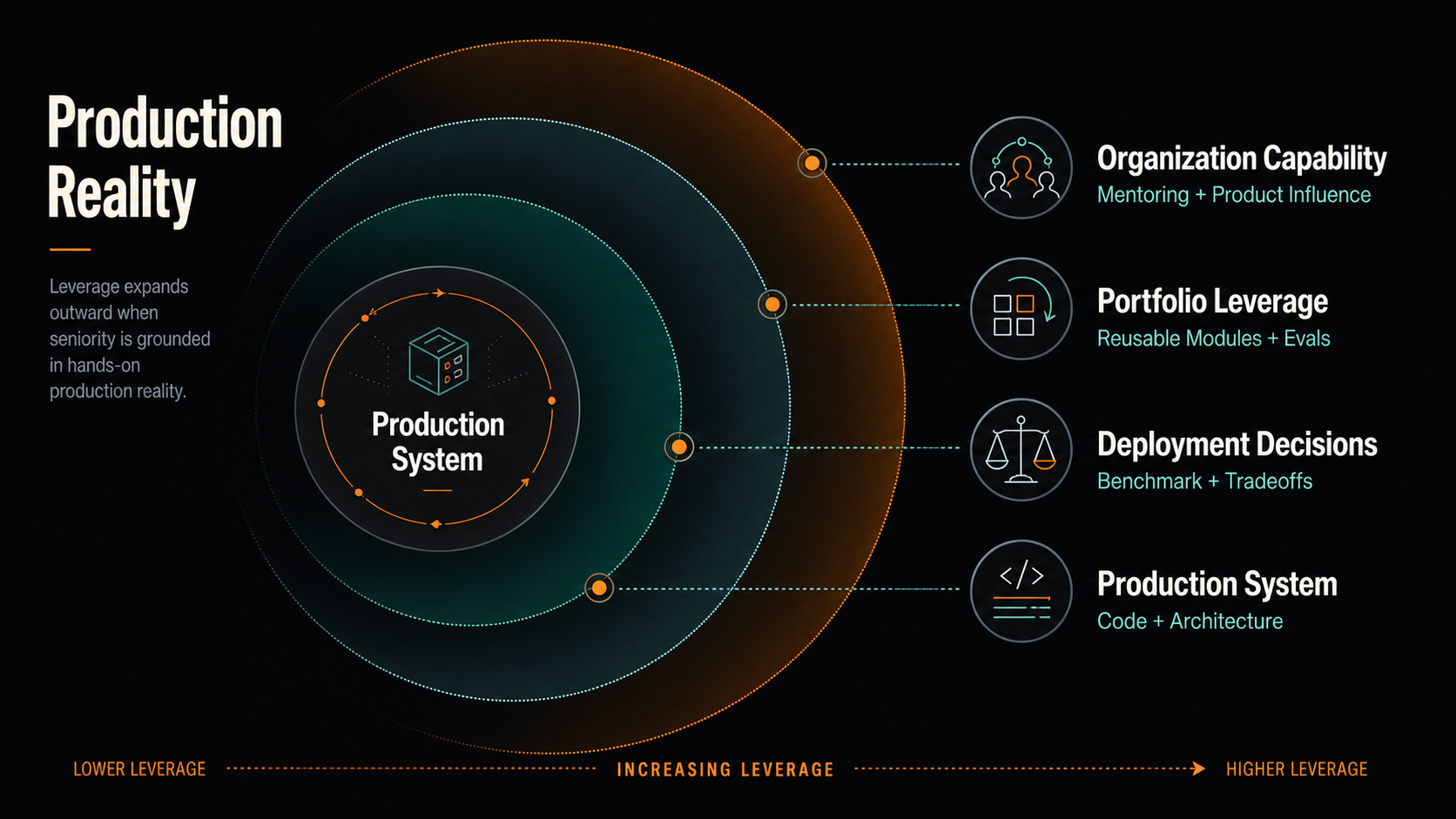
Current FDE roles show a widening radius
Google currently labels its Forward Deployed Engineer III opening as mid-level. The role owns customer discovery, production-grade AI systems, integration code, evals, observability, co-building, and the conversion of repeatable field friction into reusable modules or product requests. It also includes mentoring junior team members.
Google's Senior Staff Forward Deployed Engineer opening preserves that hands-on core, then adds executive discovery, lead-developer ownership, regional leadership, mentoring, customer-team upskilling, and influence over cross-functional strategy.
OpenAI's Platform Engineer role inside Forward Deployed Engineering shows another route to wider leverage: shared backend systems, secure integrations, observability, reusable patterns, reference architectures, and platform capabilities that serve multiple deployments.
Evidence boundary: the four-radius ladder below is an editorial synthesis of current public openings—not an official Google or OpenAI leveling framework, a universal promotion policy, or a claim about practitioner experience.
The four-radius FDE career ladder
1. Production system
Can you ship one reliable system? Own the code, architecture, integrations, security boundaries, evals, observability, and operator adoption required to move an ambiguous workflow into production.
2. Deployment decisions
Can you improve the whole engagement? Define the benchmark, find the real blocker, sequence the work, negotiate tradeoffs, and make technical and operating risk legible.
3. Portfolio leverage
Can your judgment improve several deployments? Turn repeatable lessons into modules, evaluation standards, reference architectures, platform capabilities, or product requests other teams can actually use.
4. Organization capability
Can you improve the system around the work? Mentor engineers, upskill customer teams, lead discovery with senior stakeholders, and help product and delivery teams recognize the next failure class earlier.
This does not force every FDE into one linear path. Wider leverage may come through principal deployment work, domain specialization, management, or a shared-platform role. The test is whether more important decisions become better without losing contact with production reality.
Build promotion evidence in three columns
| Outcome | Judgment | Leverage |
|---|---|---|
| What changed for the customer or system? | Which ambiguous decision did you improve? | Who can now make the next deployment better? |
| Operator workflow changed | Failure taxonomy changed the launch decision | Benchmark adopted by related deployments |
“Launched an agent workflow for a strategic account” records an outcome but hides the seniority signal. A stronger story explains the quality measure that failed, the evidence that changed the architecture or launch threshold, and the artifact that helps another team catch the same failure before production.
Customer heroics are not automatically leverage. Rescuing an account may prove commitment and technical ability. If the same failure remains invisible to the next team, the delivery system did not improve.
A six-step leverage review
- Name the production outcome. State the workflow, system behavior, or operator behavior that changed.
- Isolate the judgment call. Record what was ambiguous, which options were live, and what evidence changed the decision.
- Capture the benchmark. Define the task-success threshold, failure taxonomy, control, rollback condition, or adoption behavior that separated a demo from an acceptable system.
- Classify what became reusable. Be honest: local fix, documented pattern, module, reference architecture, shared evaluation, platform capability, product request, or coaching artifact.
- Mark the widest radius affected. A module in a repository is not portfolio leverage until another team can find, trust, and use it.
- Package one promotion story. Connect the stakes, ambiguity, decision, evidence, outcome, reusable artifact, and the next decision improved.
How teams can level the role
Do not use account revenue, years of experience, or executive exposure as the operating contract. Define levels through observable production ownership, benchmark ownership, field judgment, reusable leverage, and organizational leverage.
- Which production outcome changed?
- Which decision required the candidate's judgment?
- What benchmark became clearer?
- What did another deployment reuse?
- Who now makes a better decision because of this person's work?
- Which exception did the candidate correctly refuse to generalize?
That last question matters. Senior judgment includes knowing which customer exception should remain local rather than becoming permanent platform complexity.
Sources
- Google Cloud: Forward Deployed Engineer III, Generative AI
- Google Cloud: Senior Staff Forward Deployed Engineer, GenAI
- OpenAI: Platform Engineer, Forward Deployed Engineering
- FDE Brief seven-day KPI and Search Console reports generated 2026-07-30.
The question
What evidence is hardest to make legible in your FDE promotion case: production ownership, customer judgment, reusable leverage, or influence beyond one deployment?
Get the next FDE operating map
Weekly field notes for engineers and operators defining customer-embedded AI work.