The FDE manager is a delivery system designer
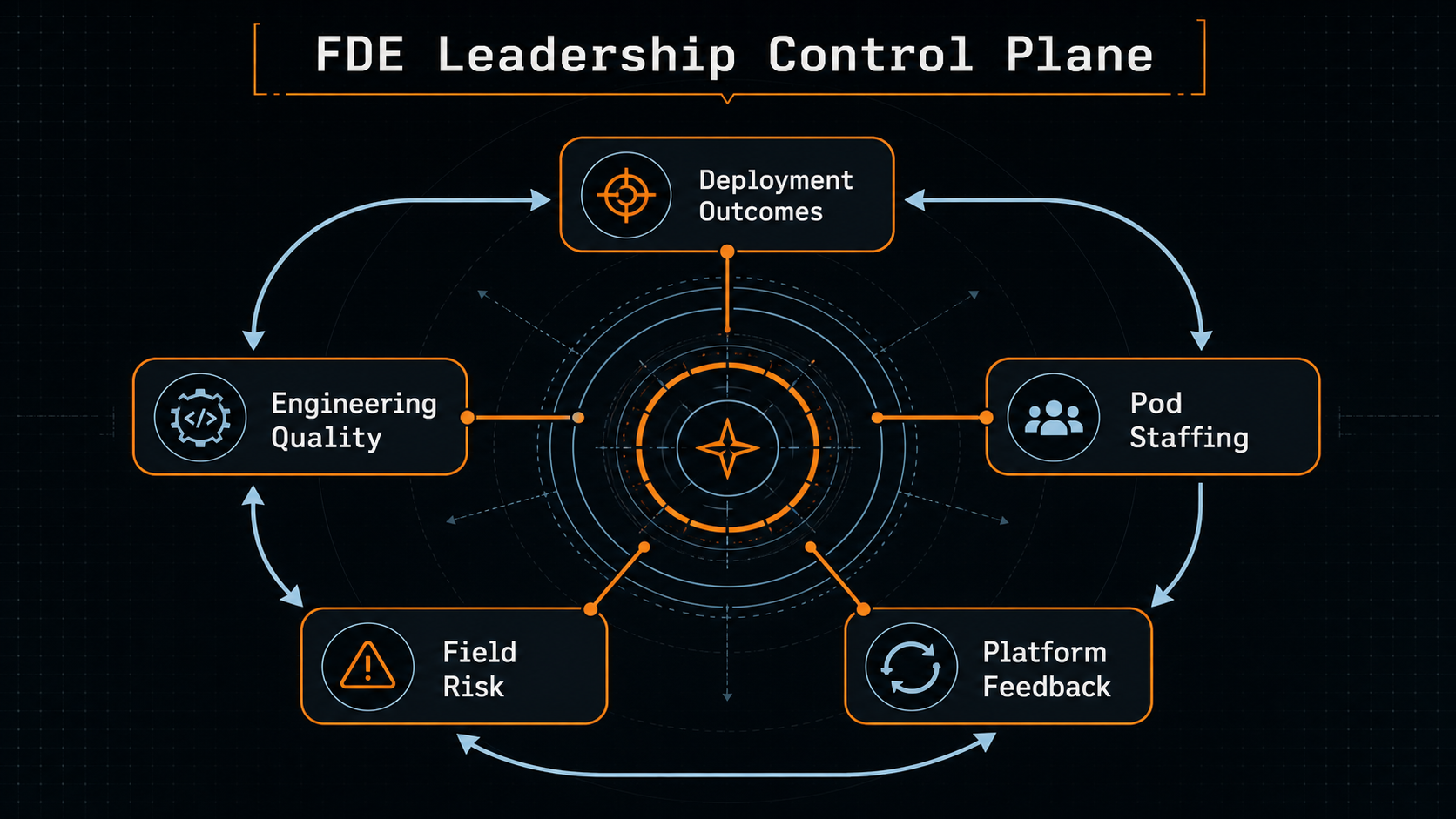
The manager of a forward deployed team does more than supervise engineers. The job is to design a system that protects technical quality, lands customer outcomes, surfaces risk early, and turns field evidence into reusable product leverage.
Why FDE management is becoming its own discipline
Current OpenAI and Google Cloud postings make a converging pattern visible. Their FDE managers are expected to set engineering standards, staff specialist teams, own delivery and business-value outcomes, coach technical leaders, detect field risk, and connect customer evidence to product priorities.
That combination is different from simply promoting the strongest customer-facing engineer. Individual FDEs can win one difficult deployment. The manager must build the conditions for several pods to ship, learn, and improve without lowering the technical bar or turning every customer exception into permanent custom work.
A converging pattern, not a universal org chart: public role definitions support these responsibility boundaries, but companies will distribute them differently. The control-plane model is FDE Brief's interpretation of the operating contract.
The five control-plane responsibilities
1. Deployment outcomes
Define what finished means. Translate customer urgency into measurable technical and business outcomes, then keep teams accountable for adoption and production value—not demo completion.
2. Engineering quality
Hold one production bar. Create standards for architecture, evals, reliability, security, observability, and maintainability even when every deployment begins with different constraints.
3. Pod staffing
Match capability to risk. Staff the right mix of customer-tagged builders, delivery owners, domain specialists, and platform engineers instead of treating all FDE capacity as interchangeable.
4. Field-risk escalation
Make weak signals travel early. Create an escalation path for technical, adoption, scope, and stakeholder risks before they become missed outcomes or hidden engineering debt.
5. Product and platform feedback
Convert evidence into leverage. Separate one-off preference from repeated constraint, preserve the deployment evidence, and route high-signal patterns into roadmap and platform bets.
The manager's weekly operating review
- Which deployment outcome moved, and what evidence proves it?
- Where is engineering quality being traded for speed, and who owns the correction?
- Which pod has a capability or decision-rights gap?
- What field risk needs escalation before the next customer checkpoint?
- Which repeated pattern is ready for platform investment—and which is still only a hypothesis?
The review should change decisions, staffing, or standards. If it only produces status, the control plane is not controlling anything.
Three management failure modes
- Hero management: the manager rescues every hard deployment, so the system never develops stronger decision rights or reusable practice.
- Portfolio management: the manager tracks milestones without owning the engineering bar or customer outcome.
- Premature platform management: field patterns are generalized before repetition and evidence justify the investment.
Sources
- OpenAI: Manager, Forward Deployed Engineering
- Google Cloud: Forward Deployed Engineering Manager, GenAI
- Google Cloud: FDE Manager, GenAI, Delta
- FDE Brief 30-day KPI, Search Console, and growth reports generated 2026-07-21.
The question
Which part of your FDE delivery system currently depends on a manager's heroics instead of an explicit operating mechanism?
Get the next FDE operating map
Weekly field notes for engineers and operators designing customer-embedded technical teams.