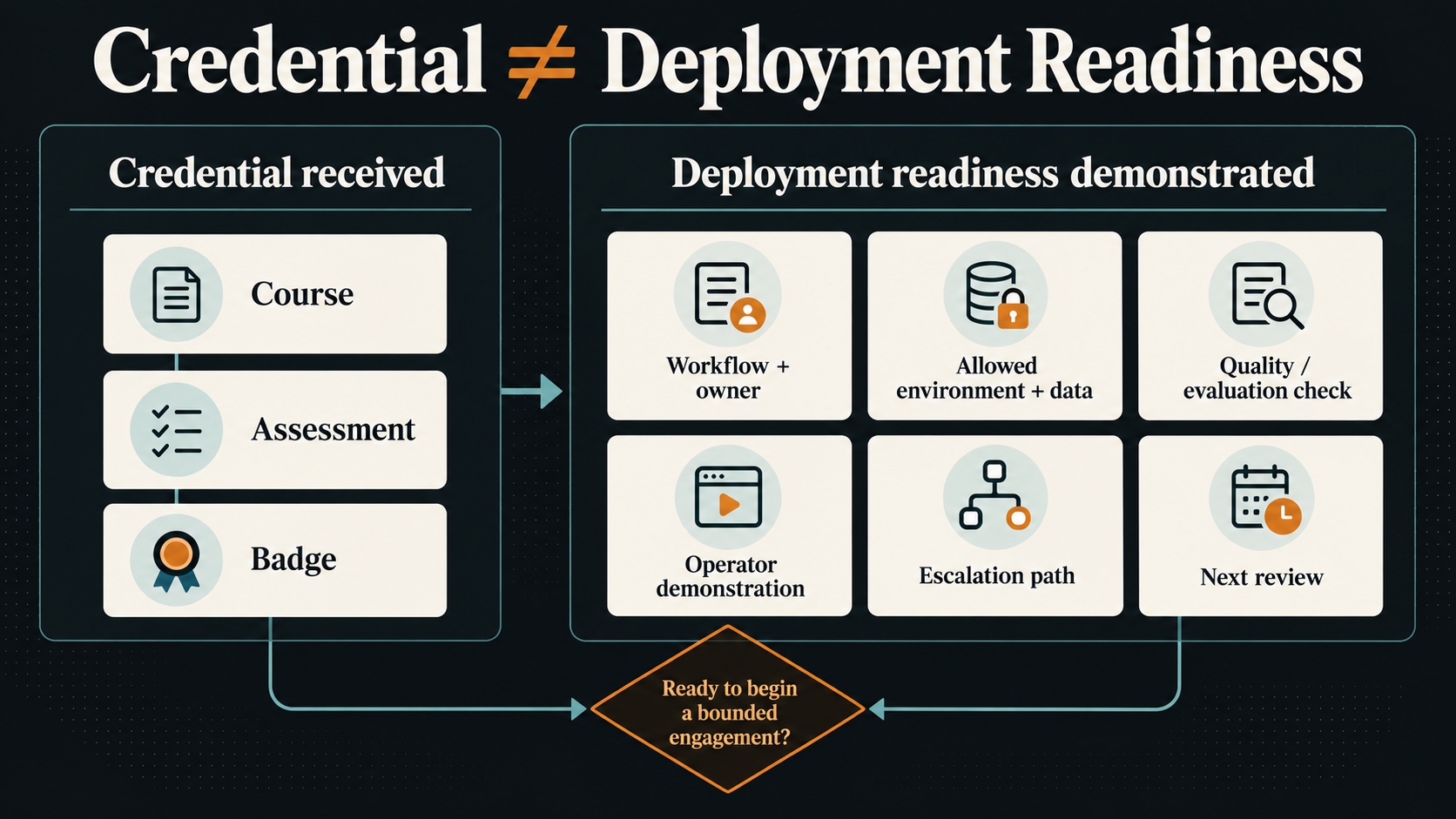
Training programs can improve a delivery team’s technical depth. They cannot, by themselves, establish that a particular customer workflow has an owner, a permitted environment, adequate evidence, or a safe route for escalation. Those are engagement-specific facts.
Proposed method: use a deployment-readiness evidence pack before a partner begins a bounded AI engagement. It is editorial synthesis, not a certification standard, procurement requirement, or approval to release a system.
Why a credential is useful—but incomplete
Anthropic’s Frontier Academy announcement, checked October 27, 2026, describes a residency with simulated enterprise deployment work, a practical assessment, and a 12-week real use case before a Frontier Deployed Engineer badge. AWS’s partner FDE pathways describe hands-on validation across grounding, orchestration, and proof rather than course completion alone. Google Public Sector separately describes an FDE academy alongside partner-led deployment and adoption funding.
These are vendor program announcements and statements of intent. They do not independently show that a credential predicts a successful customer deployment, that every participant has the same experience, or that a customer should waive its own readiness review. The useful inference is narrower: even programs that value hands-on assessment still need customer-specific evidence before work begins.
The deployment-readiness evidence pack
Swipe sideways to read all columns.
| Evidence | Question to answer | What a usable record contains |
|---|---|---|
| Workflow and owner | What narrowly named task is being improved, and who owns the customer decision? | User, bounded outcome, exclusions, and a named customer workflow owner. |
| Environment and data | Where may the work run and which data is permitted? | Approved environment, source systems, access route, data restrictions, and unresolved assumptions. |
| Quality check | What evidence is required before the next step? | Representative cases, reviewer, known limitation, and a failure or hold condition. |
| Operator demonstration | Can the receiving operator perform the bounded task and identify the stop condition? | Observed demonstration, training gap, manual fallback, and an unanswered question if one remains. |
| Escalation path | Who can pause, correct, or resolve an access, quality, or scope issue? | Named technical and workflow owners, response route, and the decision each can make. |
| Next review | When does the team decide whether to continue, narrow, or stop? | Review date, required evidence, decision owner, and the current state of the engagement. |
Worked fictional example: a support-summary pilot
Everything in this example is fictional. A delivery partner has completed an agent-training pathway and is asked to help a support organization draft internal summaries of approved tickets. The partner has a credential; the customer has not yet authorized a production integration.
Start with the bounded engagement, not the badge
- Workflow and owner: one support lead owns internal preparation for a single queue. No customer-facing messages or automated support decision is in scope.
- Environment and data: only a test tenant and an approved redacted ticket set may be used. Production credentials are absent, so the record says “hold,” not “ready.”
- Quality check: the support lead reviews a small representative set for source accuracy and unsafe omissions before any wider test.
- Operator demonstration: a support specialist must show how they reject a weak summary and use the manual workflow without the assistant.
- Escalation and review: the customer workflow owner controls scope; the partner technical lead owns a reproducible defect record. They meet after the test set to decide whether to repeat, narrow, or end the pilot.
None of these entries proves that the workflow should expand. Together, they make the first engagement inspectable enough to decide what happens next.
How to use the pack before a partner engagement
- Ask for a credential as context, not as the acceptance test. It may help explain what the team has practiced, but it does not answer the customer-specific questions.
- Require one named workflow. “Improve support with AI” is too broad to test. Start with a user, a task, a boundary, and a responsible decision-maker.
- Make permission explicit. Training environments, demo access, and production access are different states. Record which one applies.
- Define the first evidence review before implementation expands. State who reviews representative work, what limitation pauses progress, and who owns the next decision.
- Keep the customer’s authority visible. A partner can present evidence; the customer owner decides whether the workflow changes.
What this page does not replace
Use the AI implementation partner responsibility matrix when a live engagement needs a decision-rights split across customer, partner, and vendor. Use the evaluation contract for pre-release evidence and authority. Use the engagement exit test when deciding whether the customer can own the result. This page comes earlier: it asks whether the team has enough customer-specific evidence to begin a narrowly bounded engagement at all.
The FDE Brief
Get practical delivery playbooks.
Get FDE notes on evidence, deployment judgment, and customer-facing technical work.
Reader question
What proof would you ask for first?
Before a partner starts an AI engagement, which customer-specific evidence would you require?