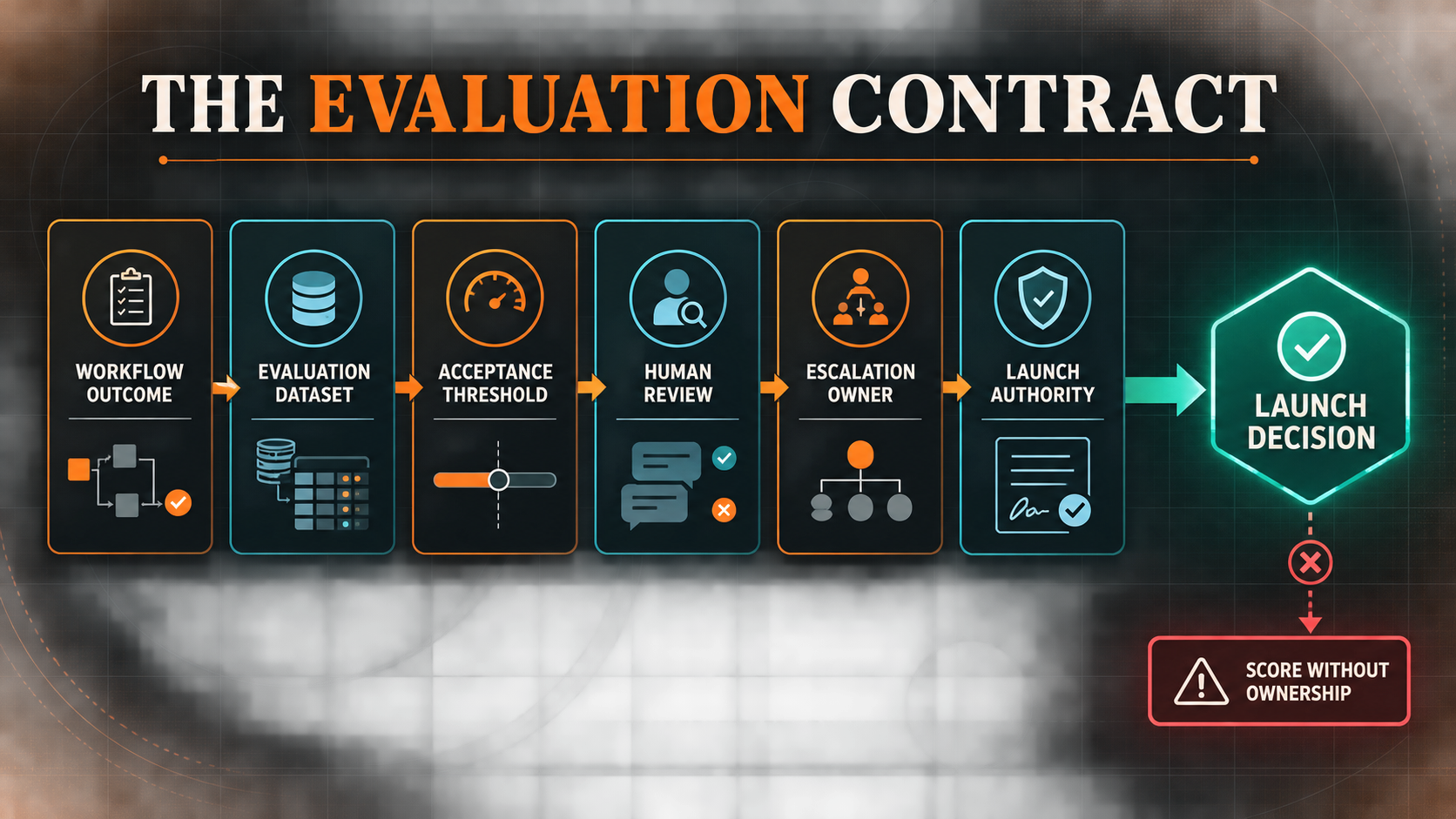
AI deployment teams often discuss evaluation as if the score itself decides whether a system is ready. It does not. A score becomes operational only when the customer and deployment team have agreed what outcome matters, what evidence counts, which threshold is acceptable, where humans intervene, who owns a miss, and who can authorize launch.
OpenAI’s current healthcare FDE role makes this decision work explicit. The posting connects customer-specific benchmarks and acceptance criteria to validation evidence, human-review workflows, escalation paths, launch criteria, production readiness, and handoff. LangChain’s current professional-services role separately places evaluation design, trace analysis, testing, and production reliability inside embedded delivery.
An eval score is not a launch decision until someone owns the threshold, exception path, and response to a miss.
The six-field evaluation contract
1. Workflow outcome
Name the user or business decision the system must improve. Model quality is not a substitute for workflow impact. Record the owner, measurement window, and failure cost in the language the operator uses.
2. Evaluation dataset
Fix the cases, edge conditions, provenance, refresh rule, and exclusions. Separate representative traffic from deliberately difficult cases. A benchmark that can silently change cannot anchor acceptance.
3. Acceptance threshold
Define the passing rule and the slices that must pass independently. State whether the threshold blocks launch, limits rollout, or triggers investigation. An aggregate score can hide the failure that matters most.
4. Human review
Specify which outputs require review, who reviews them, what evidence they see, and what happens when reviewers disagree. Human review is an operating lane with capacity and escalation needs—not a generic safeguard.
5. Escalation owner
Name the person who investigates a miss, pauses rollout, changes scope, or accepts a documented exception. Include the response time and the evidence needed to resume.
6. Launch authority
Identify who can say yes, no, or not yet—and what evidence that decision must cite. Keep technical readiness distinct from commercial urgency and executive preference.
Test the contract against three states
- Pass: Which evidence is preserved, who signs off, and what rollout boundary opens?
- Miss: Who owns diagnosis, which change is allowed, and what must be re-evaluated?
- Uncertain: Who can require more evidence, narrow the workflow, or hold the launch?
If the team cannot explain who acts in all three states, the evaluation system is measuring without governing. The same check belongs in discovery, before implementation choices and customer deadlines make the answer politically expensive.
What the contract does—and does not—prove
An evaluation contract does not guarantee a safe, useful, or successful deployment. It makes the decision legible enough to test, challenge, audit, and hand off. That matters because a production AI system is not only a model. It is a workflow with operators, exceptions, permissions, downstream actions, and someone accountable for the result.
Sources and evidence boundary
This analysis uses employer-authored pages accessed September 3, 2026: OpenAI’s healthcare FDE role and LangChain’s Deployed Engineer, Professional Services role. OpenAI explicitly describes evaluations, validation evidence, human review, escalation, acceptance thresholds, launch criteria, and handoff. LangChain’s role is included as a separate employer definition of embedded evaluation and production-reliability work. These postings do not prove actual practice, customer outcomes, or a market-wide standard. The six-field contract is editorial synthesis.
The FDE Brief
Get the next operator playbook.
Source-backed field notes for engineers making customer-embedded systems production-ready.
Reader question
Which field is still implicit?
Where does your current evaluation process rely on an unstated owner or decision rule?