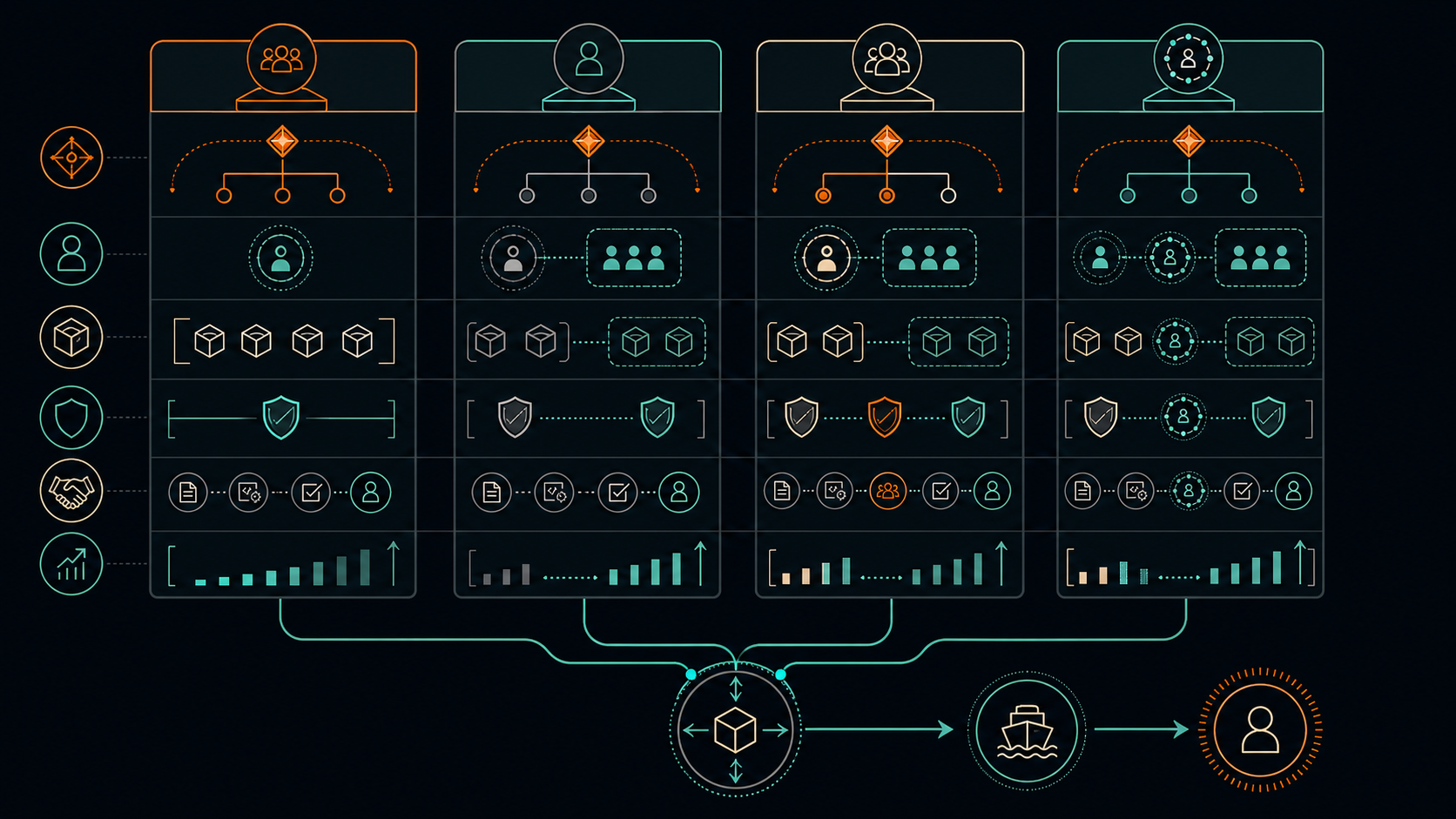
Forward deployed engineering is spreading beyond a single job description. Current announcements from OpenAI, AWS, and IBM describe different systems for putting deployment capacity close to real workflows: a vendor-controlled deployment company, partner-owned engineering teams, and human-plus-agent delivery pods.
These are vendor-authored proposals, not independent proof that one model wins. Their value is that they make the underlying design choice visible.
The operating-model question is who keeps the decision rights, who owns what gets reused, and whether the customer gains capability after the engagement.
Four operating models
1. In-house FDE team
The customer employs the team, keeps deployment decisions close to its operators, and owns the resulting code and institutional learning. This creates the strongest direct control, but the company must recruit, manage, and generalize the work itself.
2. Vendor-owned embedded team
OpenAI describes a majority-owned deployment company whose FDEs work inside organizations to diagnose opportunities and build production systems against customer data, controls, and workflows. The customer gains proximity to the vendor's platform trajectory; the key contract is how capability, operations, and decision rights transfer over time.
3. Partner-led FDE unit
AWS describes ring-fenced, credentialed teams inside consulting partners. Its stated model lets the partner retain a reusable delivery harness while the customer owns the business outcome. This can combine domain reach with a shared production bar, but governance and IP boundaries need to be explicit.
4. Human-plus-agent delivery pod
IBM's Forward Deployed Unit is a pod rather than an individual role: domain specialists, architects, engineers, and specialized agents work as one delivery system. The useful distinction is continuous operation and capability transfer, not IBM's promotional productivity claims.
A six-question selection test
- Decision rights: Who chooses the workflow, architecture, acceptable risk, and release gate?
- Customer proximity: Who works with frontline operators after the diagnostic ends?
- Reusable IP: Who owns connectors, evals, agent tooling, and patterns created during delivery?
- Governance: Who remains accountable for identity, permissions, auditability, and rollback?
- Handoff: What must be operable without the embedded team?
- Capability transfer: Does each engagement leave the customer better able to deploy the next workflow?
The cheapest-looking model can be expensive if it creates permanent dependency. The most controlled model can be slow if it cannot attract the required talent. Decide which capabilities are strategic enough to own, which can be rented, and what evidence triggers a transfer from external delivery to internal operation.
Sources
- OpenAI — OpenAI Deployment Company
- AWS — Forward Deployed Engineering for Partners
- IBM — Forward Deployed Units
- OpenAI — Frontier enterprise program
Sources checked August 18, 2026. Vendor scale, speed, and productivity claims are intentionally not treated as independently verified outcomes.
The FDE Brief
Get the next operator playbook.
Source-backed field notes for engineers and teams turning AI prototypes into trusted production workflows.
Reader question
Which deployment model does your team use?
Tell us who owns reusable IP and the handoff after launch.