The human FDE after the AI FDE
Palantir now ships an AI FDE that can change governed platform systems. The useful question is not whether agents can do FDE work. It is which work can be bounded for agent execution—and which outcomes still need a named human owner.
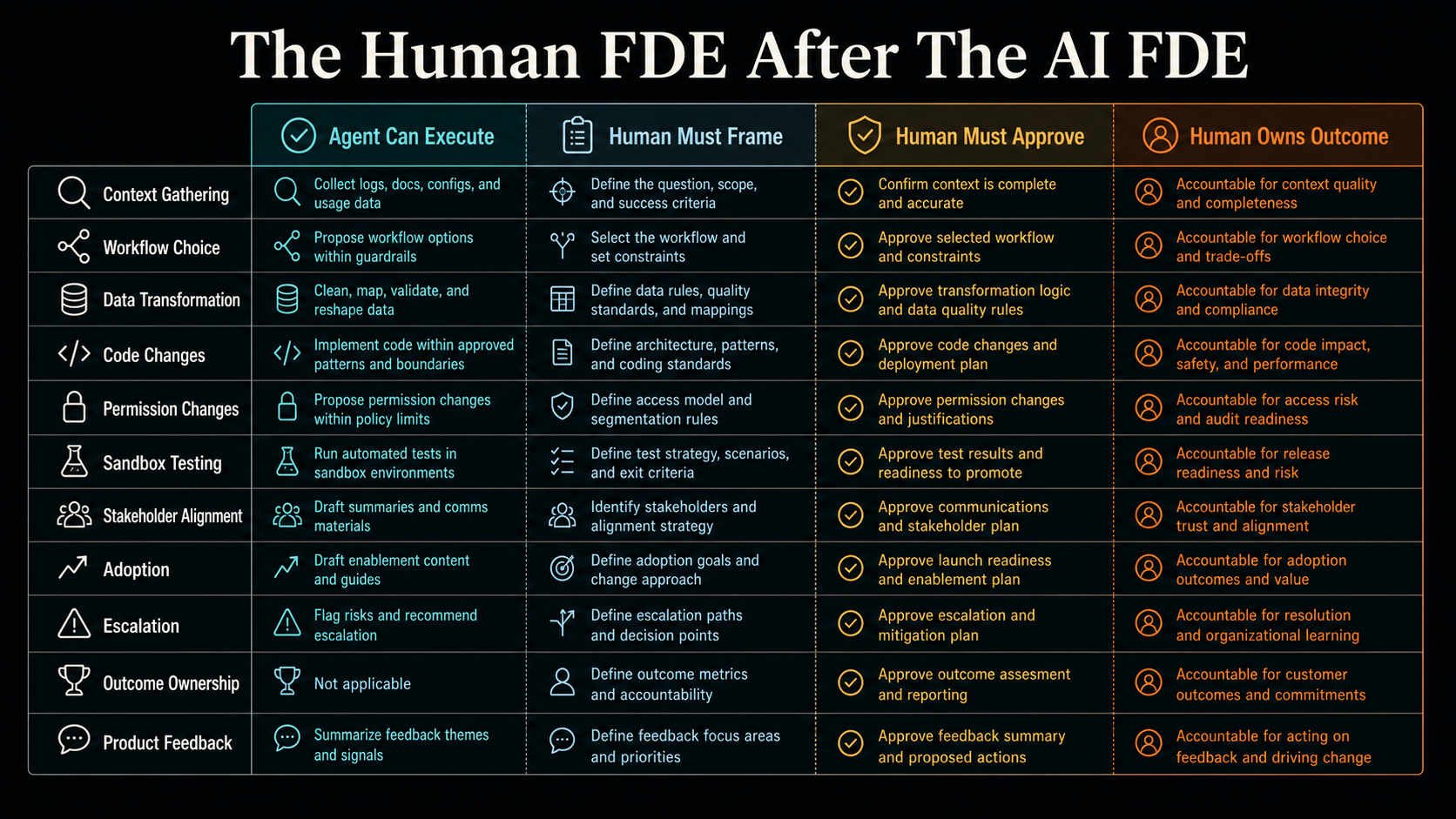
What Palantir's AI FDE can actually do
Palantir made AI FDE generally available on March 12, 2026. Its documentation describes meaningful platform work: building or modifying data pipelines, editing ontology objects and actions, writing functions, building React applications connected to Foundry data, investigating platform state, and auditing permissions and data protection.
The operating controls matter as much as the task list. Palantir says users control context, existing permissions remain in force, tool use stays visible, and changes can be tested in a sandbox before merge. This is not a generic claim that an agent can walk into any enterprise and deploy autonomously. It is a governed execution system inside Foundry.
What the human FDE still owns
OpenAI's current human FDE description covers a wider operating contract: discovery, technical scoping, system design, build, production rollout, adoption, workflow impact, delivery tradeoffs, and field feedback that changes product and model roadmaps.
Interpretation: AI FDE is best read as a task-boundary signal, not a workforce-replacement forecast. Agents can compress platform manipulation once the environment is bounded. Humans remain accountable for creating and governing that boundary.
Good agent candidates
Data transformations, code changes, platform-object edits, repeatable investigation, automated tests, draft documentation, and other work with explicit context, constrained tools, testable output, and a rollback path.
Human-owned boundary
Workflow choice, competing stakeholder needs, risk acceptance, permission expansion, adoption, escalation, delivery commitments, outcome measurement, and deciding what the field should teach the product.
A delegation test for live deployments
- Is the context explicit? The agent should not have to invent the customer workflow, authority, or success criteria.
- Are tools and permissions bounded? Name what it may inspect, change, and never touch.
- Is the output testable? Define checks that distinguish a plausible change from a correct one.
- Is the action reversible? Use branches, sandboxes, approvals, and a known rollback path.
- Is escalation defined? Conflicting requirements, new permissions, security ambiguity, failed tests, and adoption failure should return control to a human.
- Is one human accountable for the outcome? Successful code is not the same as a successful deployment.
How the FDE career signal changes
"I use agents to code faster" is becoming table stakes. A stronger proof of work shows that you can design an agent-assisted deployment system: map the workflow, package context, bound permissions, build evals, review traces, define approval gates, handle escalation, measure adoption, and turn repeated work into reusable tooling.
For a portfolio project, make the agent one worker inside the deployment—not the whole product. Show the decisions you delegated, the decisions you refused to delegate, and the evidence that made the boundary safe.
What FDE leaders should standardize
- Common context packages and approved tool adapters.
- Permission templates and change-approval rules.
- Evaluation suites, traces, incident patterns, and rollback workflows.
- Clear human ownership for adoption, risk, and customer outcomes.
- A path for repeated field work to become a shared skill, tool, or platform primitive.
The objective is not maximum automation. It is a faster, safer route to a durable customer outcome.
Sources and evidence limits
- Palantir: March 2026 announcements, including AI FDE general availability
- Palantir open positions
- OpenAI: Forward Deployed Engineer, Seattle
“The human FDE after the AI FDE” is an editorial framing. Palantir does not present AI FDE as a universal replacement for human deployment teams, and a live human job posting does not prove future hiring levels. The responsibility map is a practical interpretation of current product documentation and role definitions.
The question
Which part of your forward-deployment work would you delegate to an agent today—and which decision would you insist stays human-owned?
Get the next FDE operating playbook
Weekly field notes on customer-embedded engineering, agent-assisted deployment, and production ownership.