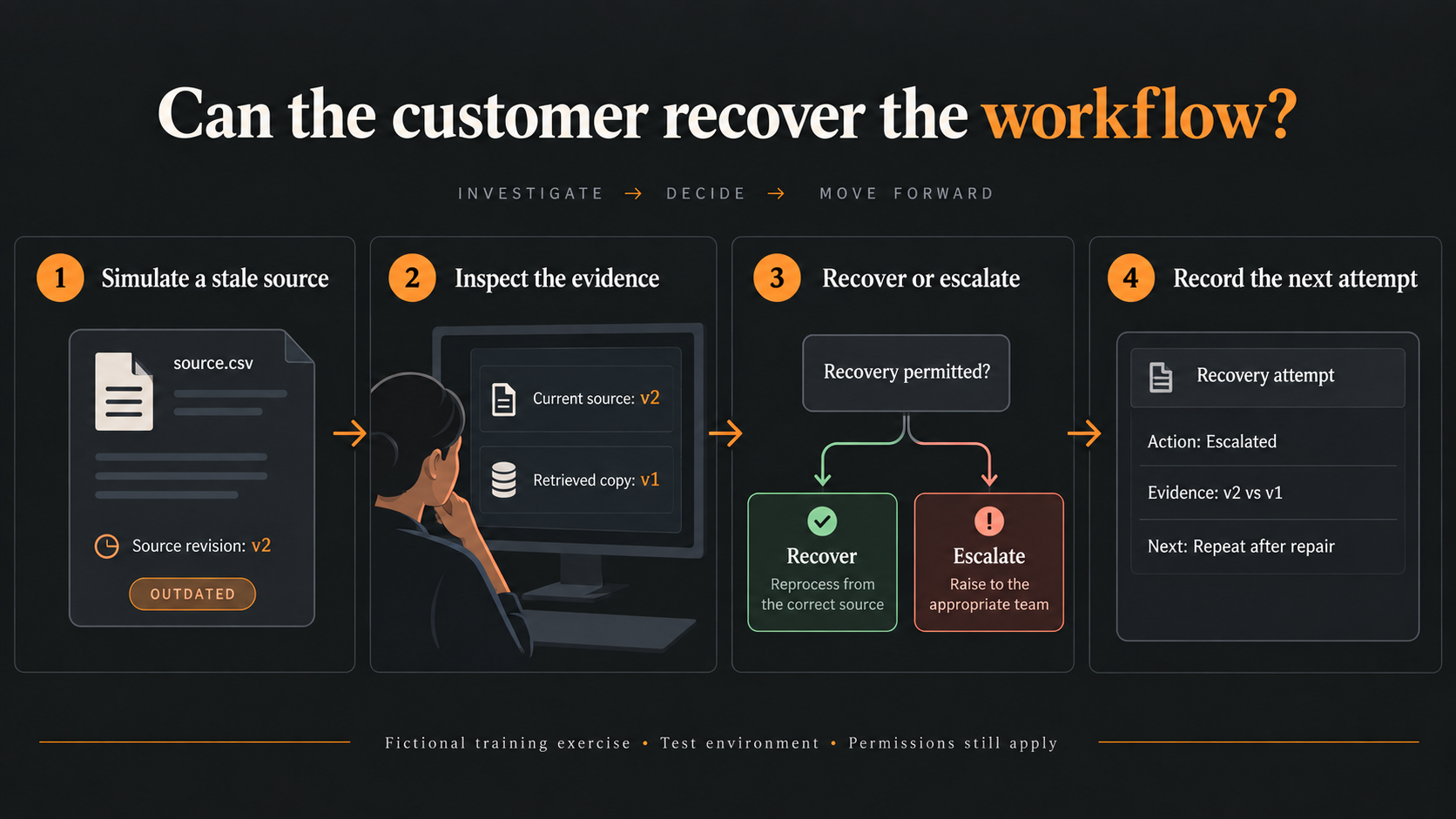
AI deployment customer training should let a customer practice an operational task, explain the evidence behind a decision, and identify when to escalate. Start with one controlled recovery exercise and record what the operator actually does. Attendance alone cannot answer whether someone can handle an unfamiliar failure.
Proposed method: the capability rehearsal below is FDE Brief’s editorial framework. It is not a vendor certification, production approval, or a measured claim that training improves reliability.
Why customer capability belongs in deployment work
OpenAI’s AI Deployment Manager — Builder posting describes technical learning experiences, customer workshops, and reusable training resources. Anthropic’s Applied AI Engineer, Enterprise Tech posting includes hands-on workshops and code reviews with customer engineers.
These employer-authored pages were checked September 29, 2026. They establish stated responsibilities at those companies, not successful training outcomes or a universal FDE job description. Our interpretation is that a deployment team should specify what the customer needs to learn as carefully as what the engineer needs to build.
Choose a task the customer will encounter
Pick a bounded task: investigating an outdated answer, recognizing a missing document, or assembling an escalation packet. Define the observable result and who is authorized to perform each action. “Understands the AI system” is too broad to observe; “locates the retrieved source and explains why its version is stale” is a usable exercise.
Use an approved test environment with synthetic or approved training data. Confirm that the exercise cannot send customer messages, modify production records, or trigger real downstream actions. The training plan does not grant access or override the customer’s permission and change processes.
A fictional stale-source exercise
Everything in this example is fictional. A support assistant drafts answers from a test knowledge base. One troubleshooting document has been updated, but the test retrieval index still contains its previous version. The trainer prepares a question whose answer depends on that revision and verifies the expected evidence before the session.
1. Present the symptom
The customer operator receives an answer containing a withdrawn troubleshooting step. The trainer asks: “Would you use this answer, and what would you check first?” The operator can use the runbook and approved diagnostic tools. Record any hints the trainer provides.
2. Ask for evidence
The operator follows the citation, compares the source revision with the retrieved version, and checks the ingestion status. In this example, the current source is newer than the indexed copy. That supports a stale-index diagnosis for this case; it does not establish that every incorrect answer has the same cause.
3. Observe the decision boundary
The operator has read access but cannot restart ingestion. They flag the draft as unsuitable for use and send an escalation to the designated ingestion owner with the source identifier, revision evidence, and test question. Escalating within their authority is a valid completion of the task. Guessing at an administrative action is not required to demonstrate capability.
4. Check the result and teach it back
The authorized trainer repairs the test index through the approved test procedure. The operator reruns the question, checks the citation and answer against the updated source, and explains what changed. A matching answer closes this exercise; it is not proof of overall system quality.
Keep an observed-attempt record
Use the following fields in the customer’s existing training or delivery record. Keep observations separate from the trainer’s interpretation.
Task and conditions
Task: recognize a stale retrieved source and route recovery. Environment: isolated training workspace. Operator: designated customer support lead. Allowed actions: inspect citations and diagnostic status, mark the test draft unusable, escalate. Completion evidence: revision comparison plus an actionable escalation.
Observed attempt
The operator checked the source revision without help, then needed one prompt to locate ingestion status. They correctly avoided restarting a job outside their access and included the document identifier in the escalation. These are fictional observations, not a scored customer result.
Remaining gap and follow-up
The operator could not find ingestion status from the runbook. The FDE owns adding the diagnostic link; the customer lead owns scheduling another attempt with a different stale document. Record the next attempt’s date and evidence when it happens. Until then, label this task “completed with a prompt,” not independently demonstrated.
A reusable rehearsal template
- Task: What real operational decision should the customer practice?
- Conditions and authority: Which environment, data, tools, and actions are permitted?
- Expected evidence: What observations distinguish a justified decision from a guess?
- Attempt: What did the operator do, and which prompts or assistance were needed?
- Decision: Did they recover within authority, escalate correctly, or leave an unresolved gap?
- Follow-up: Who will change the training material or system, and what will the next attempt test?
Agree on task-specific completion criteria before the attempt. Avoid turning the exercise into a surprise test: explain what is being practiced and which resources are available. A runbook-assisted task can be a valid operational skill. Record the assistance level so another reviewer can understand the evidence.
Use the gap to improve the deployment
If several operators cannot locate the same evidence, inspect the diagnostic interface and runbook before assigning more training. If they know what to do but lack access, resolve ownership and permissions through the normal process. If they follow the procedure and still get the wrong result, investigate the system rather than treating it as a learning failure.
Keep system acceptance, incident ownership, and customer learning as connected but distinct records. The evaluation contract defines launch evidence; the incident ownership card assigns response authority; the engagement exit test addresses transfer. This rehearsal supplies an observed attempt at one customer task. It does not replace those broader decisions.
For an FDE portfolio or team exercise, present a fictional symptom, the evidence available to the operator, and an annotated attempt record. Show how one failed step changes the runbook or interface. That demonstrates your approach without claiming an unmeasured reduction in incidents or support work.
The FDE Brief
Get practical customer enablement playbooks.
Get FDE field notes on customer learning, recovery exercises, and operational handover.
Reader question
Which task still needs your help?
Which task still brings the customer back to you after handoff?