Why incident ownership belongs in FDE work
AWS's current US Government FDE posting assigns production incident troubleshooting and root-cause resolution across models, distributed systems, and application services to the role. That is a concrete employer-defined responsibility, not evidence that every FDE is an on-call engineer.
Google's SRE incident-management chapter separates command, operations, communication, and planning. It recommends a living incident record and explicit, acknowledged handoffs. This is established operational guidance, not a new FDE market signal.
Both sources were checked September 10, 2026. Together they support a narrow editorial question: how should a customer-embedded engineer participate when several organizations control different parts of the failed workflow?
Interpretation
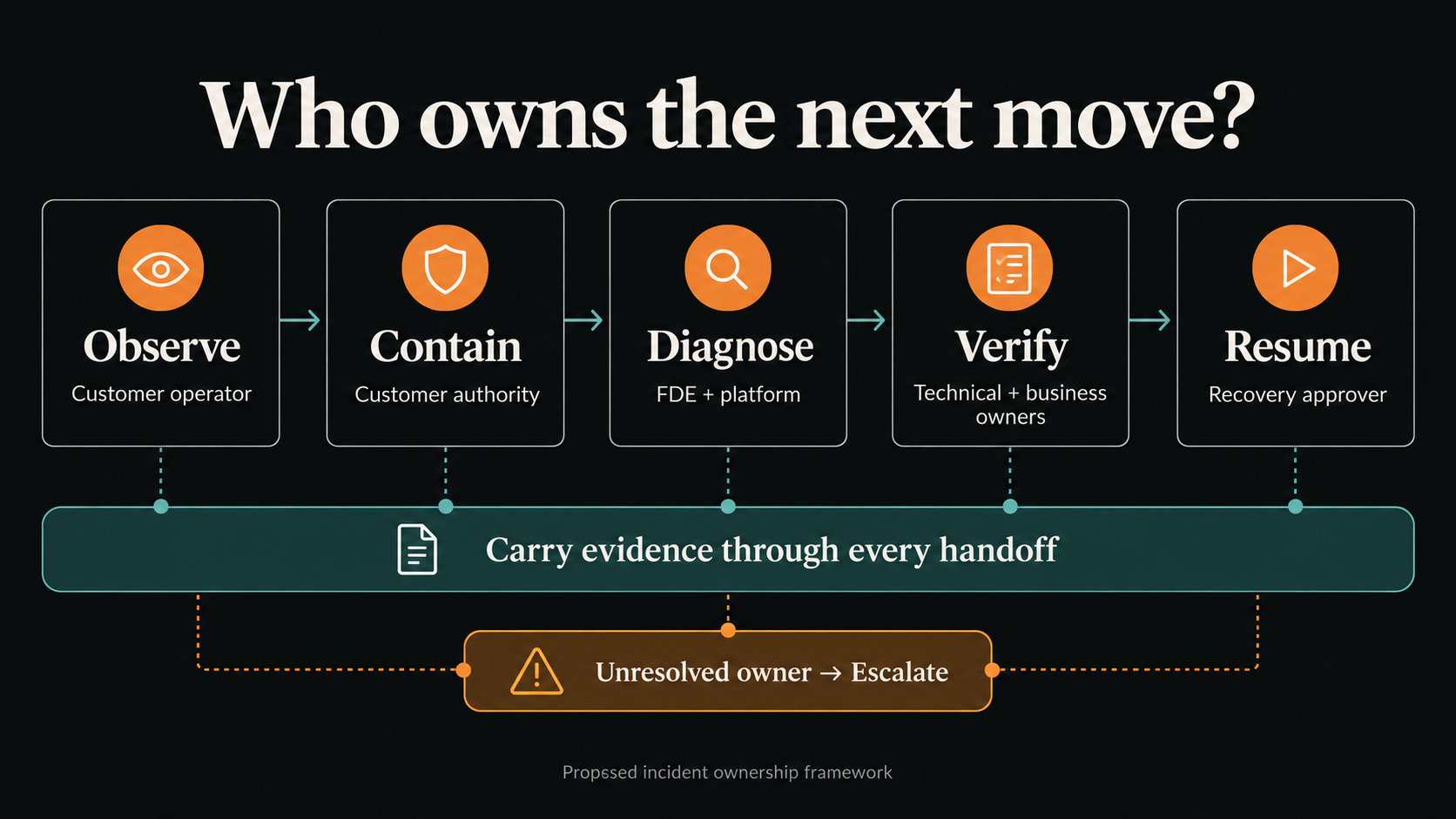
Our interpretation: an FDE incident needs an explicit bridge between technical diagnosis and customer authority. Knowing where the integration breaks does not automatically give the engineer permission to stop the customer's workflow, change its access policy, or declare business recovery.
An ownership card can make those decisions visible. It should sit inside the customer's existing incident process, with the incident identifier and escalation route at the top. It is not a second command structure, a replacement for the runbook, or a promise that a document will shorten an outage.
The card below is FDE Brief's proposed operating artifact. The companies cited above did not endorse it, and we have no interview evidence showing that they use this exact format.
Operator Lesson
Start with the failed business action and the authority needed for the next safe move.
“Model service healthy” may be useful diagnostic evidence. It does not establish that customer work completed. Equally, “the agent failed” is too broad to guide the next investigation. Record the observed symptom precisely, keep the suspected cause separate, and name the person who can authorize containment while diagnosis continues.
Worked field note: a permission failure during invoice routing
Entirely fictional teaching example. The company, people, queue, decisions, tests, and outcomes below are invented. They are not an anonymized customer story or an account of AWS or Google practice.
A customer uses an AI-assisted workflow to classify incoming invoices and write routing decisions to its internal queue. Human reviewers handle exceptions. After an access-policy change, classification still succeeds, but queue writes return permission-denied errors. The customer operator sees invoices waiting without assignments.
The FDE can inspect integration traces. The customer platform team controls the service identity. The finance operations lead controls the fallback process. Those three facts create a decision problem before they create a debugging plan: who can stop automated routing, and who makes sure invoices continue moving?
Completed ownership card — fictional incident INV-17
| Field | Entry at containment |
|---|---|
| Affected workflow | Incoming invoices classified but not assigned to reviewers |
| Observed failure | Queue writes denied; routing completion not confirmed |
| Scope and unknowns | Customer invoice queue; affected time window and backlog still being reconciled |
| Evidence location | Restricted incident record INV-17: trace IDs, queue audit results, deployment and policy-change references; no invoice payloads in the shared card |
| Customer incident owner | Priya, customer incident commander; coordinates response and unresolved decisions |
| FDE diagnostic owner | Eli, integration engineer; compares failed operations with service-identity and release changes |
| Containment authority | Priya may authorize pausing automated routing under the existing runbook; Sam, platform operator, executes the pause |
| Fallback owner | Mara, finance operations lead; assigns manual review work and tracks remaining capacity |
| Access-policy owner | Sam; proposes the minimum required permission correction through the customer's incident change process |
| Customer update owner | Jo, customer communications lead; reports confirmed impact, containment, unknowns, and the next agreed update checkpoint |
| Recovery approver | Priya, after Sam supplies technical evidence and Mara confirms business-workflow checks |
| Escalation if unavailable | Existing customer incident escalation route; a replacement must explicitly accept the role and delegated authority |
Role names are placeholders for this example. In a real deployment, record reachable people and accepted backups, with the decision rights supplied by the customer's process. One person may hold several roles if capacity allows; make each responsibility visible.
The active incident sequence
1. Contain the affected action. Priya authorizes the documented pause. Sam pauses automated routing, and Mara opens the manual review path. Eli preserves trace references and records the last observed successful write. The incident record distinguishes the point automation was paused from the still-unknown start of customer impact. No one invents a precise affected count from a single error trace.
2. Test the leading explanation. Eli compares successful and failed queue operations with the recent access change. A controlled check reproduces the denial under the workflow's service identity. That supports the permission hypothesis; it does not prove the entire incident has only one cause. Sam reviews the missing grant. The proposed correction restores only the approved queue operation rather than granting broad administrative access to make the error disappear.
3. Communicate the business state. Jo's update says that automated assignments are paused, manual review is active, the team is investigating a permission failure, and backlog scope is still being checked. The update names the next checkpoint agreed by the incident team. It does not promise a restoration time that the diagnostic evidence cannot support. Eli contributes technical facts without also becoming the default owner of every stakeholder conversation.
4. Verify recovery before resuming. Sam supplies evidence that an approved test invoice reaches the intended queue under the intended service identity. Eli checks the full operation, including the downstream assignment. Mara verifies the reviewer's business view. They also check that access outside the approved queue remains denied. These are proposed checks for this fictional design, not sufficient validation for every financial workflow.
5. Reconcile interrupted work. A successful new request does not settle the backlog. Eli and Mara compare attempted operations with durable queue records before deciding what needs replay. Ambiguous entries receive investigation or manual handling rather than blind bulk retries. Priya approves the agreed resumption scope after the owners document their checks. The recovery note distinguishes resumed new work from any remaining backlog tasks.
6. Transfer follow-through explicitly. Sam accepts the access-policy follow-up, Eli accepts an integration alert for routing failures, and Mara accepts any remaining manual reconciliation. The incident owner records who accepted each item and its review checkpoint. The FDE retains the reusable lesson about detecting failure after classification without quietly inheriting permanent responsibility for the customer's queue.
If an owner is missing
Mark the decision unresolved and invoke the existing escalation route. The card does not confer authority on whoever happens to be debugging. Continue actions already allowed by the runbook while the incident commander obtains an authorized decision-maker. If the escalation route itself is missing, that is an operational gap to raise with the customer lead, not a reason to improvise production access.
Practical Playbook
- Name the business action. Write what users cannot complete, the known scope, and the unknowns. Link the existing incident record.
- Assign the next decisions. Identify the incident owner, diagnostic owner, containment authority, update owner, and recovery approver. Confirm that each has accepted the role.
- Record containment and fallback. Capture the authorized change, executor, business fallback, and evidence preserved before changes obscure it.
- Separate observation from hypothesis. Keep error traces, proposed causes, tests, and decisions in distinct entries. Update the customer with confirmed facts and explicit unknowns.
- Prove the recovery scope. Verify the full business action, relevant access boundaries, and interrupted-work handling before the authorized owner approves resumption.
- Close with accepted ownership. Record remaining work, recipients, and review checkpoints. Turn the reusable failure into a test or supported product improvement where justified.
Use this in a tabletop exercise with one real workflow before an incident. Have each owner explain what they can authorize and where they would obtain evidence. A disagreement uncovered during the exercise is a useful output, even if no code changes.
Career Implication
An incident story can show more than how quickly you found the broken permission. Explain what you personally observed, which change you were authorized to make, how you involved the customer owner, and what evidence supported recovery. Be precise about other people's contributions.
For a portfolio, build a synthetic workflow and deliberately deny one permitted operation in a controlled environment. Show the ownership card and recovery evidence beside the technical fix. Label it as a simulation. It demonstrates your reasoning without claiming production experience you do not have or exposing customer records.
Hiring / Team Implication
If a role owns production incidents, specify which workstream it covers, who commands the response, who can change customer systems, and how after-hours escalation works. A broad responsibility sentence in a job description does not establish those operating details.
Review whether the FDE has the access and customer counterparts necessary for diagnosis. Give communication and business recovery explicit owners. Use the customer's existing incident framework and staffing constraints to assign roles; this article does not imply every deployment needs six different people or round-the-clock FDE coverage.
The FDE Brief
Get the next operator playbook.
Get practical playbooks for customer-embedded incident response, deployment decisions, and handoffs.
Reader question
Who owns the next move?
Which production incident decision in your deployment currently has two owners—or none?