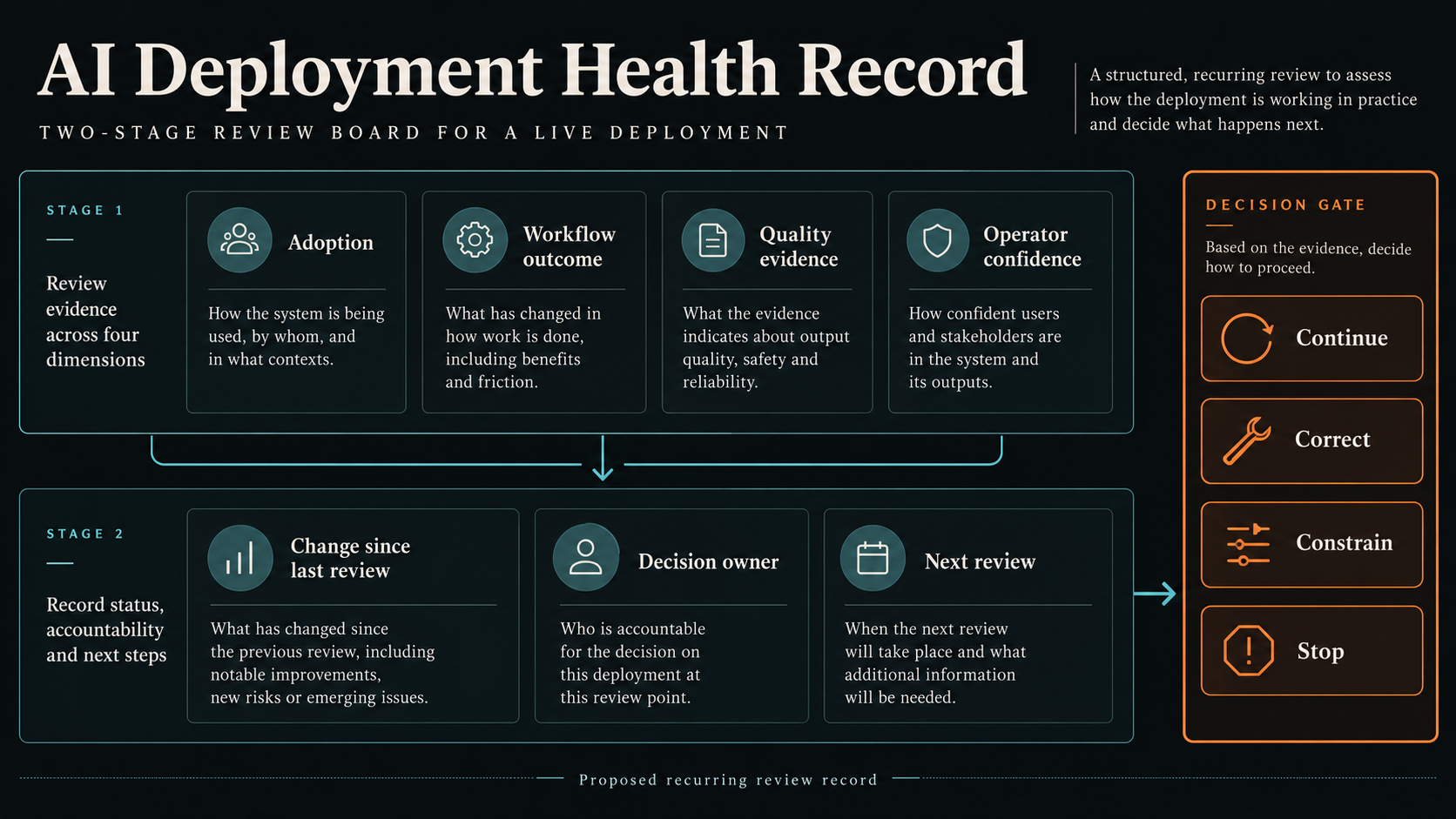
After a controlled launch, teams can keep reporting that an AI workflow is “live” while losing the evidence needed to decide what happens next. Use may be growing, but for the wrong users. A quality concern may be real, but not recorded with the workflow change that triggered it. An operator may have lost confidence, but no one owns the decision to narrow the path.
Proposed method: this health record is FDE Brief editorial synthesis. It does not set a KPI, approve a production system, or promise an outcome. Its job is smaller: preserve the evidence and decision owner for the next post-launch review.
Why post-launch needs its own record
A current Salesforce Forward Deployed Engineer posting pairs production agentic-AI delivery with deployment-health dashboards, customer KPI reporting, and field insights. A current OpenAI Forward Deployed Engineer posting names production adoption, measurable workflow impact, and eval-driven feedback. Microsoft’s Frontier Company announcement frames customer deployment as continuous improvement.
These are company-authored role and product descriptions, checked October 20, 2026. They do not prove that every team uses a dashboard, that one metric predicts value, or that this record improves outcomes. They support a narrower interpretation: post-launch work needs ongoing evidence and an explicit decision path.
The AI deployment health checklist
| Record | Question for the review | What to write down |
|---|---|---|
| Intended workflow | Which user, task, environment, and bounded decision are still in scope? | The original boundary plus any proposed expansion or exclusion. |
| Adoption signal | Is the named workflow actually being used as intended? | Observed use evidence, its source, its date, and gaps. Do not invent a target or ROI number. |
| Workflow outcome | What did the user or operator observe about the task outcome? | A concrete observation, counterexample, or unknown—not a vague “success.” |
| Quality evidence | What reviewed output, evaluation, or limitation matters at this point? | Evidence source, reviewer, unresolved failure, and whether the evidence is missing. |
| Operator confidence | Can the receiving operator explain when to use, pause, or escalate? | Reported confidence, training or runbook gap, and the escalation route. |
| Change since last review | What changed in access, source data, tools, workflow, or ownership? | The specific change, who verified it, and the affected path. |
| Decision and next review | Who chooses the next state, and when is the next check? | Named owner; continue, correct, constrain, or stop; required evidence before the next review. |
Worked fictional example: procurement-drafting workflow
Everything in this example is fictional. A procurement team uses an assistant to draft internal summaries of approved supplier documents. A human buyer still checks source citations and chooses any supplier action.
A health review that stays bounded
- Intended workflow: only approved documents in one internal preparation step; no supplier-facing messages and no automated purchasing decision.
- Adoption: the team can see that several buyers opened drafts, but it cannot yet tell whether the drafts replaced a normal preparation step. Mark that evidence missing rather than calling it time saved.
- Quality: a reviewer finds two summaries with citations that no longer match the current document revision. Record the examples and hold the affected document path.
- Operator confidence: buyers know how to reject a draft but do not know who confirms a source-version change. Name the technical owner and update the escalation route.
- Decision: constrain the workflow to verified document revisions until the next review. The customer workflow owner, not the FDE alone, owns the expansion decision.
This example does not establish a procurement policy, prove a benefit, or describe a production-safe pattern. It shows how a recurring record prevents evidence, ownership, and change history from splitting apart after launch.
Choose the next state explicitly
- Continue when the bounded workflow, current evidence, and responsible owner remain clear. Continuing is not a declaration that every adjacent use case is approved.
- Correct when an identified defect, evidence gap, or operator issue has a named remediation path. Keep the affected behavior observable while it is corrected.
- Constrain when the team can preserve a safer, smaller workflow while it learns more. Document the exclusion and the evidence required to revisit it.
- Stop when the workflow should not proceed under its current conditions. Preserve the reason and owner so the next team does not rediscover the same boundary.
How this differs from a launch gate
Use a launch evaluation contract to establish the evidence and authority before a controlled release. Use an incident ownership card when a failure requires an immediate response. Use the field-feedback packet when a customer blocker may become product learning. This page is the recurring record between those moments: it asks whether a live, bounded workflow has enough current evidence to continue, correct, constrain, or stop.
The FDE Brief
Get practical delivery playbooks.
Get FDE notes on evidence, deployment judgment, and customer-facing technical work.
Reader question
Which signal would make you pause?
Would your team stop to review adoption, quality, an access change, operator confidence, or unclear ownership?