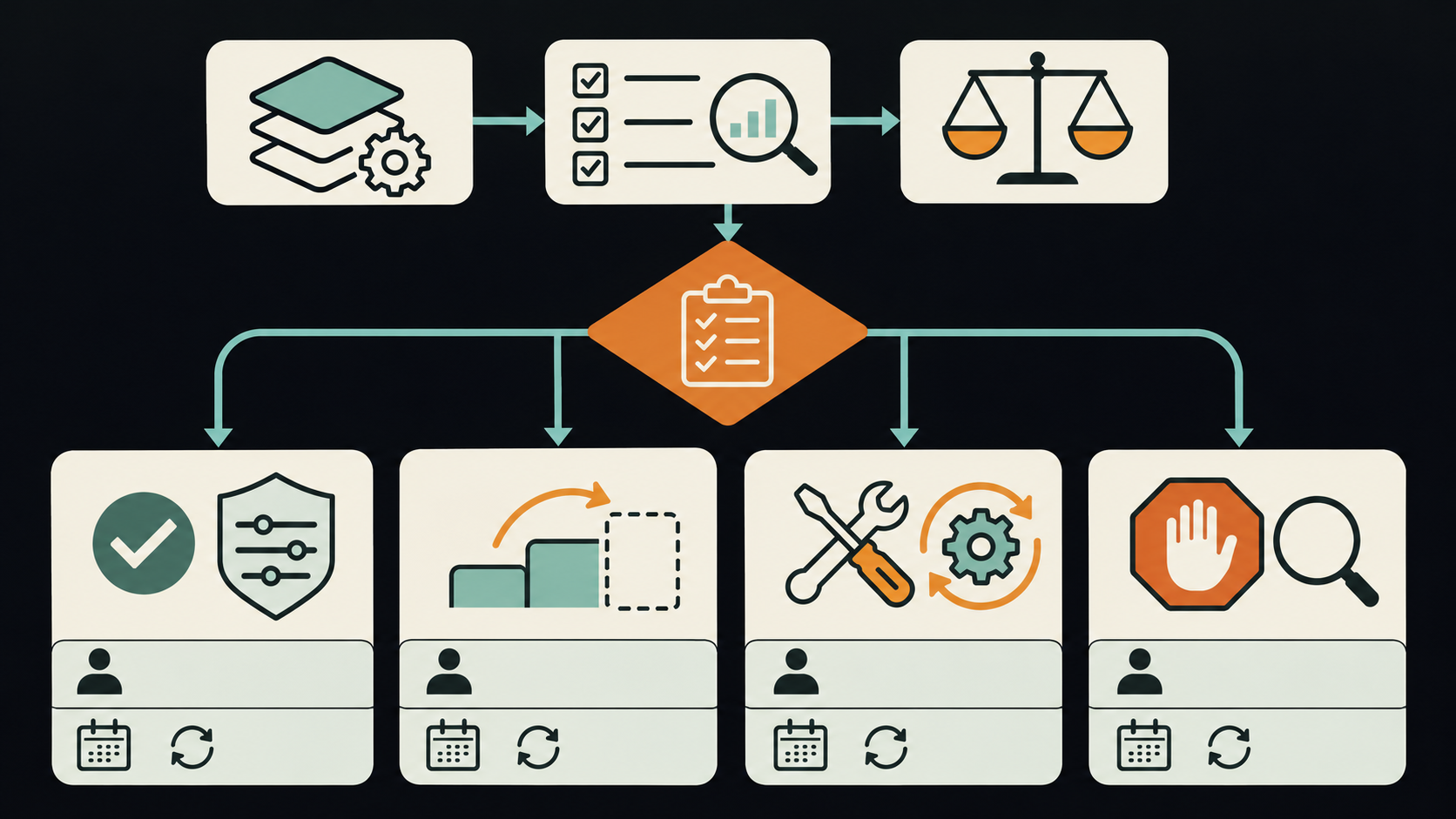
Teams often receive an evaluation result and treat it as its own conclusion: pass, fail, or a number in a dashboard. That skips the operating decision. A result matters only when it changes what can ship, under which limits, with which owner, and when the team will look again.
Proposed method: use a short evaluation decision record. It turns one named workflow and one defined evidence slice into one of four actions: proceed with named limits, constrain rollout, correct the system, or stop and investigate. This is FDE Brief editorial guidance, not a safety guarantee or universal release standard.
Why a score is not the decision
OpenAI’s Forward Deployed Engineering method distinguishes validating representative tasks and difficult exceptions from go-live work such as permissions, monitoring, and clear responsibilities. Its current Deployment Lead, FDE role names success criteria, acceptance criteria, evaluation patterns, and pre- and post-deployment measurement.
Those are company-specific descriptions of intended work. They do not establish that every team uses the same thresholds, that an evaluation guarantees a safe or useful outcome, or that a single aggregate score is adequate. The record below is an editorial way to make the next decision inspectable.
The six fields in an evaluation decision record
Swipe sideways to read all columns.
| Field | Write down | Why it changes the decision |
|---|---|---|
| 1. Workflow and baseline | The bounded user task, current method, and the decision the system is allowed to influence. | It prevents a score from drifting away from the real work. |
| 2. Evidence slice and failure class | The representative cases, difficult exceptions, exclusions, and observed failure pattern. | It makes a good average unable to hide a high-cost miss. |
| 3. Named decision | Proceed with limits, constrain rollout, correct, or stop and investigate. | It requires a change rather than a vague “watch it closely.” |
| 4. Release limits | Allowed users, actions, data, review requirements, and explicit exclusions. | It turns a decision into an enforceable first boundary. |
| 5. Owner and escalation | Who can accept the limit, investigate a miss, and pause or expand the release. | It separates evidence gathering from authority. |
| 6. Next review and product signal | The re-test date, evidence required, and whether the failure becomes a product-learning item. | It keeps a narrow release from becoming an unexamined default. |
Worked fictional example
This example is fictional. A support-triage assistant performs well on routine requests but misses a defined set of high-risk account-access exceptions. The owner does not call the pilot “passed.” They constrain the first release to low-risk queues, require human review for the exception class, assign an engineer to correct retrieval and routing, and set a re-test date with the same exception set.
The record makes the tradeoff visible: useful work can proceed in a bounded lane, while the unsafe path stays outside the release. It also preserves a product signal—the exception class and the evidence needed to revisit the boundary—instead of treating the miss as an anecdote.
Use the record before go-live
- Choose one decision, not every deployment concern. A record should be small enough to review with the people who own the workflow and release.
- Separate evidence from authority. An evaluator can report a failure; a named owner must decide whether scope, controls, or timing changes.
- Make limits observable. “Human in the loop” is not a limit until the queue, reviewer, action, and escalation route are named.
- Re-test the reason for the limit. A review date without a required evidence slice is a calendar reminder, not a decision gate.
Where this fits in the archive
Use the FDE evaluation contract to define the broader acceptance system before evidence arrives. Use the field-readiness release card to combine product and customer-fit evidence. This page is narrower: it records the decision that follows a concrete result before a bounded go-live.
The FDE Brief
Get practical delivery playbooks.
Get FDE notes on evidence, deployment judgment, and customer-facing technical work.
Reader question
What result would narrow your rollout?
Which evaluation result would change scope, controls, or the release date for your team?