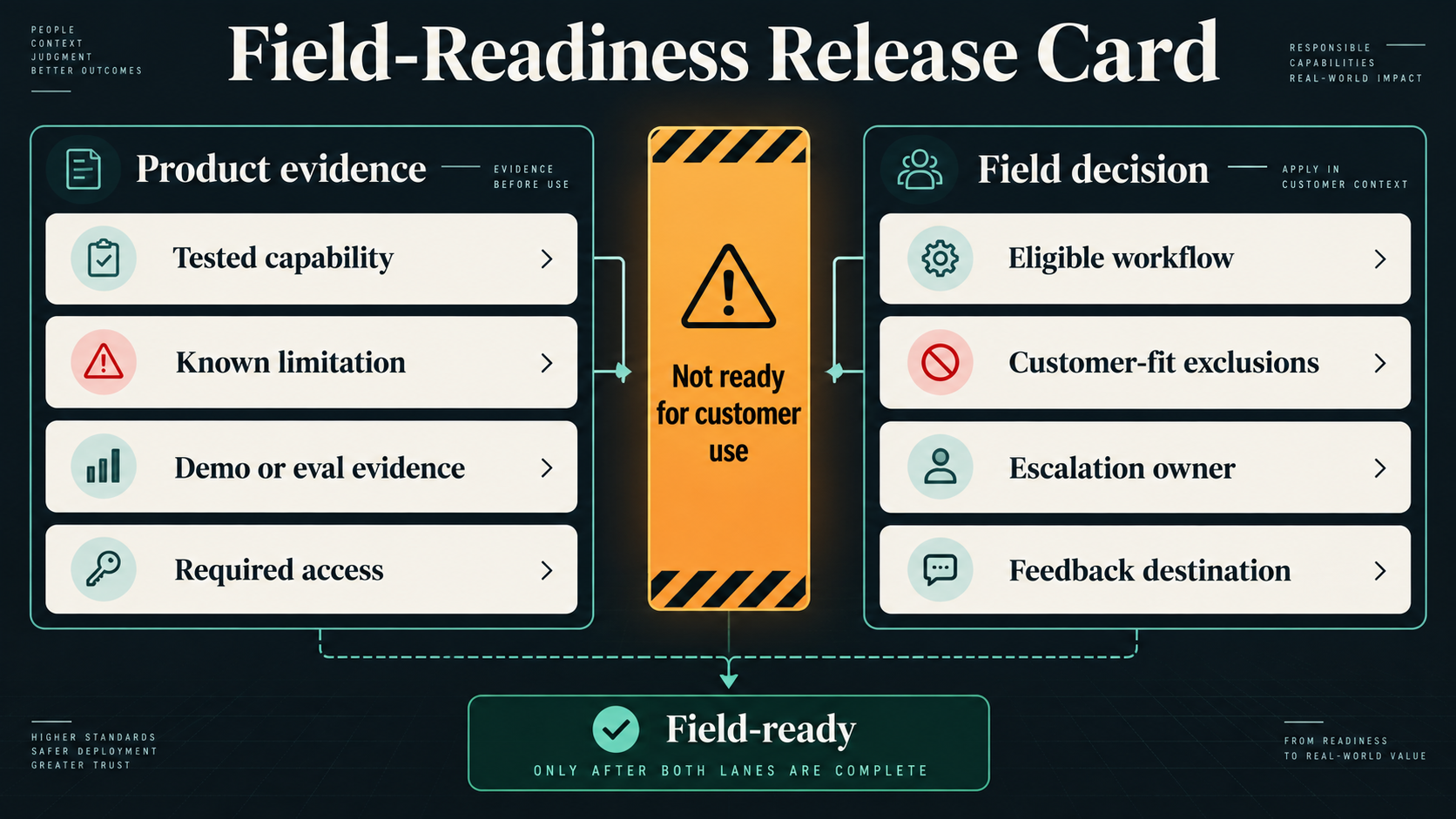
A successful demo answers a narrow question: did the capability behave as expected in that prepared setting? Before an FDE takes it into a customer workflow, the team also needs to know where it fits, what conditions it needs, where it fails, and who receives the next signal.
Proposed method: this release card is FDE Brief editorial synthesis, not an Anthropic operating standard or a production-approval process. It is deliberately smaller than an evaluation contract: it prepares a field team to make a bounded customer decision, not to authorize a launch.
Why product evidence and field use are different lanes
Anthropic’s current Applied AI Research Engineer posting describes testing, demos, evaluations, field-readiness assessment, enablement materials, and synthesis of customer blockers. Its current Forward Deployed Engineer posting describes building embedded production applications and customer-facing artifacts.
Those are employer-authored descriptions of role scope, checked October 6, 2026. They do not show that a release card improves adoption, that every team works this way, or that any particular capability is ready. The useful operational interpretation is simply to make the handoff inspectable before customer use.
The two-lane card
| Product evidence | Field decision | What to record |
|---|---|---|
| Tested capability | Eligible workflow | The exact task, inputs, and output behavior that have evidence. |
| Known limitation | Customer-fit exclusion | Where the capability should not be offered yet, and why. |
| Demo or evaluation evidence | Required access | The approved environment, data boundary, identity, and human review needed for a bounded demonstration. |
| Evidence owner | Escalation owner | Who can clarify behavior and who can decide when a field question exceeds the card. |
| Open product question | Feedback destination | What the field should capture and where that evidence is reviewed. |
A blank field is meaningful. It should produce a hold, a narrower workflow, or a named investigation—not a confident improvisation in front of a customer.
Worked fictional example: a document-summary capability
Everything in this example is fictional. A product team has tested a document-summary capability on approved English-language policy documents. It returns a draft with source links for a defined evaluation set. A field team wants to show it to a customer operations group.
Product evidence
- Tested capability: creates a concise draft summary with links to supplied source passages.
- Known limitation: it may omit a condition when source documents conflict or are incomplete.
- Evidence: reviewed against an approved test set; no claim is made about the customer’s documents.
- Required access: a sandbox with customer-approved sample documents and no tool action beyond reading.
Field decision
- Eligible workflow: a supervised review of non-urgent policy-reference material.
- Exclusion: not for regulated determinations, emergency instructions, or unsupervised publication.
- Escalation owner: the product evidence lead for behavior questions; the customer workflow owner for use-boundary questions.
- Feedback: record missing conditions, source-link failures, and reviewer corrections with the input type and intended task.
The team can now explain a bounded demonstration honestly: “This is a supervised draft aid for these sample materials.” It cannot say that the capability works for every policy source, replaces review, or is approved for the customer’s live workflow.
Use the gate before the customer conversation
- Name the proposed workflow. Do not begin with “show the new feature.” State the user, decision, source boundary, and human reviewer.
- Attach the evidence. Link to the test, evaluation, or demonstration record. If it is absent, say so.
- Write the limitation in plain language. A field seller or FDE should be able to repeat it without translating a research caveat into a promise.
- Set access and escalation conditions. The right capability in the wrong environment is not a field-ready offer.
- Route feedback as evidence. Capture a reproducible case, not only a general impression, so product and field teams can inspect the blocker together.
If either lane is incomplete, the decision is not “cancel forever.” It can be hold, restrict the workflow, gather missing evidence, or schedule a controlled demonstration. The release card makes that choice visible.
What this signals in a career or hiring review
A credible FDE candidate can distinguish a feature demonstration from a customer-ready operating boundary. In an interview case, they can ask for the evidence, constraints, workflow, access model, and escalation path before proposing rollout. Teams can evaluate the judgment in that sequence rather than rewarding the most expansive promise.
Related guides: the evaluation contract, the deployment context packet, and the customer recovery rehearsal.
The FDE Brief
Get practical field-readiness playbooks.
Get FDE notes on evidence, deployment judgment, and customer-facing technical work.
Reader question
What must be written down before field use?
What evidence or limitation would you require before taking a new capability into a customer workflow?