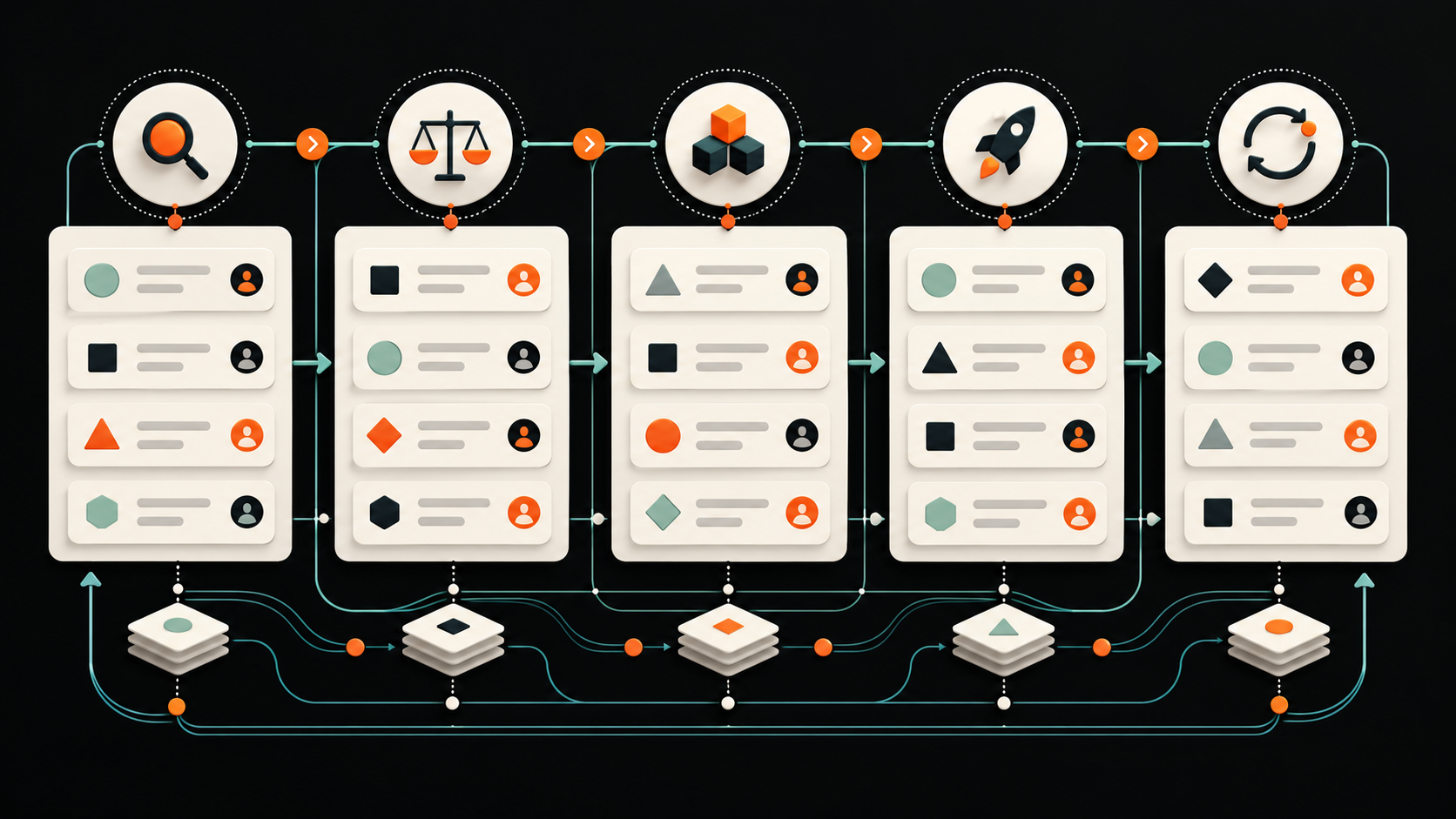
An “AI implementation engineer” title can describe sharply different work. So can “forward deployed engineer,” “solutions architect,” and “technical deployment lead.” A title may help you find a job posting, but it rarely tells you who will make a scope call, build the integration, carry a launch decision, or turn field evidence into product learning.
Proposed method: compare roles through a five-lane proof-of-work map. It asks what a person or team must make visible during a bounded customer deployment. It is FDE Brief editorial synthesis, not a promise about any employer’s actual organization.
Why the title is not enough
OpenAI’s current Forward Deployed Engineer posting names discovery, technical scoping, system design, build, rollout, adoption, and eval-driven feedback to product and model roadmaps. Anthropic’s current Staff Forward Deployed Engineer posting names direct customer embedding, technical direction, discovery, architecture decisions, end-to-end delivery, customer-operable handoff, and repeatable patterns.
These are employer-authored descriptions checked October 29, 2026. They establish only company-specific intended scope. They do not prove that every FDE, implementation engineer, or solutions role carries each lane; they also do not tell us which title is “better,” what a candidate should be paid, or how a hiring committee evaluates someone.
The five-lane proof-of-work map
Swipe sideways to read all columns.
| Lane | Evidence to ask for | Question that reveals the boundary |
|---|---|---|
| 1. Discover the workflow | Named user, current process, failure or friction, success condition, and unknowns. | Who learns the work well enough to define the problem? |
| 2. Scope the decision | In-scope outcome, constraints, tradeoffs, acceptance authority, and intentionally deferred work. | Who turns a request into a bounded commitment? |
| 3. Build and integrate | Design choice, integration boundary, testable implementation, dependencies, and technical review. | Who writes or directs the production change when the design must become real? |
| 4. Launch and operate | Evaluation evidence, release boundary, operator owner, escalation path, and a rollback or containment route. | Who is accountable for a safe, usable next state after the demo? |
| 5. Return product learning | Observed constraint, reusable candidate, supporting evidence, product destination, and next decision. | Who makes sure a local delivery teaches the wider system something useful? |
Copy the blank five-lane worksheet and see a fictional filled example →
Use the map to read a posting or plan a team
- Underline verbs, not labels. Look for discovery, scope, build, launch, operate, and feedback language. A tool list is not a delivery boundary.
- Mark what is explicit. A posting that says “partner with customers” does not necessarily say who owns acceptance, a production change, or support after launch.
- Record unknown lanes. Missing language is not evidence that the work never happens. It is a question for the hiring manager or the account lead.
- Separate contribution from authority. Someone may prepare the evidence while another person approves scope or a release. Both roles matter; neither should be implied.
- Compare one bounded workflow. “Build an AI strategy” is too broad. Compare how the team would handle a single support, operations, or knowledge workflow with a clear owner.
Worked fictional comparison
This example is fictional. A manufacturer wants an assistant that drafts maintenance summaries from approved service notes. An implementation engineer configures the source connection and drafts the first workflow. An FDE maps exceptions with the maintenance lead, proposes a narrow release boundary, adds evaluation cases for unsafe recommendations, and records the observed failures for a product team.
The roles might overlap in another company. The useful comparison is not the labels. It is whether the team has named who owns the workflow definition, scope decision, technical integration, operational release, and learning loop. If the answer is unknown, the team has an assumption to resolve before calling the work end-to-end.
Where this fits in the archive
Use the AI deployment engineer versus FDE comparison for a direct title boundary. Use the Applied AI architect versus FDE guide for an architecture-to-embedded-building distinction. Use the builder–strategist decision agreement when a live workstream needs clear evidence, recommendation, authority, and communication. This page supplies a broader reading method: follow the proof of work before concluding what a title means.
The FDE Brief
Get practical delivery playbooks.
Get FDE notes on evidence, deployment judgment, and customer-facing technical work.
Reader question
Which proof lane is missing?
In the roles you are comparing, is discovery, scope, build, operation, or product learning least clear?