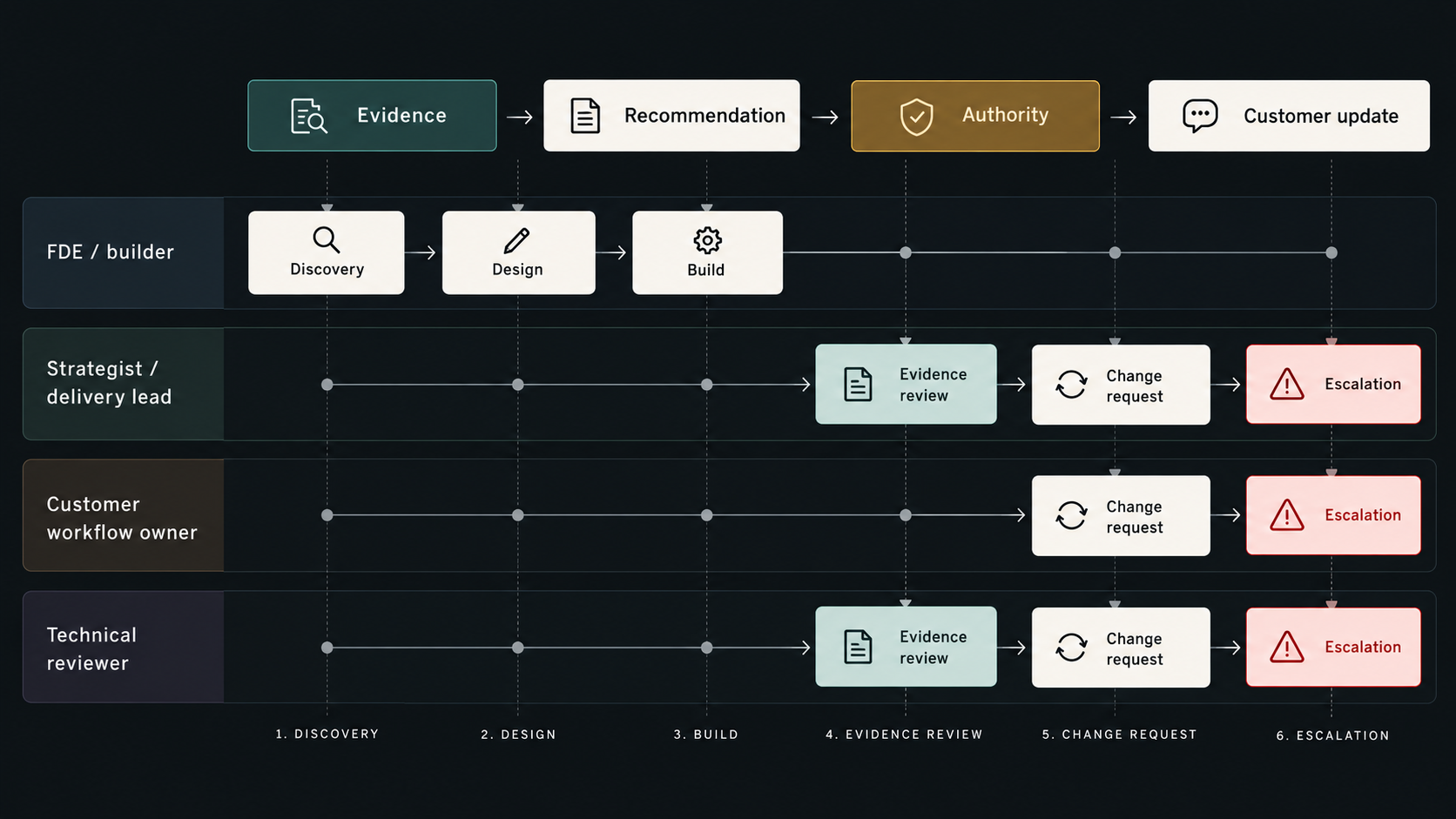
A customer-facing delivery team can have strong technical work and still surprise a customer when a finding changes the plan. The gap is rarely a missing title. It is the missing route from evidence to a recommendation, an accountable decision, and a clear update.
Proposed method: use a short builder–strategist decision agreement for one active workstream. This is FDE Brief editorial synthesis; it is not a claim about any company’s internal process or a guarantee of delivery outcomes.
Why name the handoff?
OpenAI’s current Enterprise Applied AI Engineer role describes hands-on implementation, evaluation, production launch, customer leadership, reliability, security, governance, and feedback to product and engineering teams. Mistral’s Applied AI FDE role similarly describes design, implementation, deployment, maintenance, and customer feedback in critical environments.
These employer-authored descriptions were checked October 22, 2026. They establish company-specific role scope—not a universal staffing model, a separate strategist role at every company, or proof that this worksheet improves outcomes. The interpretation here is narrower: technically hands-on customer delivery includes consequential decisions that should not remain implicit.
The six-row decision agreement
Swipe sideways to read all columns.
| Decision moment | Builder makes visible | Delivery lead makes visible | Decision and update |
|---|---|---|---|
| Discovery | Workflow, inputs, exceptions, and unknowns | In-scope outcome and customer-side owner | Customer workflow owner confirms the bounded problem |
| Design | Feasible paths, dependencies, risk, and testability | Tradeoffs against timeline and intended outcome | Technical reviewer and accountable lead name the chosen path |
| Build | Implemented, blocked, and intentionally deferred work | Whether sequence or promise must change | Scope owner updates the customer without turning a prototype into a promise |
| Evidence review | Evaluation result, failures, and evidence gaps | What evidence is sufficient for the decision | Named acceptance authority explains what the evidence supports |
| Change request | Technical blast radius and local conditions | Local exception, new commitment, or candidate pattern | Scope owner accepts, defers, or declines with a reason |
| Escalation | Reproduction, impact, concern, and safe containment | Who decides, by when, and what pauses | Escalation authority gives known facts, containment, and next review |
Copy the blank decision agreement and see a fictional filled example →
Worked fictional example
This example is fictional. An associate FDE and a deployment strategist support a procurement-operations team testing a narrow assistant that drafts routing summaries from approved notes. Before a steering meeting, the customer asks to add a new source.
Keep the decision bounded
- The FDE maps the new source, finds missing access approval, and notes that the evaluation set does not cover its document format.
- The FDE recommends keeping the source out of the next release until access and test coverage exist.
- The strategist frames the delivery choice: preserve the current bounded workflow and ask the customer workflow owner whether the source is required for acceptance.
- The workflow owner keeps the narrow review; a technical reviewer confirms the release boundary; the strategist records the dependency and tells the customer what is known, unknown, and next.
The point is not that four people are always required. It is that “the engineer owns the build” and “the strategist owns the meeting” are incomplete decision models when a request changes scope, evidence, or safety conditions.
Use it before the next customer meeting
- Choose one bounded workflow. Do not build an account-wide org chart in disguise.
- Write the six moments. Add a row only for a truly recurring decision.
- Name the actual acceptance authority. Sponsor, daily user, security approver, and workflow owner may differ.
- Use a three-state update. State what is known, unknown, and the next decision.
- Reopen the agreement when the work changes shape. A new data source, a wider release, or a security concern can invalidate the earlier authority map.
How this fits the rest of the FDE operating system
Use the evaluation contract to establish evidence and authority before a controlled release. Use an incident ownership card when a failure requires immediate response. Use the delivery-contract card to clarify whether an FDE serves an internal or customer-embedded context. This agreement fills the smaller gap inside a workstream: how evidence becomes a decision and an honest customer update.
The FDE Brief
Get practical delivery playbooks.
Get FDE notes on evidence, deployment judgment, and customer-facing technical work.
Reader question
Which handoff breaks first?
When a customer request changes the plan, is it evidence, recommendation, authority, or communication?