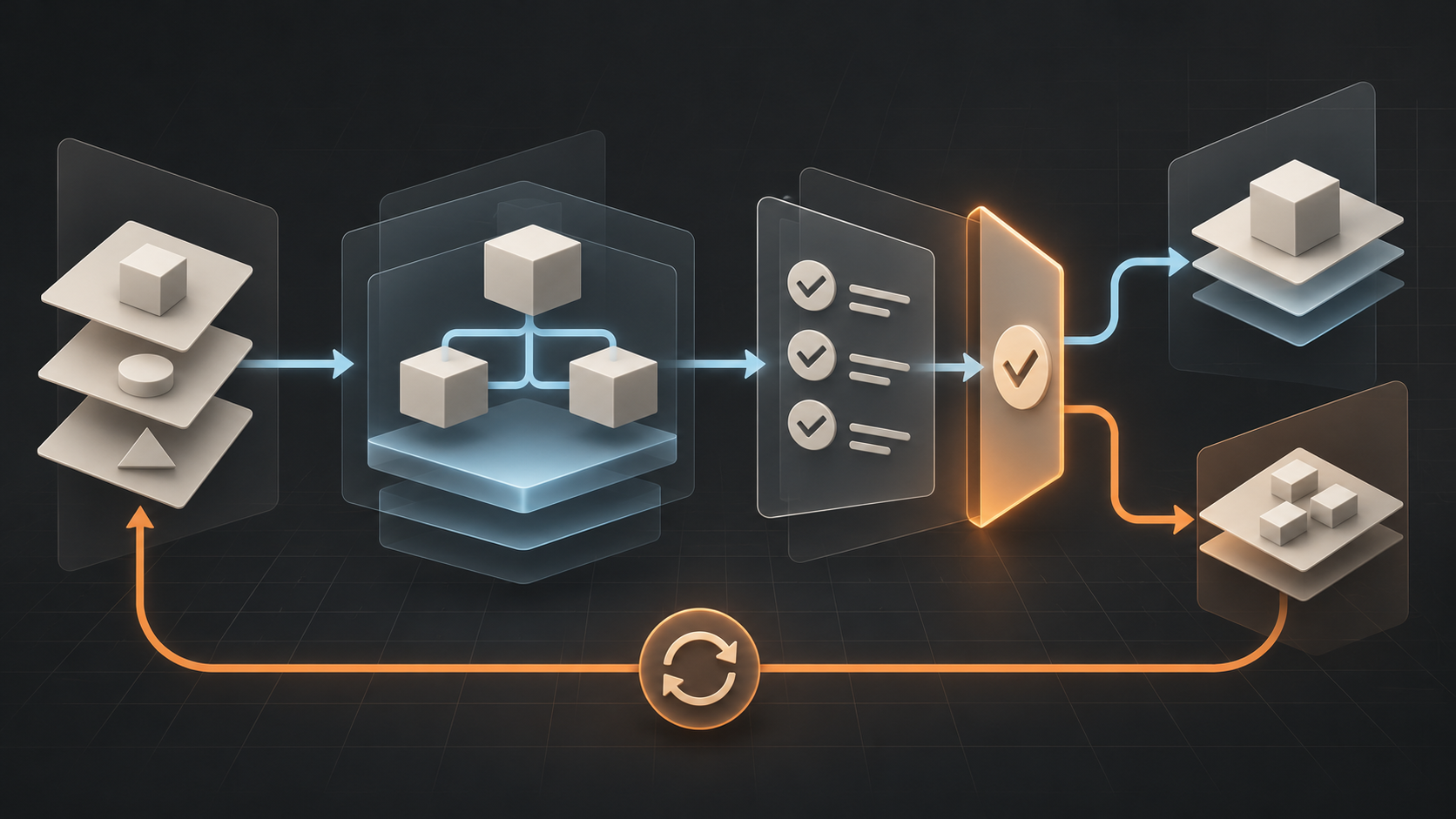
“Forward deployed engineer” is a useful starting label, but it does not tell you what completion means. One role may be accepted when a customer workflow can use a system with named evidence; another may stop at a scoped prototype or a technical recommendation. Reading the acceptance boundary makes the difference visible.
What the source actually supports
OpenAI’s current AI Infra FDE posting describes working with customer engineers, researchers, and product engineers; defining success criteria; building software; running reproducible evaluations; validating correctness and performance; and carrying work through deployment and adoption. That is one employer’s stated role scope. It does not prove a customer outcome, establish how every FDE team operates, or make a title-equivalence claim.
The five-field posting teardown
- Customer and workflow. Who uses the result, and what bounded work changes? “Enterprise customers” alone is not an acceptance boundary.
- System and intervention. Name the software, integration, model, or operational layer the role changes—not only the industry.
- Acceptance evidence. Look for a credible check: an evaluation, benchmark, review, adoption observation, or named test.
- Acceptance owner. Identify who can accept the work, hold it to a limit, or send it back unresolved.
- Feedback and reusable output. Ask what learning returns to a product or platform, without assuming every local adaptation becomes a feature.
| Posting phrase | Clarifying question | Useful signal |
|---|---|---|
| “Own customer delivery” | What is the bounded workflow and who accepts it? | Named customer or internal acceptance route. |
| “Ship production systems” | What validates correctness, quality, or performance? | An explicit evaluation, benchmark, or review surface. |
| “Bring field learning to product” | What is the route from local evidence to a product decision? | A visible owner and reusable output, not a feature promise. |
Fictional example: inspection summaries
A fictional posting says an FDE will help a maintenance team use an assistant to prepare inspection summaries. A candidate can ask which source system is integrated, which summary failures are unacceptable, who checks the output before use, and whether any reusable output is expected. Those questions clarify the acceptance boundary without presuming the role owns every operational decision.
If the description cannot answer them, that is not proof the role is weak or misleading. It is simply a cue to clarify scope before applying, interviewing, or hiring. The example claims no deployment result, customer demand, or job outcome.
Why this is an FDE tool
FDE work often spans customer context, technical change, evidence, and product learning. A title cannot carry those details. The acceptance-boundary method helps candidates compare roles and helps hiring teams describe completion without inflating responsibility or hiding unresolved ownership.
Which acceptance boundary would you clarify before applying or hiring?
Share the evidence, owner, or handoff that would make an FDE role description more useful.
Related guides
Sources and limits
OpenAI: Forward Deployed Engineer (FDE) — AI Infra. This is an employer-authored role description. The five-field method and fictional example are FDE Brief editorial guidance.