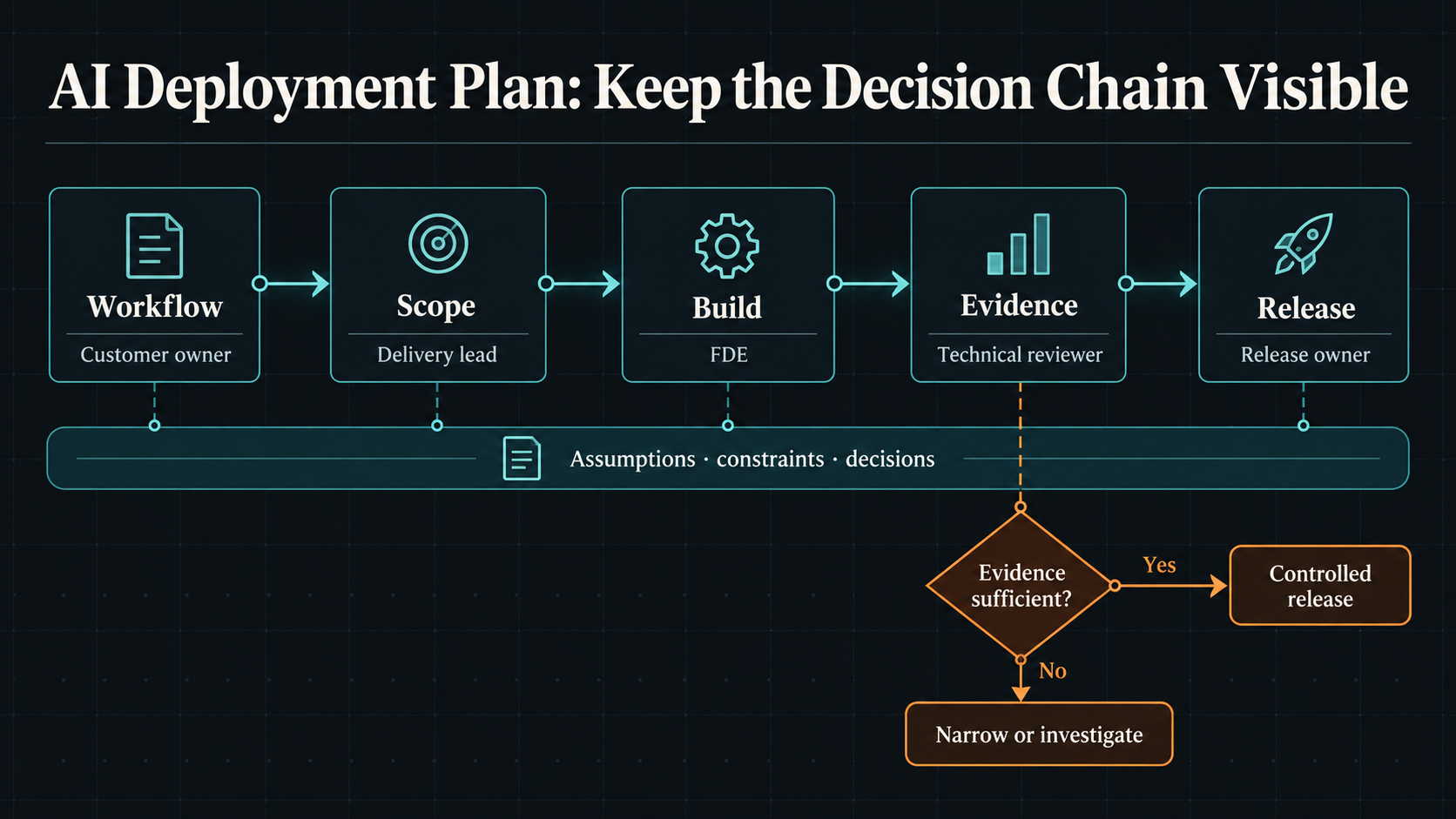
An AI deployment can look organized while the critical decision chain is invisible. The schedule has dates. A prototype exists. Everyone agrees on the headline. But no one can point to the exact workflow, scope boundary, evidence standard, or person who may decide a release is ready.
Proposed method: this five-stage plan is FDE Brief editorial synthesis, not an OpenAI or Anthropic operating standard. Use it to make the next delivery decision visible, not to convert uncertainty into a promise.
Why a delivery plan needs more than milestones
OpenAI’s current Forward Deployed Engineer posting describes owning discovery, technical scoping, system design, build, and production rollout with customer engineering and domain teams. Anthropic’s current Technical Deployment Lead posting distinguishes the technical build from responsibility for the delivery plan, product scoping, stakeholder relationships, and organizational complexity.
Those are employer-authored descriptions of role scope, checked October 13, 2026. They do not prove that every team separates these jobs, that a written plan improves delivery, or that a customer should approve a particular workflow. They do support a modest interpretation: a plan should keep the technical and organizational decisions connected rather than hiding them in separate meetings.
The five-stage deployment plan
| Stage | Question to answer | Record before moving on |
|---|---|---|
| Workflow | Who is doing what, in which environment, and what decision or output matters? | Named user, bounded job, system/data boundary, and customer owner. |
| Scope | What is included in this delivery, explicitly excluded, or still undecided? | One thin-slice outcome, constraints, dependencies, and a delivery lead. |
| Build | What must the technical solution do—and what may it not do? | Architecture choice, access/tool boundary, implementation owner, and open technical questions. |
| Evidence | What would support a controlled use decision? | Test or evaluation record, known limitations, reviewer, and unresolved risks. |
| Release | Who can allow use in the bounded workflow, and what happens if it fails? | Release owner, user guidance, monitoring/review path, escalation route, and rollback or hold condition. |
The record is deliberately not a project-management replacement. It does not estimate effort, approve spend, or declare a capability safe. It makes the assumptions, constraints, evidence, and decisions findable when the delivery team changes or the workflow changes.
Worked fictional example: a claims-review drafting assistant
Everything in this example is fictional. An insurer wants a drafting assistant to help claims specialists summarize submitted documents before a human makes a coverage decision.
How the plan stays bounded
- Workflow: a claims specialist reviews a draft summary and supplied citations for a non-urgent internal preparation task; no coverage decision is automated.
- Scope: one document class in a sandbox using approved sample data. Exclude live claims, policy interpretation, and outbound customer messages.
- Build: the FDE connects an approved document source and a read-only drafting interface. The technical owner records identity, access, and source-version assumptions.
- Evidence: a reviewer checks whether summaries preserve source citations for a defined sample. Missing citations and unsupported assertions are recorded as failures, not rounded into a success rate.
- Release: the customer workflow owner may authorize a supervised pilot only if the test record, limitation statement, and escalation route are complete. Otherwise the plan says narrow or investigate.
The fictional example does not establish a recommended model architecture, an insurance-use policy, or a safe production pattern. Its point is that every stage leaves a decision artifact for the next owner.
Run the plan as a decision chain
- Start with the workflow, not the model. Write the user, task, input, output, and human decision before choosing a capability.
- Turn scope into exclusions. An inclusion says what you intend to prove. An exclusion names the tempting adjacent work that this delivery does not authorize.
- Keep assumptions with the build. Access, source quality, identity, tool permissions, and environment assumptions should travel with the implementation rather than live in someone’s memory.
- Ask for evidence before a release decision. A demo can prompt a next test; it is not automatically evidence for a customer workflow.
- Name the authority at each gate. The FDE can own a build decision without owning a customer’s business approval. A plan should show that boundary.
What this signals in an FDE interview or hiring review
A credible FDE story explains the decision chain, not just the delivery timeline: what was learned about the workflow, how scope was narrowed, what evidence changed the plan, and who owned the next release decision. Teams can use the same artifact to distinguish a role that codes in customer context from a role that also holds delivery and stakeholder orchestration.
Related guides: the deployment context packet, the field-readiness release card, and the evaluation contract.
The FDE Brief
Get practical delivery playbooks.
Get FDE notes on evidence, deployment judgment, and customer-facing technical work.
Reader question
Which deployment decision gets lost first?
Where does your team need a named owner or clearer evidence before it expands an AI workflow?